Banks Replace 'Lower-Value Human Capital' With AI, Accelerating Collapse of Entry-Level Finance Careers and Graduate Job Market
Banks are reducing junior hiring and cutting staff as AI automates entry-level analytical work in finance, with executives like Standard Chartered's Bill Winters and JPMorgan's Jamie Dimon explicitly linking the changes to replacing human roles. This is exacerbating graduate unemployment, disrupting traditional career ladders, and signaling deeper labor market shifts with significant long-term implications for education, inequality, and white-collar work.
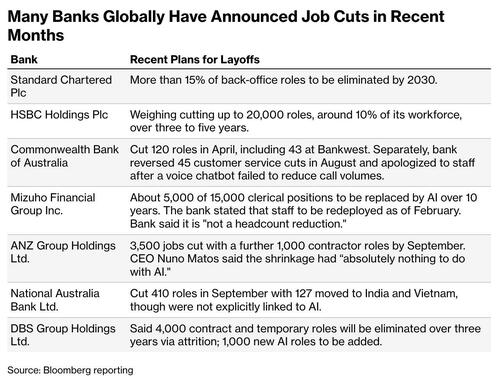
Major banks are openly discussing the replacement of junior and middle-office roles with artificial intelligence, confirming an accelerating transformation in financial services labor markets that extends far beyond simple cost-cutting. Standard Chartered CEO Bill Winters sparked controversy in May 2026 by stating that the bank's planned elimination of thousands of positions was "not cost cutting; it's replacing, in some cases, lower-value human capital" with technology investments. He later walked back the phrasing, clarifying that the bank has a responsibility to help colleagues move into higher-value roles as automation advances.[1][2]
This candor echoes broader executive commentary. JPMorgan Chase CEO Jamie Dimon has repeatedly stated that AI "will eliminate jobs" while reshaping the composition of the workforce toward more AI specialists and fewer traditional bankers in certain categories. Citigroup and other institutions have similarly acknowledged that some roles "will no longer be required" as AI handles compliance, transaction monitoring, financial modeling, and research tasks once performed by entry-level analysts.[3]
The impact is particularly acute for recent graduates. Banks are scaling back analyst intake programs significantly—some reports indicate pulls of up to two-thirds in graduate hiring—as AI automates the repetitive analytical work that traditionally served as apprenticeship training for future leaders. A 2025 New York Times investigation first highlighted how AI tools could supplant much of Wall Street's entry-level white-collar labor, raising fundamental questions about the future structure of investment banking. By 2026, this has materialized into a noticeably tighter job market where new graduates compete against both each other and rapidly improving AI systems for dwindling positions.[4][5]
JP Morgan Global Research has documented concrete data on the downstream effects: the unemployment rate for college graduates has risen to levels not seen in years, with majors exposed to AI disruption (including those feeding into finance and tech) showing particularly sharp increases. This inverts the historical pattern where white-collar credentials provided insulation from automation shocks. Recent graduates now account for a shrinking share of new hires, dropping from 11% in 2022 to 7% in 2024 according to labor market analyses, with finance and tech among the hardest hit sectors.[6][7]
While banks like Barclays, Citigroup, and Revolut report efficiency gains from deploying AI in customer support, wealth management, and compliance, employment lawyers warn of disproportionate effects on administrative and middle-office functions. Critics question whether AI is sometimes used as cover for broader cost-cutting amid economic pressures. Yet the pattern connects to larger trends: automation is eroding the traditional pipeline from university to corporate finance, potentially breaking the apprenticeship model that has sustained the industry.
Longer-term societal implications remain underexplored in mainstream coverage. If entry-level roles—the historical training ground for complex judgment, client relationships, and institutional knowledge—disappear, how will the next generation of finance leaders develop? This transformation risks widening inequality, devaluing traditional degrees, and creating a skills bifurcation where only those with specialized AI-adjacent training thrive. Without scaled reskilling initiatives or new educational models emphasizing uniquely human capabilities, banks' pursuit of productivity gains without headcount growth could contribute to structural graduate underemployment and stalled social mobility in white-collar professions. The candid language from executives reveals not just tactical adjustments but a fundamental reordering of labor value in the AI era.
LIMINAL: Banks openly replacing entry-level analysts with AI marks the acceleration of white-collar hollowing that will render many traditional degrees lower-ROI, fracture finance career ladders, and force society to confront mass reskilling needs or accept rising structural unemployment among educated youth.
Sources (5)
- [1]Bank boss sorry after describing workers as 'lower value human capital'(https://www.bbc.com/news/articles/c98rqld1j3yo)
- [2]Banks lay groundwork for mass workforce cuts as AI takes hold(https://fortune.com/2026/06/07/banks-mass-workforce-cuts-ai-entry-level-jobs-junior-analysts/)
- [3]The Worst Part of a Wall Street Career May Be Coming to an End(https://www.nytimes.com/2024/04/10/business/investment-banking-jobs-artificial-intelligence.html)
- [4]AI's Impact on Job Growth | J.P. Morgan Global Research(https://www.jpmorgan.com/insights/global-research/artificial-intelligence/ai-impact-job-growth)
- [5]AI Is Wrecking an Already Fragile Job Market for College Graduates(https://www.wsj.com/lifestyle/careers/ai-entry-level-jobs-graduates-b224d624)