NASA's Swift Observatory Nears Uncontrolled Reentry Amid Failed Rescue Attempt
Credible NASA and tracking sources confirm Swift's imminent reentry after a failed boost mission, with low but non-zero ground risk in a narrow equatorial band.
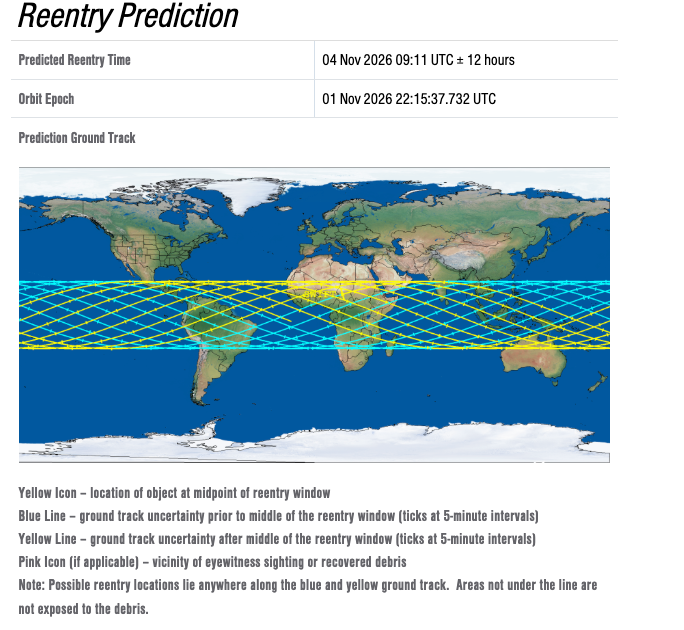
NASA's Neil Gehrels Swift Observatory, a 1.5-ton (approximately 3,200-pound) gamma-ray burst hunter launched in 2004, is on track for an uncontrolled atmospheric reentry around November 4, 2026, following the end of its science operations in late October. Official NASA updates confirm the spacecraft reached an altitude of about 171 miles (275 km) by October 20, where increased atmospheric drag from elevated solar activity rendered it unable to maintain stable observations, prompting shutdown commands. A commercial rescue effort by Katalyst Space's LINK robotic spacecraft, launched in July 2026 to boost the observatory, failed due to attitude control issues and was canceled in August. Reentry predictions from the U.S. Space Force and Aerospace Corporation center on early November with wide uncertainty windows (e.g., Nov. 3-5), narrowing only in the final hours. Swift's low-inclination orbit (about 21 degrees) restricts potential debris to latitudes between roughly 21°N and 21°S, encompassing Hawaii, Puerto Rico, southern Mexico, parts of Central/South America, Africa, and Southeast Asia—though most of this band is ocean, and the overall risk to people on the ground is estimated at about 1 in 2,100. Most of the spacecraft is expected to burn up, but denser components like tungsten pieces and X-ray telescope mirrors may survive. The mission's legacy includes over 2,000 gamma-ray burst observations and a vast multiwavelength archive that will support research for decades.
[LIMINAL]: The reentry's equatorial constraint and low casualty odds make it more spectacle than threat for most viewers, but highlight growing space debris risks and the limits of ad-hoc commercial servicing in an era of heightened solar activity.
Sources (6)
- [1]NASA’s Swift Observatory to Re-Enter Atmosphere(https://science.nasa.gov/blogs/swift/2026/11/02/nasas-swift-observatory-to-re-enter-atmosphere/)
- [2]NASA’s Swift Mission Ends Ahead of Re-Entry(https://science.nasa.gov/blogs/swift/2026/10/23/nasas-swift-mission-ends-ahead-of-re-entry/)
- [3]NASA Swift Reentry: When and Where the Satellite May Fall(https://spacetracker.live/latest-astronomy-news/nasa-swift-observatory-reentry/)
- [4]Neil Gehrels Swift Observatory Drops Back to Earth(https://www.cnet.com/science/space/neil-gehrels-swift-observatory-drops-back-to-earth/)
- [5]NASA's Swift telescope expected to fall to Earth this week after failed rescue(https://www.upi.com/Top_News/US/2026/11/02/nasa-swift-telescope-fall/5251793653866/)
- [6]SWIFT Reentry Watch as Gamma-Ray Observatory's Orbit Decays(https://keeptrack.space/reentry-watch/reentry-28485)