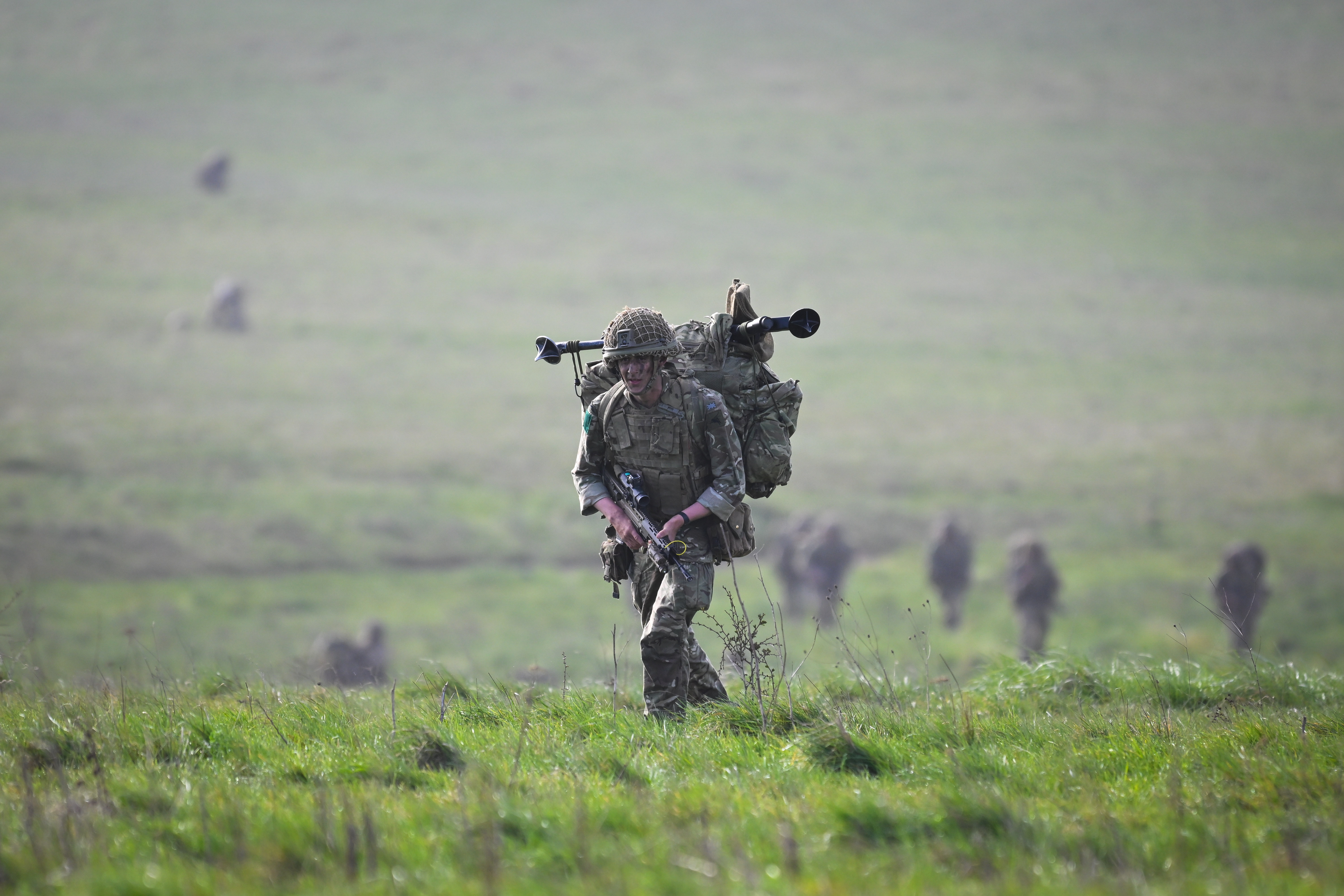
The $2.9 Trillion Spiral: How Record Military Spending Exposes a Systemic Global Arms Race
Record $2.9T global military outlays in 2025 reflect a systemic arms race driven by security dilemmas, alliance uncertainties, transparency erosion, and technological competition rather than isolated crises. Analysis connects European rearmament to Indo-Pacific shifts, critiques mainstream framing of U.S. declines, and warns of heightened miscalculation risks as NATO loosens spending definitions.
The Stockholm International Peace Research Institute's latest figures, as reported by Defense News, confirm global military expenditure hit a record $2.9 trillion in 2025—the eleventh consecutive year of real growth. Yet the coverage, while precise on regional breakdowns, treats these surges as a collection of discrete national responses rather than symptoms of a self-reinforcing, systemic international arms race. Europe's 14% jump to $864 billion, Asia's 8.1% rise, and sustained Chinese and Russian buildup reflect deepening geopolitical fractures, eroding arms-control architecture, and alliance uncertainties that mainstream reporting consistently under-analyzes.
Europe's surge is not merely reactive to Russia's war in Ukraine, now in its fifth year. Germany's 24% increase to $114 billion and first breach of the 2% GDP threshold since 1990, Spain's 50% leap, and Poland's 4.5% of GDP burden signal a structural shift toward strategic autonomy. This stems from chronic doubts about long-term U.S. reliability, especially visible in Washington's 7.5% recorded decline to $954 billion—an artifact of delayed supplemental Ukraine aid that SIPRI itself flags as temporary. With Congress eyeing $1-1.5 trillion budgets in 2026-2027 under President Trump, European capitals are hedging against transactional American policy. This mirrors patterns seen after the 2016 U.S. election but now accelerated by real capability gaps exposed in Ukraine.
In Asia, China's 7.4% rise to $336 billion (its 31st straight increase) cannot be viewed in isolation from Taiwan's 14% defense hike—the island's largest since 1988—or Japan's highest military burden since 1958. These form a classic security dilemma spiral, compounded by Beijing's gray-zone tactics and military-civil fusion strategy. The original article misses how this interconnects with European trends: U.S. force posture shifts toward the Indo-Pacific have compelled NATO members to shoulder more continental defense, freeing American resources while simultaneously alarming allies on both theaters.
Russia's $190 billion (7.5% of GDP, 20% of government spending) and Ukraine's staggering 40% of GDP outlay reveal the human and fiscal toll. Yet coverage overlooks the broader erosion of transparency and verification. SIPRI rightly warns that NATO's new 5% of GDP target by 2035—with 1.5 percentage points allocatable to vaguely defined "security-related" items—risks creative accounting, as illustrated by Italy's bridge-to-Sicily proposal. This opacity, combined with the lapse of New START and stalled UN disarmament talks, creates conditions for threat inflation and miscalculation reminiscent of the late 1970s.
Synthesizing the SIPRI data with the IISS Military Balance 2026 and a 2025 Brookings Institution study on great-power competition reveals what the original piece underplayed: the role of defense-industrial lobbying and technological domains (AI-enabled autonomous systems, hypersonics, space, and cyber) that drive spending beyond traditional platforms. RAND's 2025 analysis further shows how supply-chain lessons from Ukraine are prompting onshoring of production, locking in elevated budgets for the decade ahead. These are not isolated line items but interlocking drivers of a post-liberal international order defined by militarized rivalry.
Mainstream narratives err by framing U.S. fluctuations or European increases as anomalies rather than features of normalized great-power competition. The result is a feedback loop: one actor's "defensive" modernization is another's justification for escalation. Opportunity costs are immense—diverted resources from climate resilience, infrastructure, and social cohesion—while proliferation risks rise in the Global South as arms exporters prioritize revenue over stability.
This systemic dynamic points to a dangerous new normal. Without renewed great-power dialogue or confidence-building measures, current trajectories suggest elevated risks of inadvertent escalation in the Taiwan Strait, Baltic region, or Arctic by the early 2030s. Record spending is not signaling security; it is institutionalizing insecurity.
SENTINEL: Record spending and loosened NATO accounting standards will normalize 3-5% GDP defense burdens among middle and great powers, accelerating opaque proliferation in AI, space, and autonomous systems and materially raising the probability of limited conventional clashes escalating by 2029.
Sources (4)
- [1]Global military spending surges and reaches record high(https://www.defensenews.com/global/europe/2026/04/27/global-military-spending-surges-and-reaches-record-high/)
- [2]SIPRI Yearbook 2026: Armaments, Disarmament and International Security(https://www.sipri.org/yearbook/2026)
- [3]The Military Balance 2026(https://www.iiss.org/publications/the-military-balance/the-military-balance-2026)
- [4]Great Power Competition and Military Spending(https://www.brookings.edu/articles/great-power-competition-and-military-spending-2025/)