Taiwan as the Flashpoint: Unpacking China's Warning and the Risks of US-China Economic Decoupling
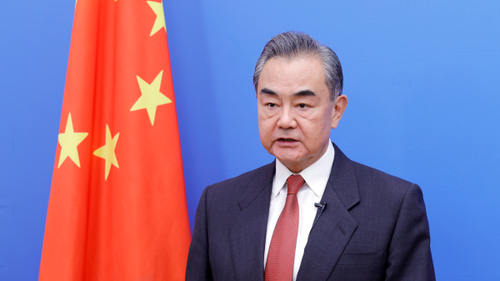
China’s Foreign Minister Wang Yi warned US Secretary of State Marco Rubio that Taiwan is the 'biggest risk factor' in US-China relations, following a $6.6 billion US arms deal with Taipei. Beyond military tensions, this standoff risks accelerating economic decoupling, disrupting Taiwan’s critical semiconductor supply, and causing market volatility in trade and tech sectors. Unaddressed by original coverage, these dynamics highlight Taiwan as a proxy in broader superpower rivalry.
Chinese Foreign Minister Wang Yi's recent statement to US Secretary of State Marco Rubio, identifying Taiwan as the 'biggest risk factor' in US-China relations, underscores a critical and escalating tension between the two superpowers. This warning, reported by The South China Morning Post via CCTV, comes on the heels of a $6.6 billion US arms deal with Taiwan, including HIMARS rocket systems, as part of an $11 billion package approved under the Trump administration. Wang’s remarks reflect Beijing’s consistent framing of Taiwan as a non-negotiable 'red line,' a position reinforced by military drills simulating blockades around the island, first seen after Nancy Pelosi’s 2022 visit. However, the original coverage misses the broader economic and strategic implications of this standoff, particularly how it could accelerate US-China decoupling and trigger market volatility across trade, technology, and investment sectors.
Taiwan is not just a geopolitical hotspot but an economic linchpin. As the world’s leading producer of semiconductors—accounting for over 60% of global supply, per the Semiconductor Industry Association—Taiwan’s stability is critical to tech industries worldwide. A conflict or even heightened tensions could disrupt supply chains, already strained by US export controls on advanced chips to China (as outlined in the US Commerce Department’s 2022 restrictions). The original reporting overlooks how Wang’s warning signals a potential escalation beyond military posturing to economic warfare. For instance, China’s simulated blockades could preview actual trade disruptions in the Taiwan Strait, through which 50% of global container traffic passes, according to the Council on Foreign Relations. A blockade or conflict would spike shipping costs and delay critical goods, impacting global markets.
Moreover, the US arms sales to Taiwan, while framed as defensive, are perceived by Beijing as a direct challenge to its sovereignty claims, fueling a cycle of retaliation. The original article fails to connect this to the broader pattern of superpower rivalry, where Taiwan is a proxy for larger ideological and economic battles. Since 2018, US-China trade wars have seen tariffs on hundreds of billions in goods, and tech decoupling has intensified with restrictions on Huawei and TikTok. Taiwan-related tensions could catalyze further economic fragmentation, pushing companies to diversify away from China-centric supply chains—a trend already visible in Apple’s shift of some production to India and Vietnam, as reported by Reuters in 2023.
From Beijing’s perspective, as articulated in Wang’s call for the US to 'honor its commitments,' China views US actions as violations of the One China policy, implicitly recognized in the 1972 Shanghai Communiqué. Yet, the US perspective, often expressed through State Department statements, emphasizes support for Taiwan’s self-defense under the Taiwan Relations Act of 1979, framing arms sales as a stabilizing measure against Chinese aggression. Neither side’s narrative fully acknowledges the economic collateral damage of this brinkmanship. Investors, already wary of geopolitical risks, may pull back from cross-strait investments, as seen in the 2022 market dips following Pelosi’s visit, when the Hang Seng Index fell 2.4% in a single day.
Looking ahead, the upcoming Trump-Xi summit in mid-May, mentioned in the original report, offers a potential de-escalation window but also risks hardening positions if Taiwan dominates the agenda. The original coverage misses how this meeting could set the tone for whether tensions manifest as contained military posturing or spill into economic domains, affecting global markets. Historical patterns, like the 2019 US-China trade talks, suggest that high-level engagements can temporarily stabilize relations but rarely resolve core disputes like Taiwan. The deeper issue is whether both powers can manage this rivalry without triggering a broader economic crisis—a question the initial reporting does not broach.
MERIDIAN: Taiwan tensions could spiral beyond military drills into economic disruptions, with a potential blockade in the Taiwan Strait spiking shipping costs and hitting global tech supply chains within the next 12 months.
Sources (3)
- [1]China's Foreign Minister to Rubio: Taiwan Is 'Biggest Risk Factor' in US-China Relations(https://www.zerohedge.com/geopolitical/chinas-foreign-minister-rubio-taiwan-biggest-risk-factor-us-china-relations)
- [2]US Department of Commerce: Export Controls on Semiconductor Manufacturing Items(https://www.bis.doc.gov/index.php/documents/about-bis/newsroom/press-releases/3158-2022-10-07-bis-press-release-advanced-computing-and-semiconductor-manufacturing-controls-final/file)
- [3]Council on Foreign Relations: The Taiwan Strait and Global Trade(https://www.cfr.org/backgrounder/china-taiwan-relations-tension-us-policy)