Medvedev's 'Animal Fear' Doctrine: How Deterrence by Dread Exposes the Collapse of Post-Cold War Diplomacy
Medvedev's recent article rejects diplomatic goodwill in favor of instilling 'animal fear' in EU leaders to deter future conflict, framing it as the only response to 'peace through strength' doctrines and German rearmament plans. This reflects the broader breakdown of post-Cold War European security structures based on trust, revealing a return to deterrence rooted in mutual dread amid underreported great power tensions.
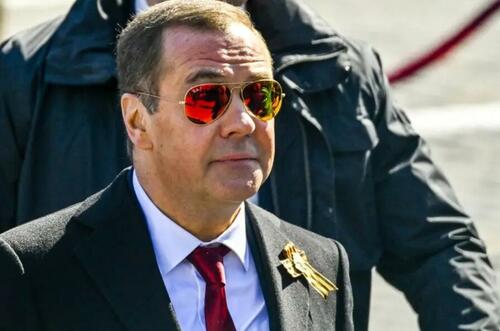
In an article published ahead of the 81st anniversary of Victory Day, Dmitry Medvedev, Deputy Chairman of Russia’s Security Council and former president, explicitly rejected diplomatic goodwill as a tool for preventing future conflict with Europe. Instead, he advocated for 'the security of Russia through the animal fear of Europe' – arguing that only the credible threat of unacceptable damage to Germany and the EU could deter what he termed 'Barbarossa 2.0'. Medvedev dismissed persuasion, unilateral confidence-building measures, and demonstrations of good intent, stating that Western powers interpret such gestures as weakness.[1][1]
This rhetoric, carried by Russian state outlets including RT, arrives amid Germany’s concerted push to transform the Bundeswehr into 'Europe’s strongest conventional army.' Chancellor Friedrich Merz has repeatedly pledged this goal, with a detailed military strategy unveiled in April 2026 targeting 460,000 combat-ready personnel (active and reserve) by 2039, structured in phases beginning with rapid readiness improvements by 2029. German officials cite the need to deter Russian aggression as the primary driver.[2][3]
Mainstream coverage often frames these developments as prudent European rearmament in response to Russia’s actions in Ukraine. Yet viewed through a deeper lens, Medvedev’s blunt language reveals the exhaustion of the post-Cold War security architecture. The post-1991 order – built on assumptions of liberal convergence, arms control treaties, and confidence-building measures like the NATO-Russia Founding Act – has unraveled through successive waves of NATO expansion, the collapse of the INF Treaty, disagreements over missile defense, and the proxy grinding war in Ukraine that has inflicted hundreds of thousands of casualties while remaining technically non-direct between NATO and Russia.
The pattern is familiar across history: when trust evaporates, systems default to raw deterrence based on fear rather than mutual vulnerability or shared norms. Medvedev’s invocation of 'animal fear' echoes classic realist thought – security dilemmas where one side’s defensive buildup (Germany’s 460,000-troop goal and EU militarization) is perceived as offensive preparation by the other. It also connects to broader global fractures: the failure of institutions like the OSCE to bridge divides, the shift toward multipolarity with rising actors outside the West, and the re-emergence of civilizational blocs where philosophical commitments to 'rules-based order' clash with spheres-of-influence realities.
While Western reporting emphasizes Russian aggression, it underreports how repeated dismissals of Moscow’s security concerns – from the 2008 Bucharest NATO summit to the 2021 draft treaties – contributed to today’s impasse. Goodwill measures, such as earlier Russian force reductions or arms control proposals, are now dismissed by both sides. The result is a feedback loop of militarization: European rearmament plans, Ukrainian deep strikes on Russian infrastructure, and Moscow’s doctrinal emphasis on inflicting unacceptable losses before any new 'Barbarossa' can materialize.
This moment signals more than tactical posturing. It highlights the philosophical poverty of a security framework that assumed ideological triumph would eliminate great-power conflict. In its place emerges an older logic – one where peace, if it holds, rests not on goodwill but on the primal calculus of fear. As tensions escalate, the risk grows that such rhetoric becomes self-fulfilling, further entrenching divisions that diplomatic nostalgia cannot bridge.
LIMINAL: Medvedev's framing of security as 'animal fear' rather than negotiated trust indicates that Russia-West relations have entered a phase of hardened realism where diplomatic off-ramps are viewed as futile, likely accelerating parallel military buildups and raising the probability of direct confrontation if a major escalation occurs in the next 3-5 years.
Sources (4)
- [1]Russia must instill 'animal fear' in EU warmongers – Medvedev(https://www.rt.com/russia/639504-medvedev-eu-warmongers-animal-fear/)
- [2]Germany’s Merz vows to build Europe’s strongest army(https://www.politico.eu/article/friedrich-merz-germany-bundestag-europe-conventional-army/)
- [3]Germany unveils strategy for becoming Europe's strongest military by 2039(https://www.defensenews.com/global/europe/2026/04/22/germany-unveils-strategy-for-becoming-europes-strongest-military-by-2039/)
- [4]Germany aims to have 'strongest' military in Europe — Merz(https://www.dw.com/en/germany-aims-to-have-strongest-military-in-europe-merz/a-72546478)