US Osprey Drill in Caracas Marks Assertive Post-Intervention Policy Shift in Latin America
The first US military drill on Venezuelan soil since the January 2026 capture of Maduro normalizes American operational presence under an interim government, reflecting a pragmatic shift toward direct engagement in Latin America that prioritizes resource security and counter-narcotics but risks inflaming local and regional opposition.
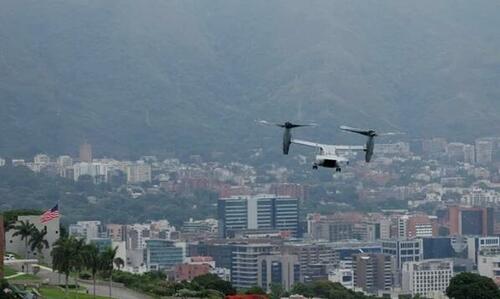
On May 23, 2026, two US Marine Corps MV-22B Osprey tiltrotor aircraft conducted a highly visible rapid-response exercise in central Caracas, landing near the recently reopened US Embassy. This marked the first acknowledged American military activity on Venezuelan soil since the January 3 US special operation that captured President Nicolás Maduro and his wife, resulting in significant casualties and the installation of an interim government. According to multiple reports, the drill—authorized by Venezuelan authorities as an evacuation rehearsal for medical emergencies or natural disasters—involved not only the aircraft but also naval vessels in adjacent Caribbean waters. US Southern Command commander Gen. Francis L. Donovan personally flew in on one of the Ospreys, held bilateral meetings with interim officials, and observed the exercise, his second high-profile visit to the capital since the intervention.[1][2]
While mainstream coverage has largely framed the event as a routine embassy security drill, the optics and timing reveal deeper policy implications. The interim administration, now led by figures from the prior socialist apparatus including Acting President Delcy Rodríguez, has pivoted toward cooperation with Washington on oil sector stabilization and security matters. This pragmatic “decapitation” rather than wholesale ideological regime change allows the US to secure strategic energy interests without the full burden of occupation, echoing elements of the Brookings Institution’s early analysis of the January operation’s contradictory visions for Venezuela’s future. Official SOUTHCOM statements and Donovan’s posture shifts emphasize counter-narcotics and direct force over broader development aid, signaling a broader Trump-era recalibration of Latin America strategy away from hands-off approaches toward visible deterrence and integration.[3][4]
Protests erupted in Caracas with demonstrators burning images of Trump and Rubio alongside “Hands Off Venezuela” banners, highlighting persistent anti-Yankee sentiment even as crowds gathered to watch the low-flying Ospreys. This domestic friction, combined with the normalization of US military presence in a former adversary state, carries underplayed risks for regional stability. Neighboring governments in Brazil, Colombia, and beyond may interpret the drill as precedent for expanded US operational reach against leftist or cartel-aligned actors. The swift reopening of the embassy in March and repeated SOUTHCOM visits suggest an emerging security architecture that could stabilize Venezuelan oil flows for US interests while potentially fueling insurgent backlash or proxy tensions reminiscent of Cold War-era dynamics. Mainstream outlets have underemphasized how this “evacuation drill” functions as both capability demonstration and political signal that US intervention in the hemisphere has entered a more muscular, normalized phase.[5][6]
The convergence of military show-of-force, high-level diplomacy with a continuity government, and energy-sector realignment points to a durable policy pivot whose full regional ripple effects—on migration, narcotics flows, and ideological alignments—remain unfolding.
Liminal Analyst: This drill cements a post-intervention US footprint in Venezuela that secures energy and security objectives under a continuity socialist facade, but mainstream underplaying of protest momentum and regional signaling suggests rising risks of hybrid instability spreading to neighbors by late 2026.
Sources (5)
- [1]US conducts military drill over Venezuelan capital Caracas(https://www.reuters.com/world/americas/us-conducts-military-drill-over-venezuelan-capital-caracas-2026-05-23/)
- [2]Marines conduct rapid response exercise at U.S. Embassy in Venezuela's capital(https://www.pbs.org/newshour/world/marines-conduct-rapid-response-exercise-at-u-s-embassy-in-venezuelas-capital)
- [3]Making sense of the US military operation in Venezuela(https://www.brookings.edu/articles/making-sense-of-the-us-military-operation-in-venezuela/)
- [4]Readout of SOUTHCOM Commander Gen. Francis L. Donovan's Meeting with Venezuelan Interim Government(https://www.southcom.mil/News/PressReleases/Article/4409015/readout-of-southcom-commander-gen-francis-l-donovans-meeting-with-venezuelan-in/)
- [5]US Marines conduct rapid-response drill in Venezuela(https://www.livenowfox.com/news/us-marines-venezuela-exercise)