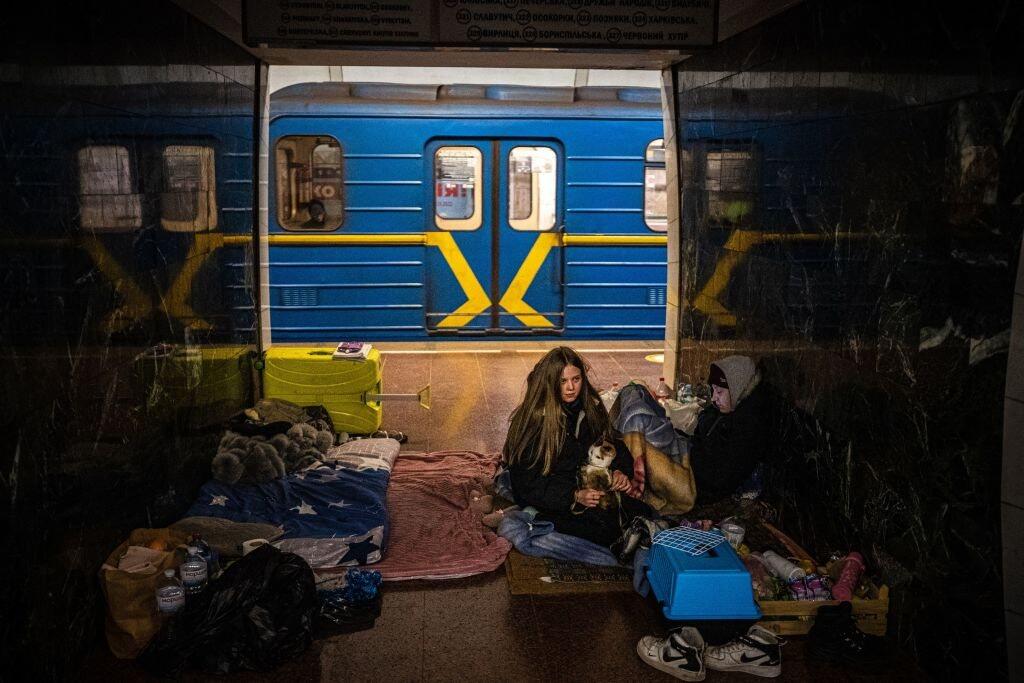
Europe is spending billions to rebuild civil shelters while most people still cannot name one
Finland’s long-standing shelter network is the model; Germany, Poland and Lithuania are now funding civil protection in the billions while public knowledge of where to hide remains thin and many “shelters” are dual-use basements rather than hardened bunkers.
Documented: frontline and large European states are putting real money and law back into civil protection after decades of neglect, using Finland as the working model and Ukraine as the operational lesson. What is claimed by governments is capacity and timelines; what is still largely untested is whether people know where to go, and whether dual-use basements count as protection when an attack is underway.
Finland is the benchmark the rest of the continent is now visiting. Helsinki maintains roughly 5,500 shelters, large and small, in a city of a bit more than 675,000 people, inside a national stock of about 50,500 shelters sized for a large majority of the population. Dual-use spaces are ordinary civic infrastructure until they are not: the Itäkeskus swimming hall, carved into bedrock and used by hundreds of thousands of visitors a year, is listed by the city as a civil-defence shelter and can be drained and converted; larger sites such as Merihaka are designed to be made operational within 72 hours. That network is the product of a continuous legal requirement, not a post-2022 panic.
Germany starts from the opposite end. Of roughly 2,000 Cold War public shelters, about 579 remain, with space for around 480,000 people in a country of more than 80 million — on the order of half a percent of the population. In June 2025 the head of the Federal Office of Civil Protection and Disaster Assistance, Ralph Tiesler, told German media the country needed to be ready for the risk of a major war in Europe and called for tunnels, metro stations, underground garages and public basements to be adapted quickly to create space for one million people, estimating at least €10 billion over four years. Reuters later reported that Interior Minister Alexander Dobrindt and Defence Minister Boris Pistorius were advancing a civil-protection package of €10 billion through 2029, covering shelters, warning systems, vehicles and the technical-relief agency. Pistorius has been explicit that the aim cannot be a dedicated bunker place for all 80 million Germans. Documented, then, is a shift from mothballed bunkers to everyday underground space plus a large budget line. Speculated — and not yet shown in completed works — is whether that produces usable protection on the timescale officials describe. As of the plans’ early stages, much of the money was still moving from announcement toward procurement.
Poland has turned the obligation into statute. A civil-protection law took effect at the start of 2025 and sets a floor of at least 0.3 percent of GDP a year. The Polish Press Agency reported that the 2025–26 programme alone was budgeted at about 16–17 billion zloty annually, with most of the money intended for local authorities to renovate or build shelters, stock supplies and train. The Financial Times reported that Warsaw earmarked 16 billion zloty for shelter-related work in one budget year and will require developers to allocate shelter space in most new buildings. The stock they are repairing is thin: proper hardened shelters cover only a small fraction of 38 million people; fire services have catalogued tens of thousands of lesser hiding places — basements, garages, car parks — that are not the same thing. A 2023 government survey, widely cited in Polish reporting, found hardened shelter space for only a few hundred thousand people. Public knowledge is a separate failure. A specific October poll figure circulating in secondary accounts — that a majority of Poles could not name a nearest shelter — has not been independently re-verified here and should be treated as claimed, not established. What is documented is the mismatch between a large statutory spend and a shelter estate that experts and the FT describe as mostly communist-era and in poor condition.
Lithuania is further along on paper capacity and still short on public knowledge. The Interior Ministry has said marked shelters number more than 6,400 and, by mid-2026 figures given to LRT, 6,618 sites with room for about 1.6 million people, roughly 58 percent of the population, with a target of 60 percent by 2027 and modernisation of at least 1,000 shelters. Funding in the tens of millions of euros has gone to municipalities. An LRT/Baltijos tyrimai survey found only 22 percent of residents could name the exact location of the nearest shelter; 31 percent said they did not know and had never looked. The ministry’s own earlier survey put awareness higher and rising, which is itself a bracket worth keeping: official and independent measures of “knowing where to go” do not yet agree, and many listed shelters are school or public basements that are not open to the public in peacetime. A state audit has questioned how many exist as functioning protection rather than as entries on a map.
Brussels has set a lower, household-level bar rather than a bunker programme. In March 2025 the European Commission’s Preparedness Union Strategy recommended that people be able to manage for at least 72 hours without normal services, covering floods, fires, pandemics and the possibility of armed aggression. Commissioner Hadja Lahbib framed 72-hour self-sufficiency as the recommended standard. That is guidance to member states and citizens, not a funded shelter network. It sits beside, and does not close, the physical gap between Finnish coverage and German or Polish coverage.
The pattern that is easy to miss is not simply “Europe is scared.” It is a split between military budgets, which have risen sharply as a share of GDP in Poland and the Baltics, and civil protection, which was dismantled after the Cold War and is now being rebuilt as dual-use infrastructure because new hardened bunkers are too slow and too expensive. Finland kept the legal duty and the rock. Germany, Poland and Lithuania are trying to buy back time with car parks, basements and apps. The expensive shift is real. The societal half — whether a resident can find the door, whether the door opens, and whether a drained swimming pool or a school cellar is what officials mean by shelter — is still mostly unproven.
Residents of Germany, Poland and the Baltic states are being asked to rely on civil-defence systems that governments are only now funding at scale, while documented shelter stocks still cover a small share of the population and surveys show many people do not know where the nearest marked shelter is.
Sources (12)
- [1]Germany plans rapid bunker expansion amid fears of Russian attack(https://www.theguardian.com/world/2025/jun/07/germany-plans-rapid-bunker-expansion-amid-fears-of-russian-attack)
- [2]German government to allocate 10 billion euros to boost civil defence(https://www.reuters.com/world/german-government-allocate-10-billion-euros-boost-civil-defence-2026-05-18/)
- [3]Germany to invest in everyday shelters, shifting from Cold War bunkers(https://www.reuters.com/business/aerospace-defense/germany-invest-everyday-shelters-shifting-cold-war-bunkers-2026-05-20/)
- [4]Stockpile 72 hours of supplies in case of disaster or attack, EU tells citizens(https://www.theguardian.com/world/2025/mar/26/stockpile-supplies-72-hours-disasters-attack-eu-tells-citizens)
- [5]EU tells the public to hold 72 hours of emergency supplies(https://www.reuters.com/world/europe/eu-commission-urges-stockpiling-emergency-supplies-2025-03-26/)
- [6]Warsaw approves civil defence initiative valued at billions(https://www.pap.pl/en/news/warsaw-approves-civil-defence-initiative-valued-billions)
- [7]Poland races to build bomb shelters(https://www.ft.com/content/2382f486-46b0-460d-8f78-b7006b8ad5b4)
- [8]Do you know where your nearest shelter is? Only one in five Lithuanians do(https://www.lrt.lt/en/news-in-english/19/2992277/do-you-know-where-your-nearest-shelter-is-only-one-in-five-lithuanians-do)
- [9]Lithuania still lacks shelters to accommodate half of the population(https://www.lrt.lt/en/news-in-english/19/2509876/lithuania-still-lacks-shelters-to-accommodate-half-of-the-population)
- [10]Finland's Massive Bomb Shelters Draw World to Helsinki in Quest for Security(https://www.usnews.com/news/world/articles/2026-05-21/finlands-massive-bomb-shelters-draw-world-to-helsinki-in-quest-for-security)
- [11]Taking a deep dive in Helsinki’s subterranean city(https://www.theguardian.com/travel/2026/sep/24/helsinki-finland-underground-city-swimming-pool)
- [12]Common civil defence shelter at Itäkeskus Swimming Hall(https://www.suomi.fi/services/servicepoint/common-civil-defence-shelter-at-itakeskus-swimming-hall-city-of-helsinki-the-social-services-health-care-and-rescue-services-division/2d0d6595-1d24-4c6c-9fe1-1993417746e9)