Tanzania and Angola agree to link Lobito and TAZARA railways into a coast-to-coast corridor
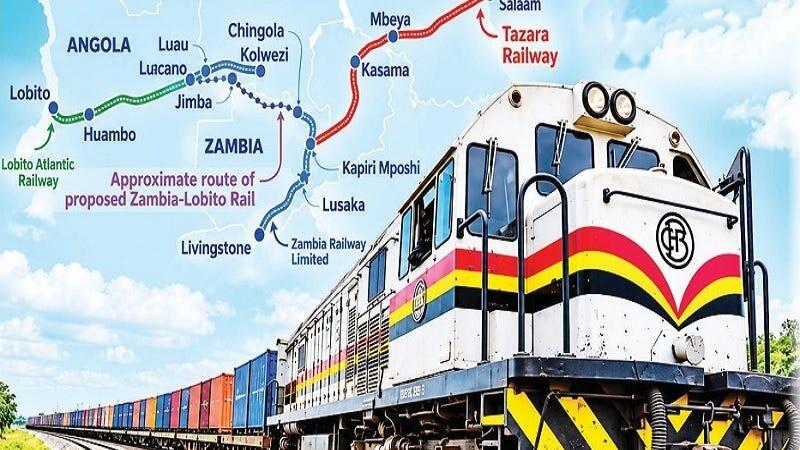
Tanzania and Angola have agreed in principle to join the Western-backed Lobito Corridor to China-backed TAZARA via Zambia and the DRC. There is no date or budget. Rival financing of the two lines is real; claims that the link will place Southern Africa’s minerals under exclusive US control are not.
Documented: On 29 October 2026, during Angolan President João Lourenço’s state visit to Dar es Salaam—the first by an Angolan head of state since 1979—Tanzanian President Samia Suluhu Hassan said Tanzania and Angola had agreed to connect their ocean corridors by rail. Angola’s Benguela Railway, the spine of the Lobito Corridor, would join the Tanzania–Zambia Railway (TAZARA) through Zambia and the Democratic Republic of the Congo, linking the Atlantic port of Lobito with Dar es Salaam on the Indian Ocean. Hassan gave no completion date and no cost. The same visit produced an air-services agreement and a Tanzanian look at a possible stake in Angola’s Lobito oil refinery, via the Tanzania Petroleum Development Corporation.
Documented context, not a finished line: The two systems already share Cape gauge (1,067 mm), so through-running is technically plausible if missing links, border procedures, and capacity are fixed. What is actually being built is still two separate investments. On the west, the US and EU have backed the Lobito Corridor since a 2023 partnership memorandum with Angola, Zambia, and the DRC. Lobito Atlantic Railway (Trafigura, Mota-Engil, Vecturis) holds a 30-year concession on the Angolan Benguela line; a financing package of about $753 million, including roughly $553 million from the US International Development Finance Corporation, is meant to raise capacity and cut mineral transport costs. Separately, the Africa Finance Corporation has named preferred contractors—including Italy’s Webuild—for an approximately 830-kilometre greenfield line from Zambia’s Copperbelt toward the Angolan network, a project variously costed in the multi-billion range and still short of financial close. On the east, China, Tanzania, and Zambia agreed in 2025 on a $1.4 billion modernisation of TAZARA, the 1,860-kilometre line China built in the 1970s so Zambian copper could reach the sea without white-ruled southern Africa. TAZARA has long been described, including by Reuters, as a counterweight to the Western-backed Lobito route.
Claimed, and only partly evidenced: Analysts writing from a New Cold War frame treat the October announcement as the start of a “Southern African Bi-Oceanic Railway” that will hand the United States structural control of the region’s copper, cobalt, and related minerals and push China out of the industry. That reading overstates what was announced. Presidents described an agreement to work toward interconnection, not a financed, scheduled construction programme. Western capital is concentrated on Lobito and the Zambia extension; Chinese capital is concentrated on TAZARA. Joining them would give landlocked producers a choice of oceans rather than a single patron’s exit. Rest of World and other reporting have also noted that Chinese firms rebuilt much of Angola’s railway before Washington’s corridor push, and that volumes of Congolese ore actually moving to the United States via Lobito have so far been modest relative to the strategic language.
Speculated, and not supported by the announcements: Claims that “all of Southern Africa” will fall into a US sphere of influence, that Washington will use hybrid pressure to void Chinese mineral contracts once the railway exists, or that the link is a prelude to forcing a lopsided trade settlement on Beijing, are inferences. No official text from Luanda, Dodoma, Lusaka, Kinshasa, Washington, or Beijing states those aims. The material fact underneath the speculation is narrower and still important: copper and cobalt routes in the Copperbelt are being financed by rival sponsors at the same time, and the two governments most associated with each corridor have now said they want those routes joined.
What the link would change, if it is ever built, is logistics optionality. A working Atlantic–Indian Ocean freight path would compete with road haulage and with single-port dependence for Zambian and Congolese mines, and it would put Dar es Salaam in direct contest with Lobito for the same tonnes. Tanzania’s own press has already framed that as a test of port efficiency, not as a geopolitical fait accompli. Until timelines, missing sections through the DRC, and money are public, the bi-oceanic railway remains a political commitment sitting on top of two unfinished, differently sponsored corridors.
Copper and cobalt shippers in Zambia and the DRC, and the ports that compete for their cargo, now have a stated plan for a second ocean exit sitting beside two corridors already financed by different powers. Until the missing links are funded, the practical effect is political signalling and route competition, not a completed transcontinental railway.
Sources (6)
- [1]Tanzania and Angola agree to link ocean corridors by rail(https://www.reuters.com/business/energy/tanzania-angola-agree-link-ocean-corridors-by-rail-2026-10-30/)
- [2]Lobito-TAZARA link: A new economic corridor amid China-West rivalry(https://businessinsider.co.tz/lobito-tazara-link-a-new-economic-corridor-amid-china-west-rivalry/)
- [3]The Race to the Copperbelt's Exit: Lobito, TAZARA and Africa's New Rail Geography(https://tmafrica.co.ug/news/race-copperbelts-exit-lobito-tazara-and-africas-new-rail-geography)
- [4]Lobito Corridor(https://en.wikipedia.org/wiki/Lobito_Corridor)
- [5]An old railroad is key to U.S.-China race for critical metals in Africa(https://restofworld.org/2026/lobito-railroad-america-china-africa-metals/)
- [6]Trans-African Rail Freight: Tanzania and Angola Plan to Connect the Indian Ocean to the Atlantic(https://logistafrica.com/en/highlights/trans-african-rail-freight-tanzania-and-angola-plan-to-connect-the-indian-ocean-to-the-atlantic/)