Narrative Skirmishes and Supply Chain Fragilities: Apple's Foldable iPhone Exposes Engineering and Geopolitical Fault Lines
Conflicting Nikkei and Bloomberg reporting on Apple's foldable iPhone highlights genuine engineering risks in flexible displays and hinges, reveals gaps in mainstream coverage of supply-chain geopolitics, and demonstrates how narrative competition influences investor expectations and Polymarket odds at a pivotal moment for Apple's growth strategy.
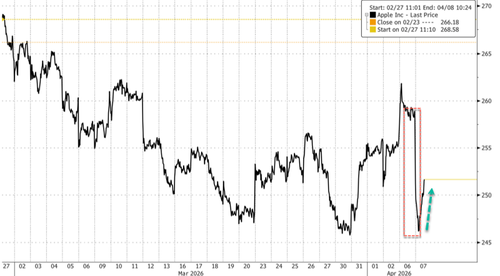
Conflicting accounts from Nikkei Asia and Bloomberg on Apple's first foldable iPhone illustrate more than a routine supply-chain leak cycle. Nikkei, citing multiple sources embedded in the handset ecosystem, reported unexpected engineering challenges during early test production, warning that April-to-early-May verification tests could force delays in mass production and shipment schedules. Bloomberg's subsequent dispatch, also based on anonymous insiders, asserted the device remains on track for a September 2026 launch window alongside the iPhone 18 Pro models. Apple shares dropped as much as 5.1% following the initial Nikkei story before partially recovering, while Polymarket probabilities of a pre-2027 release oscillated between 75% and 81%.
This episode fits a longer pattern visible since Samsung's Galaxy Fold debut in 2018. Apple has trailed competitors by nearly a decade, a lag repeatedly flagged in analyst notes from Ming-Chi Kuo (TF International Securities) and Display Supply Chain Consultants' quarterly foldable shipment trackers. Where mainstream coverage focused on the immediate stock reaction and betting-market swings, it underplayed Apple's historically deliberate cadence: the company has deferred foldable entry until it could meet internal benchmarks on crease visibility, hinge durability, and multi-year reliability that early Samsung and Huawei devices struggled to achieve.
A third perspective emerges from DSCC's public data releases showing foldable smartphone shipments exceeding 20 million units globally in 2024, dominated by Chinese and Korean vendors. These reports indicate that ultra-thin flexible OLEDs and specialized hinge assemblies remain concentrated among a handful of suppliers (Samsung Display, BOE, LG), creating single points of failure Apple has historically sought to avoid. Nikkei's sources explicitly downplayed memory-chip constraints, instead emphasizing "engineering challenges" around integrating these components at Apple's quality thresholds, an admission the Bloomberg rebuttal did not directly refute.
The story also intersects with policy realities rarely mentioned in consumer-tech reporting. U.S. CHIPS and Science Act incentives, export controls on advanced semiconductors, and ongoing friend-shoring pressure have compelled Apple to diversify assembly beyond China. Yet specialized foldable subsystems are not easily relocated; primary display and hinge expertise remains anchored in East Asia. This reality mirrors broader geopolitical tensions: Huawei's continued foldable progress despite entity-list restrictions demonstrates how alternative supply networks can evolve under sanctions, while Apple's tighter component standards limit its agility.
Neither Nikkei nor Bloomberg accounts constitute primary technical disclosures; both rely on the same opaque supplier tier that has fed competing narratives around prior Apple launches (Apple Watch ceramic finishes, early Face ID yields). The speed of Bloomberg's counter-report itself suggests an information-management dynamic familiar to observers of tech "narrative operations," where selective sourcing can stabilize or destabilize investor expectations within hours.
What remains unresolved is whether initial production will be capped at the 7-8 million units Nikkei projected. Historical precedent from Apple's first-generation products shows constrained launches often serve as market-testing mechanisms rather than outright failures. For policymakers tracking technological leadership metrics, the episode underscores how corporate secrecy, supplier concentration, and media amplification interact to shape perceived U.S. competitiveness in next-generation consumer hardware. The resolution, whenever it arrives, will test not only Apple's engineering culture but the resilience of trans-Pacific supply architectures under increasing geopolitical strain.
MERIDIAN: Conflicting Nikkei-Bloomberg accounts on Apple's foldable device signal real engineering bottlenecks in concentrated Asian supply chains; continued narrative volatility may accelerate U.S. policy pressure for display-tech diversification.
Sources (3)
- [1]Nikkei Asia: Apple foldable iPhone faces engineering snags(https://asia.nikkei.com/Business/Technology/Apple-s-foldable-iPhone-faces-engineering-hurdles-sources-say)
- [2]Bloomberg: Apple Foldable iPhone Said to Remain on Track(https://www.bloomberg.com/news/articles/2025-04-08/apple-still-aiming-to-launch-foldable-iphone-in-2026)
- [3]ZeroHedge Synthesis of Conflicting Reports(https://www.zerohedge.com/technology/foldable-apple-iphone-hit-engineering-snags-raising-risk-delays-odds-2027-release-80)