Very Strong El Niño Builds in 2026, Amplifying Risks to Concentrated Global Food Supplies Amid Geopolitical Pressures
NOAA-confirmed very strong El Niño development in late 2026 heightens food price and supply risks through weather and policy amplification in geographically concentrated agricultural markets, with corroboration from official forecasts and analyst reports on interconnected energy/fertilizer pressures.
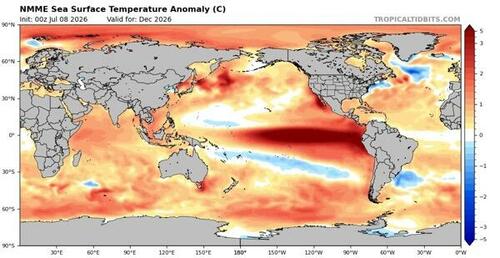
Official NOAA Climate Prediction Center assessments confirm El Niño conditions are present and strengthening, with an 81% chance of a 'very strong' event (ranking among the largest since 1950) during October-December 2026 and a 97% probability of persistence through early spring 2027. Sea surface temperature anomalies have already reached levels supporting this intensification, consistent with warnings of adverse weather across key agricultural regions in Asia, Australia, and the Americas.
This aligns with analyses highlighting systemic vulnerabilities: global trade in staples like rice, soybeans, corn, sugar, and palm oil is dominated by just a few exporters, making markets susceptible to localized shocks that can trigger export restrictions and biofuel diversions. Goldman Sachs research has flagged Southeast Asian food supply risks from the combination of El Niño effects, elevated energy prices, and fertilizer disruptions linked to Middle East tensions, with net importers like Singapore and the Philippines particularly exposed.
Deeper connections emerge when viewing the event alongside policy responses. Historical patterns show El Niño often correlates with droughts or floods that reduce yields in concentrated production zones, but the real amplification stems from downstream reactions—governments prioritizing domestic security through stockpiling or mandates, which fragments trade further and heightens price volatility beyond direct weather impacts. Fertilizer procurement seasons overlapping potential Strait of Hormuz issues add another layer, as nitrogen supply chains remain fragile.
While mainstream coverage often frames such events within broader climate trends, the immediate threat lies in how concentrated supply chains convert modest disruptions into outsized price signals and protectionist cascades. Credible forecasts from the CPC and multi-model ensembles underscore that stronger events tilt probabilities toward expected regional anomalies without guaranteeing uniform outcomes everywhere.
[LIMINAL]: Concentrated exporter reliance plus policy feedback loops could drive sharper, more persistent food price spikes than weather models alone predict, especially if fertilizer or export shocks coincide with peak El Niño effects.
Sources (6)
- [1]Climate Prediction Center: ENSO Diagnostic Discussion(https://www.cpc.ncep.noaa.gov/products/analysis_monitoring/enso_advisory/ensodisc.shtml)
- [2]Official NOAA CPC ENSO Strength Probabilities(https://cpc.ncep.noaa.gov/products/analysis_monitoring/enso/roni/strengths/)
- [3]El Nino forms, expected to strengthen, say NOAA forecasters(https://www.noaa.gov/news-release/el-nino-forms-expected-to-strengthen-say-noaa-forecasters)
- [4]Southeast Asia will likely face a food-supply shock ... Goldman Sachs(https://www.facebook.com/cnbc/posts/southeast-asia-will-likely-face-a-food-supply-shock-as-food-becomes-more-expensi/1408958621105527/)
- [5]A Sea Change for Commodity Prices: Why Markets appear to be underpricing El Niño risks(https://www.nb.com/insights/a-sea-change-for-commodity-prices-why-markets-appear-to-be-underpricing-el-ni-o-risks)
- [6]Iran war: Why a super El Niño event poses fresh risks to ...(https://www.cnbc.com/2026/04/09/el-nino-food-risks-iran-war-fertilizer-weather.html)