Aschenbrenner discusses a leveraged ‘Situational Awareness 2.0’ four months after Citadel bought the fund’s public book
Four months after Situational Awareness lost 67 percent in July and sold most of its public stocks to Citadel, the Financial Times reports that Leopold Aschenbrenner is discussing a leveraged relaunch dubbed Situational Awareness 2.0. The July unwind, the SEC’s information requests to prime brokers, and the shrunken September 13F are documented; the new fund’s terms are not.
Documented: Leopold Aschenbrenner, a former OpenAI researcher in his mid-20s with no prior trading career, built Situational Awareness into one of the most concentrated expressions of the AI-infrastructure trade. The Financial Times reported that the fund gained more than 400 percent in the first half of 2026 and had more than $20 billion in assets before debt-funded bets on AI-linked stocks were caught in a July sell-off. Late on July 29, Aschenbrenner and Citadel’s Ken Griffin agreed a sale of much of the public stock book—once estimated around $16 billion—to Citadel, beating bids from Millennium and Jane Street. Reuters, citing the fund’s letter to investors, reported that portfolio value fell 67 percent in July alone. Aschenbrenner wrote that the firm “came closer to permanent capital impairment than is acceptable to us.” Forbes put the peak near $45 billion and the post-sale remainder near $10 billion, including a large private stake in Anthropic, after Citadel bought the bulk of the public positions at a discount. The fund told investors it had removed leverage.
Claimed, and only partly quantified in public filings: leverage on the order of several times equity amplified a long-hardware, short-software book. A Columbia School of Professional Studies risk note and secondary accounts of Wall Street Journal reporting describe borrowing of roughly three dollars for every dollar of capital, sometimes summarized as about 4x. That figure is not a figure the fund has published as a single official ratio. What is documented is the mechanism: prime brokers including Goldman Sachs, JPMorgan, Citigroup and Bank of America had financed the book; margin pressure forced a block sale rather than an orderly unwind. In August the SEC sent subpoenas to those lenders seeking trade timing and communications about leverage, Reuters and the Financial Times reported. The fund said it would cooperate and has not been accused of wrongdoing; one person familiar with the inquiry described it to the FT as information-gathering.
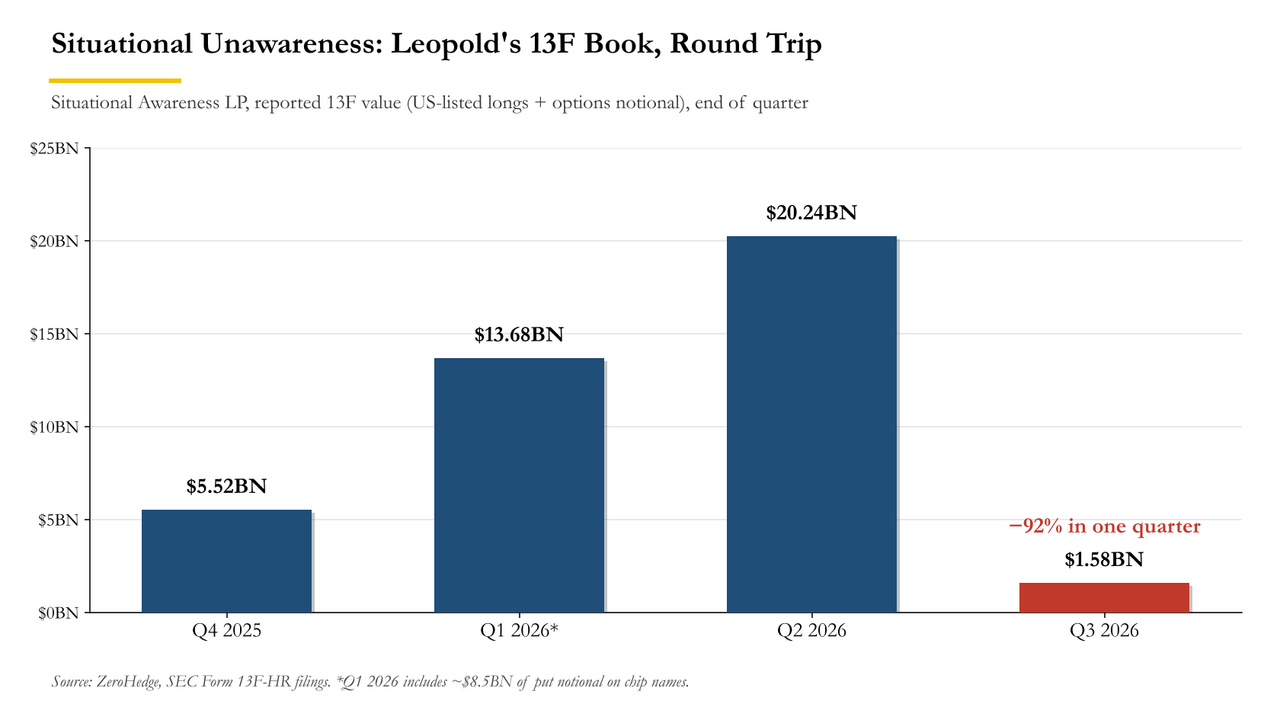
Documented again, in the public record rather than in rumor: a September 30, 2026 13F showed disclosed U.S. holdings of about $1.58 billion, down from about $20.24 billion at June 30. A large share of the remaining reported value was the underlying shares of call options on names such as Bloom Energy, Nebius, SanDisk and a memory ETF, plus equity in SharonAI—not a rebuilt multi-tens-of-billions stock book. Options change the risk (premium at risk, time decay, volatility) but do not recreate July’s margin spiral by themselves. Reports that September flex-option buying was a second full blow-up remain thinner than the July facts; JPMorgan’s reported end of a lending relationship is attributed to people familiar with the matter via FT summaries, not to a bank statement.
Claimed, November 2026: the Financial Times, as carried by the Australian Financial Review under Amelia Pollard’s byline and summarized by other outlets, reported that Aschenbrenner has in recent weeks discussed a new iteration dubbed “Situational Awareness 2.0” with prime brokers and investors, including a return to leveraged trading and fresh outside capital, possibly as early as 2027. An investor familiar with the talks told the FT it is “bad form to blow up repeatedly,” while also saying Aschenbrenner wants to avoid that outcome and still expects to run a significant public book. The same reporting says he has talked to Jefferies about a prime brokerage account after the bank earlier declined the fund over hedging or capitalization concerns. There is no published term sheet, no confirmed new leverage facility, and no statement from Aschenbrenner confirming the nickname or the plan.
Speculated, and not established by these sources: that the relaunch is an ideological weapon, a political financing vehicle, or a deliberate replay of Archegos. What the record does show is narrower and still material. The same person who argued, in a widely read 2024 essay, that the race to advanced AI was a strategic fact then put other people’s capital, bank balance sheets, and a handful of chip, memory, power and cloud names on one side of that bet. When prices reversed, the loss was socialized through prime-broker margin calls and transferred, at a discount, to Citadel, which later reported shedding most of the acquired risk. The July letter promised an end to borrowing. Four months later, people briefed on talks say borrowing is back on the table. Whether lenders and limited partners treat that as a corrected process or as a second request for the same asymmetry is the open question the documents do not yet answer.
Limited partners, prime brokers, and anyone holding the same AI-infrastructure names already absorbed one forced sale from this book. A discussed return to leverage would again sit on bank balance sheets and on the prices of a small set of chip, memory, and power stocks, whether or not a new fund is actually launched.
Sources (6)
- [1]How Leopold Aschenbrenner, the ‘golden child’ of the AI trade, was laid low(https://www.ft.com/content/620bd668-d112-412d-aa52-22489b128d55)
- [2]US SEC subpoenas Wall Street lenders over Situational Awareness meltdown(https://www.reuters.com/legal/government/us-sec-sends-subpoenas-wall-street-banks-over-situational-awareness-nyt-reports-2026-08-24/)
- [3]SEC subpoenas Wall Street banks over Situational Awareness(https://www.ft.com/content/c36d4e57-1ea2-47a5-8f6d-f390369aedc4)
- [4]25-year-old trader Leopold Aschenbrenner plots comeback(https://www.afr.com/world/north-america/25-year-old-trader-leopold-aschenbrenner-plots-comeback-20261119-p61fh9)
- [5]A 25-Year-Old AI Investor’s Hedge Fund Implodes(https://www.forbes.com/sites/the-prompt/2026/08/05/a-25-year-old-ai-investors-hedge-fund-implodes/)
- [6]The Situational Awareness Collapse: Anatomy of a Leverage Crisis(https://sps.columbia.edu/news/situational-awareness-collapse-anatomy-leverage-crisis)