April Jobs Report Masks Deeper Labor Market Fragility Amid AI Disruption and Policy Implications
The April 2026 jobs report, while showing a headline payroll gain of 115,000, masks significant labor market weaknesses including sectoral imbalances, declining full-time employment, and AI-driven job losses in the Information sector. Discrepancies between surveys and potential Federal Reserve policy missteps highlight broader risks of inequality and instability, urging a reevaluation of labor and economic strategies.
The April 2026 jobs report, initially touted as a robust indicator of economic health with a headline payroll increase of 115,000 jobs against an expected 65,000, reveals significant vulnerabilities upon closer examination. Beneath the surface, the data exposes a reliance on low-quality job growth, persistent divergences in key metrics, and emerging threats from artificial intelligence (AI) that could reshape labor markets and influence Federal Reserve policy. This analysis delves into the nuances of the report, contextualizes it within broader economic patterns, and highlights overlooked connections to inequality and monetary policy.
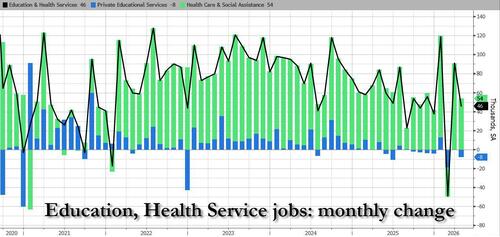
Firstly, the composition of job gains in the Establishment Survey raises concerns about the sustainability of growth. As reported by the Bureau of Labor Statistics (BLS), 46,000 of the new jobs came from Education and Health Services—sectors often tied to government or quasi-government funding—and 38,000 from courier and messenger roles, potentially reflecting volatile gig economy trends rather than stable employment. Meanwhile, manufacturing, a traditional pillar of middle-class jobs, recorded a loss of 2,000 positions, continuing a year-long decline of 73,000 jobs. This sectoral imbalance suggests a hollowing out of high-quality employment, a trend that has persisted through much of the post-COVID recovery and risks exacerbating income inequality.
More troubling is the discrepancy between the Establishment and Household Surveys, a recurring issue that undermines confidence in headline figures. The Household Survey reported a decline of 226,000 employed workers in April, with a consistent downward trend averaging 343,000 losses per month in 2026. Full-time jobs dropped by 424,000, while part-time roles rose by 123,000, pushing full-time employment back to levels last seen in December 2024. This divergence, coupled with a labor force participation drop that kept the unemployment rate steady at 4.3%, points to a labor market far weaker than the payroll data suggests. The BLS’s Birth/Death adjustment, adding an estimated 391,000 jobs based on model assumptions, further casts doubt on the report’s reliability, echoing past criticisms of over-optimistic revisions under the current administration.
Beyond statistical discrepancies, the report signals an accelerating threat from AI-driven job displacement, particularly in the Information sector, which saw a loss of 13,000 jobs in April. This aligns with broader evidence of automation’s impact on white-collar roles, as highlighted in a 2025 International Monetary Fund (IMF) working paper estimating that up to 40% of global jobs could be exposed to AI disruption, with advanced economies facing higher risks in cognitive-intensive fields like programming and data analysis. While the ZeroHedge coverage flags this as a novel concern, it misses the longer trajectory of automation’s impact, evident since at least the early 2020s when firms began integrating generative AI tools post-ChatGPT’s release. The current data suggests this trend is now hitting employment figures tangibly, a development that could accelerate if unchecked by policy.
What the original coverage overlooks is the potential interplay between these labor market fragilities and Federal Reserve decision-making. With inflation pressures lingering—core PCE inflation stood at 2.8% in March 2026, per the Federal Reserve’s preferred gauge—the Fed faces a dilemma. Weak underlying employment data, despite headline strength, may argue for maintaining or lowering interest rates to stimulate demand, yet persistent inflation could force a tighter stance, risking further labor market deterioration. Historical patterns, such as the Fed’s delayed response to labor market signals in the late 1970s, suggest that misreading these mixed indicators could deepen economic inequality, as lower-wage and part-time workers bear the brunt of any slowdown.
Additionally, the rise of gig and part-time roles alongside AI displacement points to a structural shift toward precarious employment, a trend insufficiently addressed in the ZeroHedge piece. This connects to broader geopolitical and policy debates on universal basic income (UBI) or retraining programs, as seen in European experiments like Finland’s 2017-2018 UBI pilot, which showed mixed results in improving employment but notable gains in worker well-being. Without proactive measures, the U.S. risks a widening gap between high-skill, AI-augmented roles and low-skill, unstable jobs—a dynamic that could fuel social unrest, as witnessed during the 2020-2021 gig worker protests.
In synthesizing these elements, it becomes clear that the April jobs report is not merely a statistical anomaly but a harbinger of deeper challenges. The interplay of unreliable data, sectoral imbalances, AI-driven displacement, and looming policy decisions underscores a labor market at a critical juncture. Policymakers, businesses, and workers must grapple with these realities to mitigate risks of entrenched inequality and economic instability.
MERIDIAN: The convergence of AI displacement and labor market fragility could push the Federal Reserve toward a dovish stance by late 2026, prioritizing job creation over inflation control, though this risks fueling long-term wage disparities.
Sources (3)
- [1]Bureau of Labor Statistics: April 2026 Employment Situation Summary(https://www.bls.gov/news.release/empsit.nr0.htm)
- [2]IMF Working Paper: Gen-AI: Artificial Intelligence and the Future of Work(https://www.imf.org/en/Publications/WP/Issues/2025/01/14/Gen-AI-Artificial-Intelligence-and-the-Future-of-Work-542379)
- [3]Federal Reserve Economic Data: Core PCE Inflation March 2026(https://fred.stlouisfed.org/series/PCEPI)