Record Low Consumer Sentiment in 2026 Exposes Deep Partisan and Methodological Divides Amid Resilient Macro Data
May 2026's record-low Michigan Consumer Sentiment (44.8) clashes with strong GDP, jobs, and spending data, driven by partisan divides (50+ point gaps) and survey methodology changes, revealing deeper public-official narrative fractures.
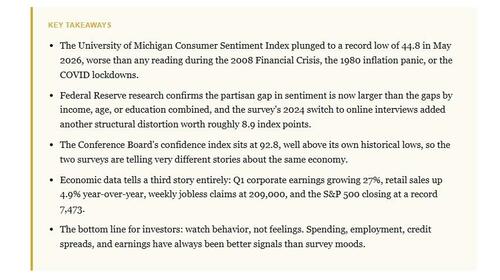
The University of Michigan’s Consumer Sentiment Index hit a record low of 44.8 in May 2026, the worst reading since the survey’s inception in 1952 and below levels seen during the 2008 financial crisis or COVID lockdowns. Official data from the Surveys of Consumers confirm this plunge, with the index later rebounding modestly to 48.9 in June amid easing gasoline prices. Yet this coincides with robust economic signals: retail sales growth, strong corporate earnings beats, low unemployment around 4.3%, and GDP tracking models showing annualized growth above 4% in Q2.
This disconnect is not new but has intensified. Historical patterns showed sentiment tracking GDP closely through recessions; since 2022, GDP has held steady at 2-3% annual growth while sentiment languished below 70. Analyses attribute part of the gap to a methodological shift: the full transition to online surveying by mid-2024 introduced an estimated 8-9 point downward bias due to changes in respondent demographics.
A larger factor is partisan polarization. University of Michigan special reports and independent analyses document an X-pattern at administration transitions, with Republican sentiment surging and Democratic sentiment collapsing post-2024 election. Gaps have widened to 50+ points, far exceeding divides by income or age, as confirmed by Richmond Fed research and Substack data reviews. Independents track national averages more closely, suggesting the headline figure increasingly reflects political affiliation rather than uniform economic experience.
Broader context from Federal Reserve notes and Brookings Institution highlights how consumers report feeling worse despite verified spending increases post-pandemic, pointing to persistent inflation perceptions and media amplification. Mainstream outlets often emphasize headline resilience while downplaying how these surveys reveal eroding trust in official narratives, potentially signaling risks to future consumption if the gap persists.
The phenomenon underscores systemic issues: surveys capture subjective realities shaped by politics and methodology, while hard data reflects aggregate activity. Both can be 'right' in their domains, but the divergence demands scrutiny of how economic perceptions are measured and politicized.
[Heterodox Analyst]: Persistent partisan skew in sentiment surveys may erode policy responsiveness, as official data underweights lived inflation pressures felt across demographics.
Sources (6)
- [1]Surveys of Consumers - University of Michigan(https://www.sca.isr.umich.edu/)
- [2]Consumer sentiment hits fresh record low in May as Iran war fuels inflation worries - CNBC(https://www.cnbc.com/2026/05/22/consumer-sentiment-hits-fresh-record-low-in-may-as-iran-war-fuels-inflation-worries.html)
- [3]Consumer Sentiment Isn't Politics, but Politics Is Reshaping It - Stay at Home Macro(https://stayathomemacro.substack.com/p/consumer-sentiment-isnt-politics)
- [4]Tracking consumer sentiment versus how consumers are doing - Federal Reserve(https://www.federalreserve.gov/econres/notes/feds-notes/tracking-consumer-sentiment-versus-how-consumers-are-doing-based-on-verified-retail-purchases-20250424.html)
- [5]The paradox between the macroeconomy and household sentiment - Brookings Institution(https://www.brookings.edu/articles/the-paradox-between-the-macroeconomy-and-household-sentiment/)
- [6]US - Michigan Consumer Sentiment Index - by Political Party - MacroMicro(https://en.macromicro.me/charts/110438/us-michigan-consumer-sentiment-index-within-political-party)