Intel's Record Stock Surge: White House Push for Apple Deal Signals Broader U.S. Semiconductor Strategy
Intel's stock hit a record high after a White House-brokered deal to make chips for Apple, reflecting U.S. efforts to strengthen domestic semiconductor production amid rivalry with China. Beyond market hype, this reveals deeper policy goals under the CHIPS Act, geopolitical stakes, and questions about the sustainability of government intervention in tech.
Intel's stock soared nearly 20% to a record high of over $130 following a Wall Street Journal report on a preliminary agreement to manufacture chips for Apple, a deal heavily influenced by White House intervention. This development, while significant for Intel's turnaround under CEO Lip-Bu Tan, reveals deeper geopolitical currents and policy priorities that extend beyond a single corporate partnership. The U.S. government's role—evident in Commerce Secretary Howard Lutnick's direct engagement with Apple CEO Tim Cook and President Trump's personal advocacy—underscores a strategic push to bolster domestic semiconductor production amid global supply chain fragility and intensifying tech rivalry with China.
The original coverage by ZeroHedge captures the market excitement and White House involvement but misses critical context about the broader policy landscape and historical patterns of U.S. industrial intervention. First, it overlooks the significance of the CHIPS and Science Act of 2022, which allocated $52.7 billion to revitalize American semiconductor manufacturing. Intel has already received commitments for up to $8.5 billion in grants under this act, alongside the government's conversion of $9 billion in federal grants into a 10% equity stake in August 2025. This deal with Apple appears less as a standalone corporate win and more as a deliberate outcome of a multi-year policy framework to reduce reliance on foreign foundries like Taiwan Semiconductor Manufacturing Company (TSMC).
Second, the coverage underplays the geopolitical stakes. The U.S.-China tech rivalry has escalated since export controls on advanced semiconductors were tightened in 2022 and 2023 by the Biden administration, targeting firms like Huawei. Intel's partnerships with Apple, Nvidia, and SpaceX—brokered with White House involvement—signal an attempt to consolidate a domestic tech ecosystem capable of countering China's advancements through state-backed giants like SMIC. However, skepticism remains: Apple's reversal from its 2020 decision to phase out Intel chips (a move driven by performance gaps) raises questions about whether this deal is substantive or a symbolic gesture to align with U.S. policy goals. The lack of clarity on which Apple products will use Intel chips, as noted in the original report, fuels speculation that this may be more about optics than operational integration.
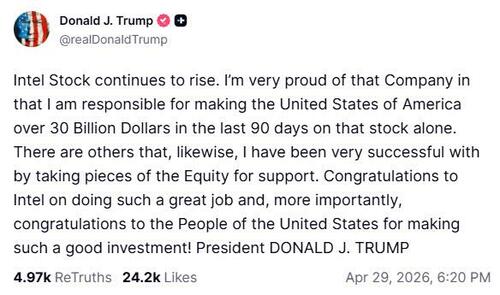
Historically, U.S. government intervention in strategic industries is not new—consider the Defense Production Act during the Cold War or bailouts of the auto industry in 2009. What’s distinct here is the direct equity stake and personal involvement of political leaders, reminiscent of Trump's earlier dealings with companies like Carrier in 2016 to prevent offshoring. This pattern suggests a return to muscular industrial policy, though it risks accusations of cronyism or market distortion, especially given Trump's public boasts about profits from Intel's stock rise. ZeroHedge hints at this with a cynical tone ('just press release bullet points'), but fails to connect it to the broader debate on whether such interventions can sustainably rebuild U.S. manufacturing or merely inflate asset bubbles, as seen in Intel's dot-com-era echoes.
Another missed angle is Intel's internal transformation under Tan, whose ties to China initially drew Trump's ire. Tan's hiring of TSMC veteran Wei-Jen Lo and investment in the 14A manufacturing process indicate a technical pivot to close the gap with rivals. Yet, the ongoing lawsuit from TSMC over Lo's defection highlights the cutthroat nature of talent wars in this sector, a dimension of competition the original article ignores. If Intel fails to deliver on performance, even White House-backed deals with Apple may falter, as tech giants prioritize efficiency over political alignment.
Synthesizing multiple sources, the Intel-Apple deal emerges as a microcosm of U.S. efforts to reclaim semiconductor leadership. The Department of Commerce's 2023 report on supply chain vulnerabilities warned of over-reliance on East Asian manufacturing, with 92% of advanced chips produced in Taiwan—a geopolitical flashpoint. Meanwhile, a 2025 Congressional Research Service brief on the CHIPS Act emphasized that domestic production capacity remains years behind schedule, with Intel's foundry business still unproven against TSMC's scale. These documents frame the Apple deal as a high-stakes test of whether policy-driven partnerships can translate into technical and economic outcomes, or if they merely prop up struggling firms for political gain.
Ultimately, this story is less about Intel's stock price and more about the intersection of industrial policy, national security, and corporate strategy. The White House's heavy hand may secure short-term wins, but long-term success hinges on Intel's ability to innovate—a challenge history shows is not guaranteed, even with government backing.
MERIDIAN: The Intel-Apple deal may boost short-term confidence in U.S. semiconductor policy, but Intel's unproven foundry capabilities and historical lag behind TSMC suggest long-term challenges unless technical innovation matches political ambition.
Sources (3)
- [1]Intel Jumps To Record High On Deal To Make Chips For Apple, Following White House Pressure(https://www.zerohedge.com/markets/intel-jumps-record-high-deal-make-chips-apple-following-white-house-pressure)
- [2]Department of Commerce Report on Semiconductor Supply Chain Vulnerabilities (2023)(https://www.commerce.gov/news/reports/2023/01/ict-supply-chain-report-semiconductors)
- [3]Congressional Research Service: CHIPS for America Act Implementation (2025 Update)(https://crsreports.congress.gov/product/pdf/R/R47523)