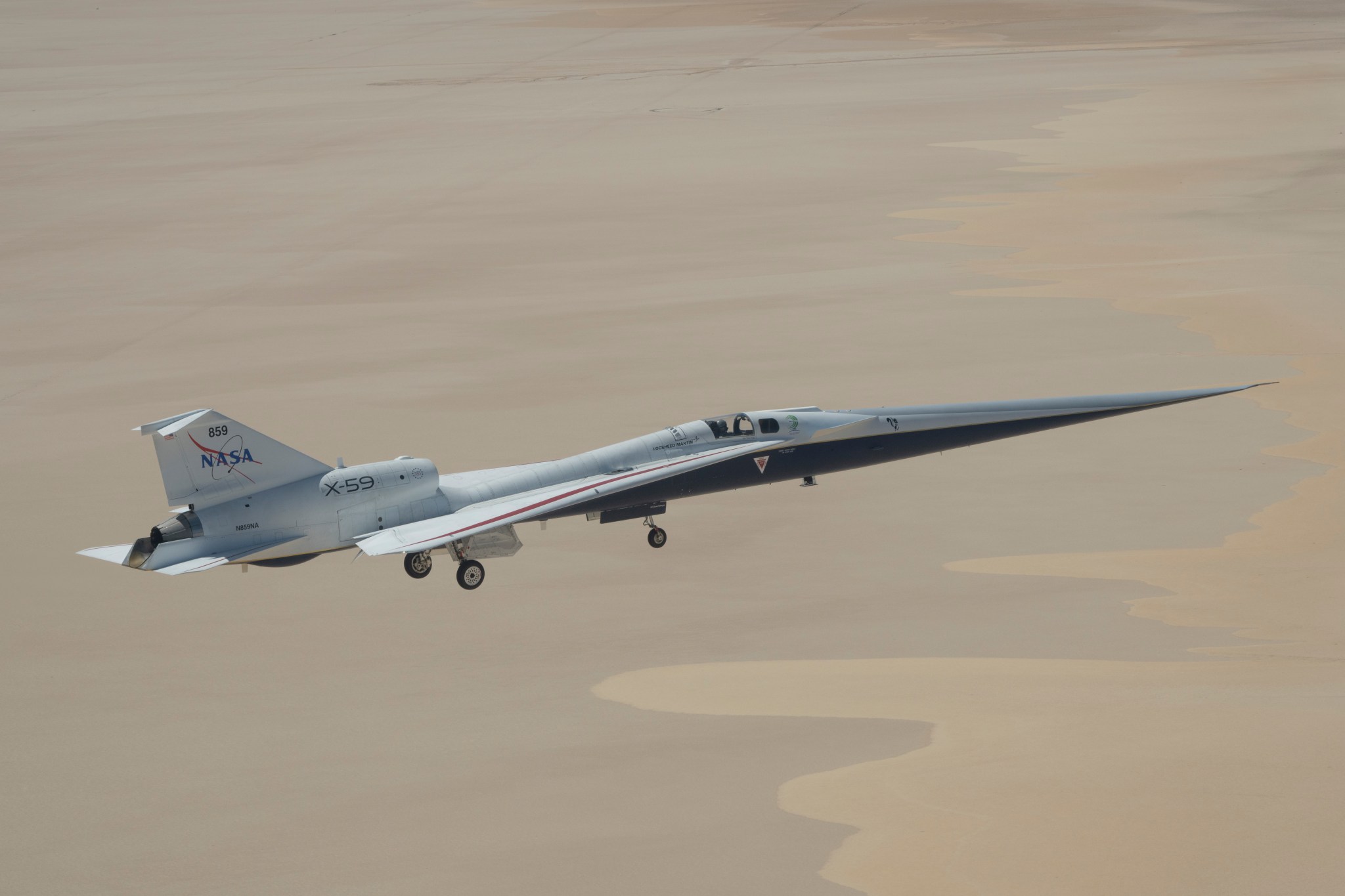
X-59's Quiet Push: How NASA's Hardware Milestone Exposes Gaps in Supersonic Regulation and Public Data
NASA's X-59 reaches its first supersonic milestone this June, but the program still lacks robust public-acceptance data and faces integration hurdles that prior coverage has minimized.
While NASA's official update centers on the X-59's envelope expansion toward Mach 1.4 at 55,000 feet, the coverage underplays the aircraft's role as a regulatory testbed that could finally overturn the 1973 FAA ban on civil supersonic overland flight. The first supersonic tests scheduled for early June rely on a chase plane with shock-sensing probes, meaning any acoustic data will be contaminated by conventional booms—an explicit limitation the agency acknowledges but does not quantify for future community surveys. Drawing on FAA sonic-boom studies from 2018 and historical Concorde operations data, the X-59's design targets a ground-level pressure signature below 75 PLdB, yet the current test block prioritizes structural and systems validation over public perception metrics. This sequencing risks repeating the 2000s-era mistake of advancing airframes before social-acceptance datasets exist at scale. Two overlooked factors stand out: integration with existing ATC routing at 43,000-plus feet and supply-chain lessons from the delayed F-35 external vision system, which shares camera architecture with the X-59's forward display. If community overflight campaigns beginning in 2027 replicate the small-sample methodology of prior NASA noise studies (n<500 participants), the resulting regulatory petition could face the same evidentiary challenges that stalled earlier supersonic proposals.
HELIX: Regulatory approval for quiet supersonic overland flight will depend on 2027 community surveys whose sample sizes remain unspecified, creating a potential bottleneck for commercial adoption.
Sources (3)
- [1]Primary Source(https://www.nasa.gov/centers-and-facilities/armstrong/nasas-x-59-prepares-for-first-supersonic-flight/)
- [2]Related Source(https://www.faa.gov/about/office_org/headquarters_offices/apl/noise_emissions/supersonic_aircraft)
- [3]Related Source(https://www.nasa.gov/mission_pages/Quesst)