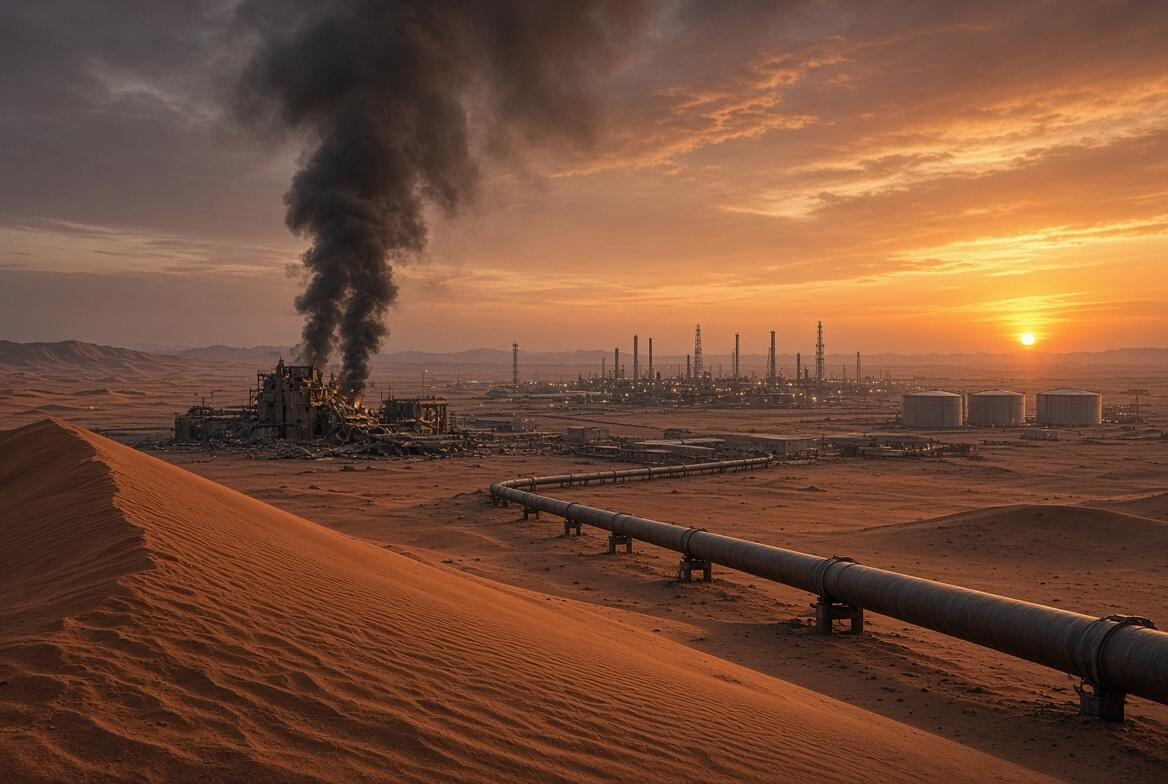
Saudi East-West Pipeline Attacks Extend Gulf Energy Reconstruction to 2033-2036 at $550B-$2.28T Cost
Repeated attacks on Saudi pipeline infrastructure have lengthened reconstruction timelines to 2033-2036 and raised costs to between $550 billion and $2.28 trillion. Saudi export reliability declines as equipment procurement and security constraints compound. Regional actors gain asymmetric pressure on Gulf energy flows without direct confrontation.
Saudi Arabia maintained oil exports via the East-West pipeline to Yanbu after Hormuz disruptions, but September drone attacks on pumping stations and the October Khurais incident halted flows multiple times. Karl Miller's analysis models throughput losses at 40.6 million barrels after seven days and 174 million after thirty, treating the system as interdependent stations rather than isolated pipes. Equipment lead times of 84 months for compressors and transformers set the critical path. Saudi interests center on preserving export revenue and market share against Houthi maritime claims at the Red Sea entrance. The attacks impose direct costs in lost throughput while raising reconstruction expenses through security requirements and repeated disruptions. Iran-backed groups gain leverage by targeting bypass infrastructure without engaging Saudi air defenses directly. Primary records include Saudi statements attributing strikes to Iraqi militias and Houthi declarations of a maritime ban on Saudi shipping. Miller's funding envelopes document three scenarios where base capital of $400-1,400 billion rises with execution uplifts of $100-630 billion. Partial capacity returns earlier, but full stabilization requires sequential procurement unavailable from inventory. Riyadh now faces incentives to diversify export routes and accelerate domestic security hardening. Washington assessments that treat Saudi output as a reliable buffer must adjust for the extended timeline and financing gaps that extend beyond 2030.
Miller: Saudi crude exports via Yanbu fall below 4 million barrels per day for at least 90 consecutive days by Q2 2027.
Sources (3)
- [1]Saudi Aramco Operational Reports(https://www.aramco.com/en/investors/reports-and-presentations)
- [2]IEA Oil Market Report October 2026(https://www.iea.org/reports/oil-market-report-october-2026)
- [3]Karl W. Miller Saudi Arabia: The Breaking Point(https://sonar21.com/saudi-arabia-the-breaking-point-12-october-2026)