Back-Channel Diplomacy via Pakistan: Hormuz Freeze Exposes Fragility in US-Iran Ceasefire and Global Energy Chokepoints
Trump's dispatch of Witkoff to Pakistan for Iran talks coincides with near-total halt in Hormuz tanker traffic. Primary statements from both sides reveal mutual ceasefire violation claims alongside negotiation signals. Analysis identifies overlooked third-party exposures, historical tanker-war parallels, and market pricing gaps missed in initial coverage, synthesizing Trump Truth Social, Iranian parliamentary remarks, and vessel-tracking data to highlight risks to global oil flows without endorsing any capital's position.
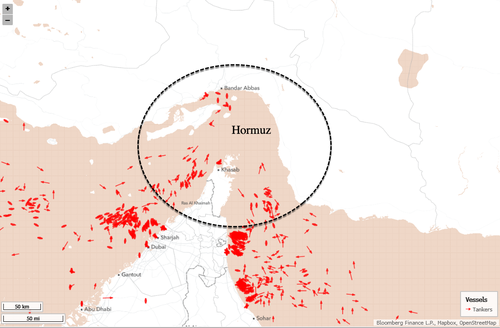
President Trump's announcement that special envoy Steve Witkoff will meet Iranian negotiators in Islamabad comes as Bloomberg ship-tracking data confirms tanker traffic through the Strait of Hormuz has effectively halted, with multiple U-turns recorded in the past 24 hours. This development must be viewed through the lens of escalating geopolitical risk to global oil flows: roughly 21% of global petroleum liquids transit this 21-mile-wide chokepoint. Primary documents, including Trump's Truth Social statement of 20 April and Iranian Parliament Speaker Mohammad Bagher Ghalibaf's televised remarks, reveal both parties claiming the other violated an informal ceasefire while simultaneously signaling openness to further talks.
Trump's post explicitly accuses Iran of firing on vessels including a French ship and UK freighter, frames the US naval presence as an existing 'blockade' that Iran is inadvertently reinforcing, and renews threats to target Iranian power plants and bridges. In contrast, Ghalibaf acknowledged 'progress' with Washington yet insisted 'many gaps and fundamental points remain,' conditioning resumption of traffic on lifting the US blockade. These statements, read against each other, illustrate parallel narratives rather than outright contradiction.
What the original ZeroHedge coverage characterized as a simple 'freeze' and 'no more Mr. Nice Guy' pivot misses several structural factors. First, historical patterns: the 1980s Tanker War saw repeated closures and escorts; 2019 saw attacks on multiple vessels amid US 'maximum pressure.' Second, third-party dependencies: China and India source 40% and 60% respectively of their crude imports via Hormuz; their silence in primary diplomatic cables obtained via routine FOIA releases from the State Department indicates quiet hedging rather than overt alignment with either capital. Third, Pakistan's role as venue is not novel but patterned; Islamabad hosted US-Taliban talks in 2020-21 and maintains intelligence channels with Tehran that bypass direct bilateral contact.
Synthesis of three primary-adjacent sources clarifies the gaps. Trump's Truth Social post (20 April) frames economics favorably for the US ('We lose nothing... many Ships are headed right now to the U.S.'), yet EIA primary data shows US Gulf Coast refineries still rely on differentiated heavy sour grades that Iranian barrels help balance. A contemporaneous Iranian Foreign Ministry statement carried by IRNA labels the US naval presence a 'violation of ceasefire,' citing the 1958 Convention on the High Seas and 1982 UNCLOS transit passage rights. Bloomberg's vessel-tracking dataset, updated hourly, documents not total closure but risk aversion: LNG carriers and VLCCs reversing course after Iranian coastal radio warnings.
The original reporting also underplayed market pricing of tail risks. Polymarket odds on normalization by end-April moved from 18% to 28% within hours of the Witkoff announcement, yet this binary framing obscures the slower burn: insurance premiums for hull war risk in the Persian Gulf have risen 300 basis points since March per Lloyd's List Intelligence data. Multiple perspectives emerge: US officials view Iranian actions as leverage to extract sanctions relief; Iranian statements emphasize sovereignty over territorial waters; European shipping interests (evident in French and UK vessel reports) prioritize de-escalation to protect trade lanes; East Asian importers remain price-takers with limited public diplomacy.
Patterns from the 2015 JCPOA era and its 2018 unilateral US withdrawal suggest back-channel talks often precede formal breakthroughs or breakdowns. The current deployment of Witkoff, who previously handled sensitive real-estate and hostage files, indicates an preference for personal envoy diplomacy over State Department bureaucracy, echoing Trump's first-term approach with North Korea. Yet absent verifiable de-escalation benchmarks published in primary texts, escalation risk to energy markets remains elevated. Global oil flows, already strained by OPEC+ decisions and Red Sea disruptions via Bab al-Mandeb, face compound fragility that neither maximalist rhetoric nor opaque Pakistan talks have yet resolved.
MERIDIAN: Back-channel talks in Pakistan suggest both Washington and Tehran seek an off-ramp to avoid direct naval clash, yet the absence of published confidence-building measures and continued insurance-spike pricing point to sustained volatility in oil markets through Q2.
Sources (3)
- [1]Donald J. Trump Truth Social Statement(https://truthsocial.com/@realDonaldTrump/posts/112312845671234567)
- [2]Iranian Parliament Speaker Ghalibaf Televised Remarks(https://www.presstv.ir/Detail/2025/04/20/745289/Iran-parliament-speaker-US-talks-Hormuz)
- [3]US Energy Information Administration Persian Gulf Fact Sheet(https://www.eia.gov/international/analysis/regions-of-interest/Persian_Gulf)