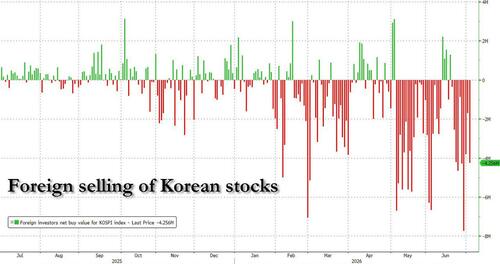
South Korea's Won Weakens Sharply Amid Heavy Foreign Equity Outflows and Market Concentration Risks
June 2026 saw the Korean won plunge to multi-year lows with heavy foreign stock selling and liquidity strains in securities firms, driven by index concentration in Samsung/SK Hynix and rebalancing/hedging flows; corroborated by mainstream reports, signaling potential vulnerabilities without confirmed wider Asian contagion.
South Korea's currency, the won, has come under significant pressure in June 2026, trading near 17-year lows around 1,550-1,560 KRW per USD amid accelerated foreign investor selling of local equities and broader market volatility. This follows a period of rapid gains in the KOSPI driven by semiconductor giants Samsung Electronics and SK Hynix, which together dominate indices like MSCI Korea. Foreign outflows reached tens of billions of dollars in recent months, with Goldman Sachs estimating around $62 billion as of late May, exacerbated by rebalancing needs due to single-stock concentration limits exceeding typical thresholds (e.g., Samsung and Hynix weights pushing rebalancing flows).[1][2]
Liquidity conditions have tightened onshore, with reports of increased borrowing by securities firms to fund retail margin trading, leveraged single-stock ETFs, and futures hedging. Commercial paper and short-term bond issuance by these firms has surged, exceeding KRW 100 trillion monthly in recent periods. Collateral value declines from the won's depreciation and KTB bond selloffs have further strained margins, echoing dynamics seen in late 2022. The Bank of Korea and Ministry of Economy and Finance held emergency meetings on June 7 to address volatility, pledging interventions against excessive moves while monitoring for speculative activity.[3]
MSCI's decision to retain South Korea in the emerging markets category, citing FX accessibility and onshore liquidity concerns, adds context, as does the rollout of 24-hour won trading trials amid vulnerabilities.[4] While chip export strength provides some fundamental support, the concentration risk and hedging flows (including NDF markets) highlight fragility. Government vows to curb volatility coincide with US rate concerns rippling across Asian markets, though Korea-specific outflows and leverage dynamics stand out. No widespread evidence yet links this directly to broader regional stress, but the episode underscores how rapid equity rallies in concentrated markets can transmit shocks via FX and funding channels.
[Financial Analyst]: Korea's concentrated rally unwind could foreshadow similar liquidity-FX feedback loops in other export-heavy Asian economies if global rate or tech demand shifts intensify.
Sources (6)
- [1]South Korea's stock boom sparked a currency crisis(https://www.axios.com/2026/06/05/korea-stocks-currency-ai)
- [2]Korea's stocks and currency take hit as foreigners sell for 20 days straight(https://www.youtube.com/watch?v=Gdq7kDdc6us)
- [3]Kospi, SK Hynix, Samsung Electronics: Why foreign investors are selling(https://www.cnbc.com/2026/06/08/kospi-sk-hynix-samsung-electronics-why-foreign-investors-are-selling.html)
- [4]South Korean won nears global financial crisis levels(https://www.upi.com/Top_News/World-News/2026/06/07/won-us-dollar-exchange-rate-foreign-investors/1551780873678/)
- [5]Emergency Market Situation Review Meeting (Jun.7, 2026)(https://english.moef.go.kr/pc/selectTbPressCenterDtl.do?boardCd=N0001&seq=6423)
- [6]Always-on won: Korean dealers fret about risks in landmark shift to 24-hour trading(https://www.reuters.com/world/asia-pacific/always-on-won-dealers-fret-about-risks-landmark-shift-24-hour-trading-2026-06-26/)