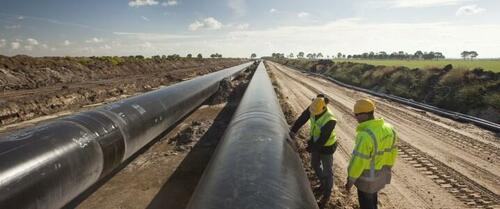
Hormuz Escalation Exposes Europe's Fragile Energy Lifeline: Low Gas Storage Signals Imminent Winter Collapse
Equinor warns that with EU gas storage at ~35%—far below norms—prolonged Strait of Hormuz disruptions from Middle East conflict could prevent adequate winter reserves, risking €90/MWh prices, industrial collapse, and exposing Europe's post-Russian gas LNG dependency as a critical fragility.
Europe stands on the brink of a severe energy crisis as critically low natural gas storage levels collide with ongoing disruptions in the Strait of Hormuz, according to warnings from Norwegian energy major Equinor. As of late May 2026, EU gas inventories hover just above 35% capacity—well below the seasonal norm of around 50%—following a harsh winter that left major hubs in the Netherlands, Germany, and France severely depleted. Reuters reports that Equinor executives have stated a prolonged 1-3 month closure of the strategic chokepoint could prevent storage from reaching even a tight 75% by winter, potentially driving Dutch TTF benchmark prices toward €90/MWh and triggering industrial demand destruction.[1][1]
This situation reveals a deeper structural fragility missed by much mainstream incremental coverage. After pivoting away from Russian pipeline gas in 2022, Europe bet heavily on LNG imports to bridge the gap. Yet the 2026 Middle East conflict—triggering attacks on Qatari facilities and effective closure of the Strait through which roughly 20% of global LNG transits—has exposed how this 'diversification' simply traded one geopolitical vulnerability for another. Oxford Energy's March 2026 modelling warns that reduced LNG inflows could leave November 2026 storage levels 11-16 bcm below the prior year, with global market tightening forcing Europe into bidding wars against Asia.[2]
Inverted seasonal price curves have compounded the problem: summer spot prices exceeding winter futures have discouraged the traditional summer injection cycle. Distorted markets, combined with competing Asian demand, have made replenishment extraordinarily expensive. Bruegel analysis highlights that while Qatar supplies only about 8% of EU LNG directly, the global ripple effects from Hormuz have tightened the entire market, undermining decarbonization goals as nations may be forced to reactivate coal plants or even reconsider Russian LNG despite phase-out pledges.[3]
The EU Commission convened emergency Gas and Oil Coordination Group meetings in March 2026, noting stable but vulnerable stocks and signaling that prolonged Hormuz closure would prompt full reassessment of supply security. IEEFA had previously flagged that Hormuz risks could jeopardize up to 10% of Europe's LNG imports from Qatar and UAE, a warning now materializing. Unlike the 2022 shock, this crisis arrives with storage already near historic lows for the season, leaving scant buffer.[4][5]
The missed connection lies in Europe's 'decarbonization fragility': aggressive net-zero policies reduced domestic production and long-term contracts, leaving the continent exposed to spot-market volatility. Equinor's alert underscores that without rapid resolution in the Persian Gulf, Europe faces not just higher prices but potential fuel switching, factory closures, and household energy rationing—exposing how incremental policy tweaks have papered over fundamental supply chain weaknesses. This could accelerate political backlash against green mandates and reshape global energy alliances as winter approaches.
LIMINAL: Europe's depleted gas storage combined with Hormuz disruptions forecasts a winter of forced industrial shutdowns, sky-high energy prices, and policy reversals that will expose the brittle foundations of its post-2022 LNG-dependent energy strategy.
Sources (5)
- [1]Europe gas stocks could turn critical if Hormuz shut for 1–3 months, Equinor says(https://www.reuters.com/business/energy/europe-gas-stocks-could-turn-critical-if-hormuz-shut-13-months-equinor-says-2026-05-21/)
- [2]Modelling the Impact of the Strait of Hormuz Closure on European Gas Markets(https://www.oxfordenergy.org/wpcms/wp-content/uploads/2026/03/Comment-Modelling-the-Impact-of-the-Strait-of-Hormuz-Closure.pdf)
- [3]How Europe should respond to the Iran gas shock(https://www.bruegel.org/analysis/how-europe-should-respond-iran-gas-shock-and-how-it-shouldnt)
- [4]Commission and EU countries coordinate and assess the situation on oil and gas markets(https://energy.ec.europa.eu/news/commission-and-eu-countries-coordinate-and-assess-situation-oil-and-gas-markets-2026-03-13_en)
- [5]Strait of Hormuz disruption would jeopardise 10% of Europe’s LNG imports(https://ieefa.org/resources/strait-hormuz-disruption-would-jeopardise-10-europes-lng-imports)