Native European Emigration: Unpacking the Data on Brain Drain Amid Broader Demographic Shifts
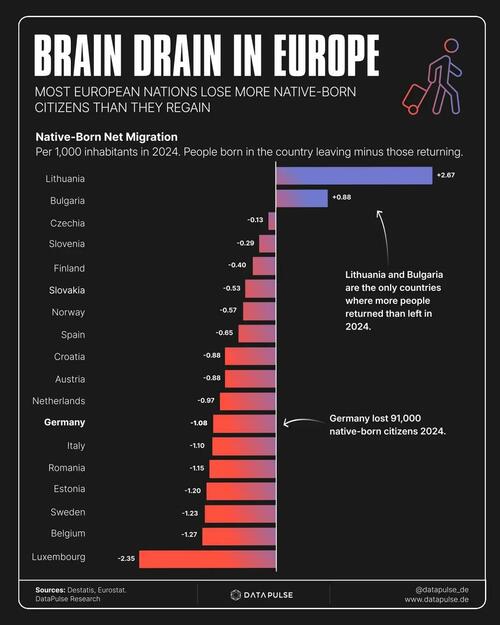
Eurostat-backed data shows native-born net emigration from key EU economies in 2024, revealing talent mobility patterns that parallel but are distinct from headline immigration narratives, amid persistent low fertility and aging challenges.
A recent analysis drawing on Eurostat data highlights net outflows of native-born residents from several major European economies in 2024, including Germany, Italy, Sweden, and others, while only Lithuania and Bulgaria recorded modest gains among those tracked. This pattern, visualized by DataPulse and presented via Visual Capitalist, underscores intra-European labor mobility alongside outward moves driven by wages, career prospects, and housing costs. Eurostat's own migration statistics for 2024 confirm substantial overall emigration flows from EU countries (around 3.2 million total emigrants), with notable shares involving nationals or native-born individuals in certain member states. These trends intersect with documented demographic headwinds: fertility rates persistently below replacement across the continent, aging populations, and an increasing reliance on foreign-born inflows to sustain workforce levels, as noted in analyses from BBVA Research and the IOM. While net migration for the EU as a whole remains positive due to non-EU immigration, the selective departure of skilled natives raises questions about innovation capacity and regional economic vitality in origin countries. Connections often overlooked include how high housing costs in Western hubs accelerate mobility for younger professionals, compounding Eastern and Southern Europe's long-standing talent outflows, even as some return migration occurs in places like Romania and Latvia per Eurostat breakdowns of immigrant citizenship.
[Demographer]: Native outflows could accelerate skill shortages in origin countries unless offset by retention policies or return incentives, potentially widening intra-EU economic divergences by 2030.
Sources (4)
- [1]Migration to and from the EU - Statistics Explained(https://ec.europa.eu/eurostat/statistics-explained/index.php?title=Migration_to_and_from_the_EU)
- [2]Europes Native-Born Brain Drain(https://www.visualcapitalist.com/cp/europes-native-born-brain-drain/)
- [3]Migration Trends in the EU(https://www.bbvaresearch.com/wp-content/uploads/2026/04/Migration_Trends_in_the_EU.pdf)
- [4]Europe | World Migration Report(https://worldmigrationreport.iom.int/what-we-do/world-migration-report-2024/chapter-3/europe)