Spain's VACIM Localization Exposes Europe's Defense Sovereignty Drive and NATO's Supply Chain Fractures
Spain's decision to localize the SUPERAV amphibious vehicle through Indra reveals Europe's accelerating push for defense industrial sovereignty, exposing transatlantic supply chain tensions, divergent operational priorities, and the limitations of traditional NATO burden-sharing narratives that mainstream coverage consistently underplays.
While Defense News accurately chronicles Indra's selection as lead systems integrator for Spain's 34-unit order of the Marine Infantry Amphibious Combat Vehicle (VACIM), the coverage remains confined to contract mechanics and corporate positioning. It misses the deeper geopolitical signal: this is a deliberate European move to localize technology originally developed for the U.S. Marine Corps, reflecting accelerating efforts to seize control of critical supply chains and reduce strategic dependence on American primes.
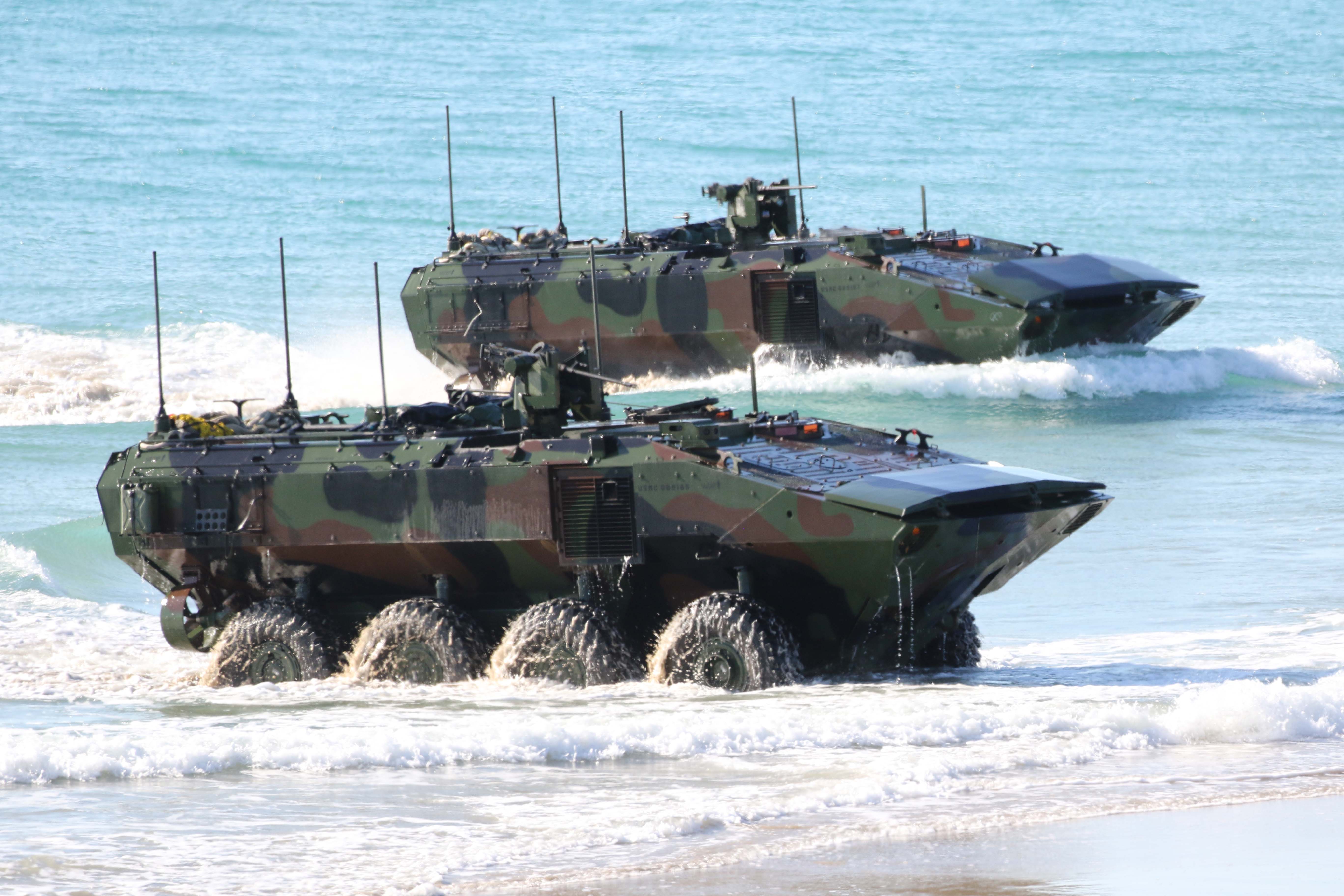
The vehicle in question, Italy's SUPERAV 8x8 developed by IDV (now under Leonardo following its €1.7 billion acquisition in 2025), was adapted from the BAE-IDV bid that won the U.S. Amphibious Combat Vehicle (ACV) program in 2018. Spain's decision to route integration through Indra—rather than direct procurement—follows Italy's own 2022 purchase of 36 units (with plans to reach 64). This creates a European customer cluster that modifies the baseline platform with sovereign mission systems, command-and-control suites, and locally sourced subsystems.
Mainstream reporting overlooks how this fits a clear post-2022 pattern. Russia's invasion of Ukraine exposed NATO's dangerous reliance on U.S. munitions, components, and political will. In response, the EU has poured resources into the European Defence Fund (EDF) and PESCO initiatives explicitly designed to incentivize intra-European collaboration and local production. Spain's VACIM variants (Troop Transport, Command and Control, Recovery, and Ambulance) are being tailored for Mediterranean and North African contingencies, contrasting sharply with the USMC's focus on high-intensity littoral operations in the Indo-Pacific.
What the original story gets wrong is framing this as simple industrial participation. It is industrial sovereignty by design. Indra was reportedly bidding to acquire IDV itself before Leonardo prevailed; the current integrator role represents a consolation prize that still secures Spanish intellectual property development and workforce retention. This mirrors broader transatlantic tensions seen in the FCAS-GCAP fighter dispute, Germany's push for European tank and artillery champions, and France's insistence on national control of strategic programs.
Synthesizing the Defense News report with Reuters coverage of Leonardo's IDV purchase (which consolidated Italian IP ownership) and the 2024 NATO Defence Production Action Plan—which explicitly warned of fragmented European supply chains and vulnerability to U.S. export controls—this deal reveals uncomfortable realities about burden-sharing. Washington has long criticized European under-spending; yet when Europe does spend, it increasingly does so in ways that build parallel industrial capacity rather than deepening interoperability with U.S. systems. The Italian choice of Leonardo's Hitrole 12.7mm turret over the U.S. Kongsberg 30mm remote weapon station already demonstrated doctrinal divergence. Spain is likely to extend this customization.
These moves carry risks. Localized variants may complicate maintenance, logistics, and NATO standardization. However, they also hedge against potential American retrenchment—whether driven by Pacific priorities, domestic political shifts toward isolationism, or future arms export restrictions. In an era of great-power competition, European states increasingly view sovereign defense industry not as protectionism but as strategic insurance.
The Indra-IDV agreement is therefore more than a procurement footnote. It is a case study in how NATO's European pillar is maturing beyond cash contributions into autonomous capability development. The transatlantic alliance remains essential for collective defense, yet the supply-chain realities and industrial policies now emerging suggest a future of selective interoperability rather than full-spectrum dependence. Mainstream defense journalism has largely treated this as business-as-usual competition. It is, in reality, a structural power shift with lasting implications for alliance cohesion and European strategic autonomy.
SENTINEL: Europe's localization of U.S.-origin amphibious technology via Spanish and Italian industry is a clear signal of strategic autonomy gaining momentum. This will intensify transatlantic friction over defense exports and interoperability even as NATO publicly celebrates increased European spending.
Sources (3)
- [1]Indra to make Spanish variant of amphibious vehicle used by US Marines(https://www.defensenews.com/global/europe/2026/04/17/indra-to-make-spanish-variant-of-amphibious-vehicle-used-by-us-marines/)
- [2]Leonardo completes purchase of Iveco Defence Vehicles(https://www.reuters.com/business/aerospace-defense/leonardo-buy-iveco-defence-vehicles-17-billion-euro-deal-2025-03-12/)
- [3]NATO Defence Production Action Plan(https://www.nato.int/cps/en/natohq/official_texts_228771.htm)