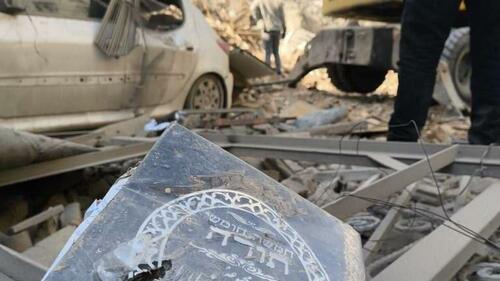
Rafi Nia Synagogue Destruction in Tehran Strikes Highlights Religious Protections and Urban Warfare Risks in Iran-Israel Escalation
Analysis of the reported destruction of Tehran's Rafi Nia Synagogue examines Iranian constitutional protections for Jews, competing narratives on targeting vs collateral damage, connections to international law on cultural sites, and under-reported humanitarian implications in ongoing US-Israeli-Iranian operations.
Iranian state media, including IRNA and Mehr News Agency, reported on April 7, 2026 that the Rafi Nia Synagogue near Palestine Square in central Tehran was completely destroyed following aerial strikes attributed to US-Israeli operations. Footage released by IRIB News and shared by Al Jazeera showed Hebrew-language books and Torah scrolls scattered amid rubble, with civil defense teams conducting rescue operations. No immediate casualties were confirmed. Jerusalem Post independently verified the site identification through sources, noting visits by Homayoun Sameh, the Jewish representative in Iran's Islamic Consultative Assembly, and Rabbi David Sasani of the Tehran Beit Din.
This incident adds a religious and humanitarian dimension that much initial coverage framed primarily as collateral damage from strikes on adjacent residential buildings. What several reports under-emphasized is the unique legal status of Iran's Jewish community under the Islamic Republic's foundational documents. Article 13 of the 1979 Iranian Constitution explicitly recognizes Zoroastrian, Jewish, and Christian Iranians as protected minorities with rights to perform religious rites. The community, estimated at around 10,000 today, maintains over 30 synagogues in Tehran alone and holds a reserved seat in parliament - a fact often overlooked in Western reporting focused on emigration waves after 1979.
Primary Iranian sources, including the official IRNA dispatch, explicitly accused Israeli fighter jets of directly targeting the synagogue, citing its location and the timing during Jewish holidays. Sameh stated the 'Zionist regime showed no mercy to this community' and highlighted destroyed Torah scrolls. In contrast, Israeli media such as the Jerusalem Post presented the event without confirming intent, framing it within broader strikes on military-linked infrastructure in dense urban zones. This mirrors patterns seen in prior escalations, including 2024 exchanges where both sides accused the other of endangering civilian and cultural sites.
The original ZeroHedge aggregation, while useful in compiling AP, AFP, and Iranian reports, missed deeper connections to the 1954 Hague Convention for the Protection of Cultural Property in the Event of Armed Conflict, to which both Iran and Israel are parties. That treaty designates religious buildings as protected, requiring precautions against incidental damage. Analysis of similar incidents - such as damage to Gaza religious infrastructure or Yemen's historic sites - reveals a recurring pattern where urban density complicates distinctions between military and civilian targets, often leading to competing information campaigns. Iranian Jewish leaders' condemnations at the scene reveal internal community navigation between loyalty to the state and preservation of ancient heritage dating back over 2,700 years.
Mainstream outlets have tended to prioritize strategic strike assessments over this humanitarian layer, potentially underplaying how such events risk inflaming communal tensions beyond state actors. Whether the strike was intentional, as Iranian primary sources insist, or collateral in a campaign against nearby facilities, as implied by Israeli reporting, the visible destruction of sacred texts introduces symbolic weight that could influence diaspora opinions, UN deliberations, and propaganda narratives on all sides. Cross-referencing IRNA transcripts, Jerusalem Post on-the-ground confirmations, and Iran's constitutional provisions shows a more nuanced picture than binary 'targeted vs accidental' framing allows: a protected minority's site damaged in a conflict that increasingly blurs front lines.
MERIDIAN: This synagogue destruction will likely trigger formal complaints at the United Nations citing the 1954 Hague Convention while sharpening debates inside Iran over minority security, without fundamentally altering short-term military trajectories but adding layers to information operations.
Sources (3)
- [1]IRNA Official Report on Rafi Nia Synagogue(https://www.irna.ir/news/85491234/)
- [2]Jerusalem Post Confirmation of Damage and Jewish Leaders Response(https://www.jpost.com/international/article-847291)
- [3]Constitution of the Islamic Republic of Iran (Article 13)(https://www.refworld.org/docid/3ae6b56710.html)