First US New World Screwworm Detection in Decades Confirmed in Texas Calf, Exposing Cattle Herd Vulnerabilities
USDA confirmed New World screwworm in one Texas calf in June 2026—the first U.S. case in decades. Swift containment using quarantines, surveillance, and sterile fly releases is underway with no further detections reported. The finding threatens an already historically low cattle herd, with risks of major economic losses, higher beef prices, and exposure of vulnerabilities in U.S.-Mexico livestock trade.
The U.S. Department of Agriculture (USDA) has confirmed the presence of New World screwworm (NWS) in a three-week-old calf in Zavala County, Texas—the first such detection in the United States in decades. Larvae were found in the animal's umbilical area, prompting immediate activation of containment protocols including a 20 km infested zone with quarantines, livestock movement controls, enhanced surveillance, increased fly trapping, and accelerated releases of sterile NWS flies both on the ground and via ongoing aerial dispersal of millions per week. To date, no additional cases have been identified.[1][1]
This confirmation arrives amid a multi-year northward creep of the parasite through Mexico, with prior detections prompting border surveillance expansions, import suspensions on live cattle from affected regions, and the 2025 opening of a sterile fly production facility in South Texas. USDA officials, including Under Secretary Dudley Hoskins, have framed the response as a national security priority, noting that preparatory investments and cross-border efforts bought critical time. Texas Animal Health Commission partners are coordinating on the ground, designating an official infested zone spanning Zavala and parts of Uvalde counties.[2][3]
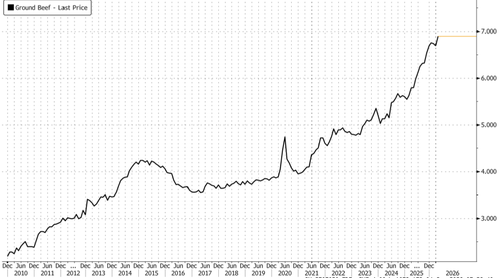
The New World screwworm, whose larvae consume living flesh of warm-blooded animals, was eradicated from the U.S. in the 1960s through the sterile insect technique—the same method now being rapidly scaled. While the current incident appears isolated with no evidence of establishment, an outbreak could prove catastrophic for an already strained cattle sector. The national herd sits near 75-year lows due to years of drought, high feed costs, and delayed rebuilding. Texas livestock alone could face estimated economic losses approaching $1.8 billion in a widespread scenario, according to industry analyses referenced across reporting. Reuters highlights the direct threat to the cattle supply, with potential ripple effects including further delays in herd recovery, tighter supplies for meatpackers, and upward pressure on record-high beef prices.[4][5]
Deeper connections emerge when viewing this through agricultural vulnerability lenses. The U.S. imports roughly 60% of its live cattle from Mexico, creating a biosecurity vector that critics argue exposes domestic production to southern hemisphere risks. This event underscores systemic fragilities: concentrated livestock operations, climate-enabled range expansion of pests, and reliance on just-in-time supply chains. Beyond cattle, NWS threatens wildlife, pets, and—in rare instances—humans via open wounds, though USDA emphasizes the food supply remains safe as the parasite does not infest processed meat. Broader food-price ripples could exacerbate inflationary pressures in an environment of already elevated commodity costs, while bullish for live cattle futures and supportive of animal health companies.
Officials from USDA and Texas are urging immediate reporting of suspicious wounds or maggots in livestock. The rapid deployment of the National Veterinary Stockpile and regionalized trade negotiation strategies aim to contain both biological and economic fallout. Historical success against NWS suggests containment is achievable, yet this detection serves as a stark reminder of how single-point biosecurity failures can amplify existing stresses across the agricultural economy.
LIMINAL: This breach in long-standing biosecurity defenses, layered atop historic cattle herd lows and heavy reliance on Mexican imports, is poised to amplify commodity shocks, sustain elevated food prices, and force reevaluation of continental livestock trade resilience.
Sources (4)
- [1]USDA APHIS: USDA Confirms Presence of New World Screwworm in the United States(https://www.aphis.usda.gov/news/agency-announcements/usda-confirms-presence-new-world-screwworm-united-states)
- [2]Reuters: Flesh-eating parasite New World screwworm confirmed in Texas, USDA says(https://www.reuters.com/business/environment/flesh-eating-parasite-new-world-screwworm-confirmed-texas-usda-says-2026-06-04/)
- [3]Texas Animal Health Commission: New World Screwworms(https://www.tahc.texas.gov/emergency/nws.html)
- [4]CNN: Flesh-eating New World screwworm detected in Texas calf(https://www.cnn.com/2026/06/03/health/new-world-screwworm-case-texas)