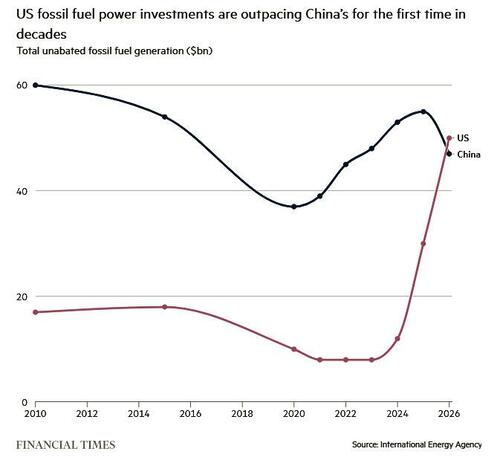
US Fossil Fuel Power Investment Surges to $50B, Outpacing China Amid AI-Driven Electricity Demand
Corroborated IEA data shows US coal/gas power capex hitting $50B in 2026, exceeding China's, fueled by data center/AI demand and turbine shortages; reveals tensions between green transition goals and real-world electricity needs.
The International Energy Agency has forecast that U.S. spending on coal and natural gas power generation will reach approximately $50 billion in 2026, marking the first time in decades that American investment in these fuels exceeds China's by about $3 billion. This development, reported by the Financial Times and corroborated across outlets including Reuters and specialized energy platforms, stems primarily from explosive demand for electricity driven by data centers and AI infrastructure.[1][2]
In the first quarter of 2026 alone, U.S. companies placed orders for around 20 GW of gas turbine capacity, with prices for turbines rising sharply from roughly $800/kW to over $2,500/kW due to supply constraints. Major manufacturers like GE Vernova reported signing 21 GW of new gas turbine agreements in Q1, with data center customers accounting for a significant and growing share—orders from this segment reached $2.4 billion in the quarter, exceeding all of 2025. Siemens Energy and Mitsubishi have similarly noted record backlogs, with substantial U.S. portions.[3]
Beyond direct data center offtake, the expansion of intermittent renewables has increased the need for reliable baseload and flexible gas-fired generation to maintain grid stability. Broader context from the IEA's World Energy Investment 2026 report and analyses by Global Energy Monitor highlight the U.S. now leading globally in gas-fired power capacity under development (nearly 252 GW), with Texas alone accounting for over 80 GW, much of it tied to hyperscale computing loads. This surge underscores how AI's power hunger—projected to drive unprecedented demand growth after two decades of flat U.S. electricity consumption—is reshaping investment priorities.[4]
The trend challenges optimistic timelines for rapid decarbonization, as practical grid realities and surging loads from tech infrastructure prioritize dispatchable fossil resources in the near term, even as longer-term shifts toward nuclear, renewables, and storage continue.
IEA/FT: Persistent gas turbine demand from AI will extend fossil investment cycles into the 2030s, delaying net-zero milestones unless nuclear and storage scale dramatically faster than current trajectories.
Sources (4)
- [1]America Bets $50 Billion on Coal and Gas Power as Electricity Demand Soars(https://oilprice.com/Latest-Energy-News/World-News/America-Bets-50-Billion-on-Coal-and-Gas-Power-as-Electricity-Demand-Soars.html)
- [2]IEA forecasts US fossil fuel power spending to beat China for the first time in decades, FT reports(https://www.reuters.com/business/energy/iea-forecasts-us-fossil-fuel-power-spending-beat-china-first-time-decades-ft-2026-07-01/)
- [3]Data centers drive record surge in GE Vernova power equipment orders(https://www.power-eng.com/gas/turbines/data-centers-drive-record-surge-in-ge-vernova-power-equipment-orders-as-turbine-slots-tighten-through-2030/)
- [4]Betting big on data centers, U.S. now leads world for new gas power development(https://globalenergymonitor.org/research/betting-big-data-centers-us-now-leads-world-new-gas-power-development)