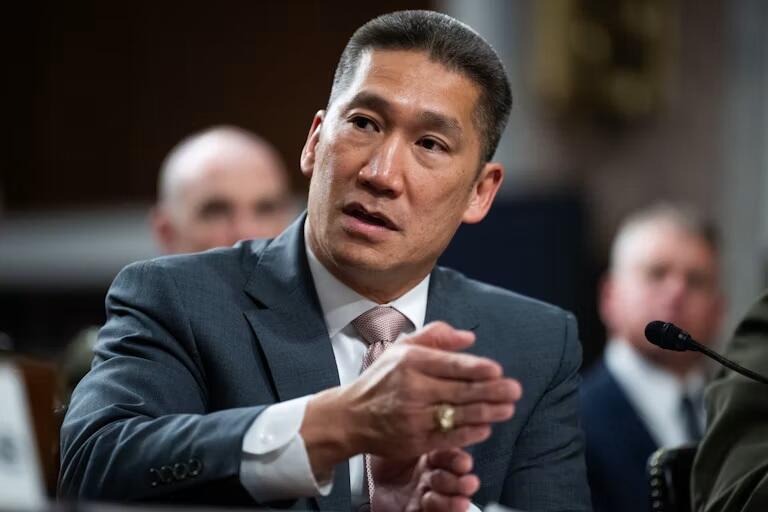
Navy chief tells families destroyer tours may run 11 months as Iran operations stretch the fleet
Acting Navy Secretary Hung Cao has told families and Congress that destroyer deployments tied to the Iran blockade are running toward 11 months because the fleet has 286 ships against a 355-ship requirement. USS Spruance just completed a 12-month, post-World War II record deployment; Lincoln’s lasted 321 days. Senators and spouses have raised food shortages and suicide attempts; Cao has disputed how those hardships are framed while confirming the operational strain.
Documented: Acting Navy Secretary Hung Cao has told sailors’ families and, separately, the Senate Armed Services Committee that the Navy is holding ships at sea far longer than the usual six-to-seven-month cycle because the battle force is too small for current demand. At a Nov. 9 town hall in Mayport, Florida, with families of the destroyers USS Mason, USS Donald Cook, and USS Delbert D. Black, Cao said they should prepare for deployments of at least 11 months and that 17 destroyers are required to enforce the blockade of Iranian ports and intercept strikes in the Strait of Hormuz, according to audio reviewed by MS NOW. He tied the length of those tours to a fleet of 286 ships against a stated requirement of 355, the same explanation he gave senators on Nov. 17. He also said the service is trying to accelerate unmanned surface vessels so they can take some of that blockade load off manned destroyers, and that each extra month at sea adds about a week of maintenance before a ship can redeploy.
Documented numbers already on the books show what “nearly a year” looks like in practice. The Navy’s own account says the destroyer USS Spruance returned to San Diego on Nov. 13, 2026, after a 12-month deployment that began Nov. 21, 2025, with the Abraham Lincoln carrier strike group. Stars and Stripes reported the sail at 357 days, longer than USS McFaul’s 333-day deployment that ended in October, and described it as the longest U.S. Navy ship deployment since World War II. Official releases credit Spruance with launching dozens of Tomahawks between February and August during Operation Epic Fury, destroying 12 drones and four anti-ship cruise missiles, and enforcing blockade operations, including disabling the cargo vessel M/V Touska. USS Abraham Lincoln’s own deployment lasted 321 days, 286 of them without a port call, a figure cited by senators and Navy Times during Cao’s confirmation hearing. Families of the USS George H.W. Bush carrier strike group, which left Norfolk in late March for an expected six-to-seven-month cruise, were told at a Nov. 9 Norfolk town hall to plan for a possible year-long deployment and that the crew would not be home for the holidays, reporting that MS NOW, The National Interest, and other outlets traced to that meeting.
Documented, and contested inside the same hearing: the human ledger of those extensions. Sen. Mark Kelly raised family reports that sailors on USS George Washington and USS Boxer had lost large amounts of weight, including one claim of more than 45 pounds, and that some were relying on care packages for adequate food. Cao’s response, as reported by Navy Times, treated some of those cases as pickiness—likened, in the Mayport audio described by MS NOW, to children saying the refrigerator is empty. Senators also pressed him on mental health. Cao has acknowledged eight suicide attempts in the Lincoln strike group during the deployment; he has described them as “mitigations” because chaplains and counselors intervened and no one died. At the Norfolk town hall, spouses described sailors who sought help and were told there was no time, including one account of four suicidal episodes aboard the Bush. Cao has publicly rejected coverage that casts crews as victims, calling some of it dishonest in an August Navy statement that emphasized sorties, ordnance, and retention. Sen. Richard Blumenthal told him at the hearing that the handling of families left the impression he did not care. That exchange is on the record; whether the food and suicide accounts are fully representative of the fleet is not established by a single hearing.
Claimed, not independently audited here: that three international vessels were sunk because U.S. ships were doing the blockade job, and that without that presence domestic prices would spike. Those lines appear in accounts of Cao’s remarks to families. What is on firmer ground is the operational picture the Navy itself has published—blockade enforcement, Hormuz escorts, and combat under persistent drone and missile threat—and Cao’s own statement to senators that the war against Iran, which he dated to a U.S. and Israeli campaign begun in February, is straining the force.
The structural point is less dramatic than any single town-hall quote and harder to dismiss. A 286-ship Navy cannot rotate 17 destroyers through a high-threat blockade on a six-month clock without either dropping presence or extending people. Extensions defer maintenance, which is how a deployment record becomes a shipyard problem months later. Destroyers, with crews of a few hundred and thinner medical and morale infrastructure than a carrier, absorb the same political mission with less margin. Families are the part of the system that cannot be unmanned: births missed, holidays canceled, and return dates moved after the spouses have already rearranged childcare. Cao has said the Navy is working to shorten tours. Documented so far is the opposite pattern—Lincoln at 321 days, Spruance at a year, Bush families told to plan for twelve months—while the requirement he cites, 355 ships, remains a goal rather than a fleet.
Sailors on destroyers and carriers, and the families waiting on them, are absorbing deployments that the Navy’s own leaders say the current fleet cannot sustain on a normal rotation. Longer tours defer ship maintenance and have already produced documented disputes in Congress over food, mental health, and when crews come home.
Sources (6)
- [1]Cao defends Navy record as he seeks permanent secretary post(https://www.stripes.com/branches/navy/2026-11-17/hung-cao-senate-hearing-navy-secretary-23496357.html)
- [2]Cao addresses Navy suicide prevention, extended deployments and USS South Dakota firings during hearing(https://www.navytimes.com/news/your-navy/2026/11/17/cao-addresses-navy-suicide-prevention-extended-deployments-and-uss-south-dakota-firings-during-hearing/)
- [3]The Navy’s ships — and sailors — are being pushed to their limits in enforcement of Iran blockade(https://www.ms.now/news/navy-iran-destroyers-blockade-military-families)
- [4]USS Spruance returns to San Diego following historic 12-month combat deployment(https://www.c3f.navy.mil/News/Article/4647560/uss-spruance-returns-to-san-diego-following-historic-12-month-combat-deployment/)
- [5]USS Spruance returns home to San Diego after nearly a year at sea(https://www.stripes.com/branches/navy/2026-11-13/uss-spruance-12-months-combat-deployment-23455948.html)
- [6]USS George H.W. Bush Deployment Could Last an Entire Year, Navy Officials Warn(https://nationalinterest.org/blog/buzz/uss-george-h-w-bush-deployment-could-last-entire-year-ps-111226)