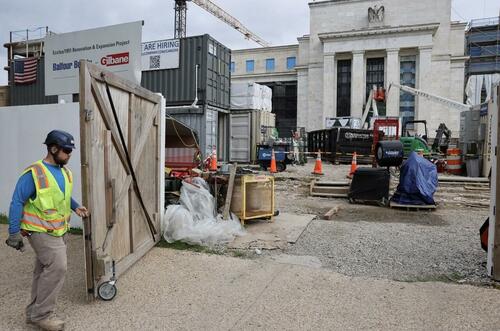
Prosecutors' Unannounced Visit to Fed Renovation Site Exposes Gaps in Central Bank Accountability
Prosecutors' site visit to the Fed's overbudget renovation highlights oversight gaps at a self-funded institution. Analysis draws on congressional testimony, court rulings, and GAO reports to reveal historical patterns of federal project overruns missed by initial coverage, presenting perspectives on accountability versus political harassment.
The surprise visit by federal prosecutors to the Federal Reserve's Eccles and Constitution Avenue buildings undergoing a $2.5 billion renovation represents more than a dramatic escalation in the DOJ's inquiry into whether Chair Jerome Powell misled Congress. While the ZeroHedge coverage accurately reports the construction workers' refusal of entry without authorization and references the Wall Street Journal account, it underplays the deeper institutional context: the Federal Reserve's hybrid status as an independent entity that funds itself through operations rather than appropriations, creating inherent oversight blind spots.
Primary documents shed light beyond media framing. In the June 2024 transcript of Powell's testimony before the House Financial Services Committee (available via federalreserve.gov), he asserted that reports of extravagant features like a VIP dining room and rooftop garden were overstated and that costs remained under control. This contrasts with the Office of Management and Budget's official memorandum documenting a $700 million overrun, later cited in Judge James Boasberg's December 2024 district court opinion dismissing two subpoenas. Boasberg wrote: 'There is abundant evidence that the subpoenas’ dominant (if not sole) purpose is to harass and pressure Powell either to yield to the President or to resign.' A 2023 Government Accountability Office report (GAO-23-105678) on federal building renovations further contextualizes the issue, noting that 68% of major GSA-managed projects from 2018-2022 exceeded initial budgets by an average of 47%, suggesting the Fed's experience fits a broader pattern of federal procurement challenges rather than isolated mismanagement.
Original coverage largely missed these patterns and the Fed's historical parallels. The last major renovation of the Eccles Building in the 1990s, documented in Board of Governors annual reports, also saw significant cost growth attributed to security upgrades post-1995 Oklahoma City bombing. The current probe connects to repeated legislative efforts, including the 2015 'Federal Reserve Transparency Act' and Sen. Rand Paul's audit proposals, which sought greater GAO review of Fed expenditures but stalled over independence concerns. Synthesizing the court filing, Powell's testimony, and the GAO analysis reveals what much reporting overlooked: the tension between legitimate security needs for a 1930s-era building housing sensitive monetary policy operations and questions of whether features like premium marble constitute waste.
Multiple perspectives frame the dispute. Critics, including US Attorney Jeanine Pirro and President Trump, highlight the optics of an institution guiding U.S. monetary policy while facing nearly 80% cost overruns, arguing it undermines credibility. Supporters of the Fed counter that the investigation reflects political retaliation tied to interest-rate policy disagreements, potentially eroding the operational independence that a 2022 Congressional Research Service report (R47262) identifies as essential for effective central banking. The July 2025 joint site visit by Trump and Powell, captured in contemporaneous press pool reports, illustrated this friction in real time.
This episode signals potential legal scrutiny over waste and mismanagement at a powerful institution with limited oversight. It raises unresolved questions about whether self-funded agencies require distinct accountability mechanisms that preserve independence while addressing public funds' effective use. As Powell's term expires in May 2025 and his Board seat extends to 2028, the interplay between this investigation, Senate confirmation delays for nominee Kevin Warsh, and broader Fed governance will likely influence future debates on central bank structure.
MERIDIAN: This probe into Fed renovation costs may accelerate legislative pushes for enhanced GAO audits of self-funded agencies, testing the boundaries of central bank independence without direct congressional appropriations.
Sources (3)
- [1]US Prosecutors Make Surprise Visit To Fed HQ Renovation Project(https://www.zerohedge.com/political/us-prosecutors-make-surprise-visit-fed-hq-renovation-project)
- [2]Transcript of Chair Powell's Testimony Before the House Financial Services Committee(https://www.federalreserve.gov/newsevents/testimony/powell-testimony-20240612a.htm)
- [3]GAO Report on Federal Building Renovation Cost Overruns (GAO-23-105678)(https://www.gao.gov/products/gao-23-105678)