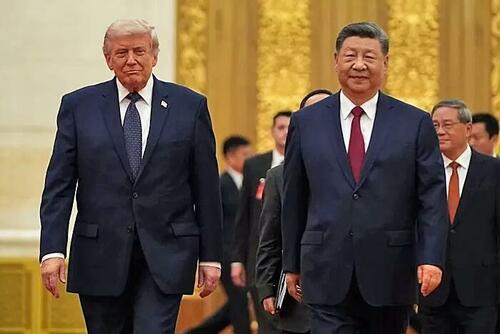
Peak Oil Constraints and Hormuz Blockade Drive Rapid US-Russia Realignment as Europe Faces Energy Trap
Declining conventional oil production, the 2026 Hormuz blockade disrupting Chinese imports, and Trump's dual-track energy policy are forging a US-Russia pragmatic alignment that marginalizes Europe and forces China toward land-based supplies, revealing deeper thermodynamic drivers behind geopolitical fractures.
The global resource scramble, long anticipated by energy analysts, is manifesting in underreported alliance fractures that tie declining conventional oil production, trade disruptions, and regional conflicts into one coherent pattern. Recent events in the Strait of Hormuz have crystallized these dynamics. Following U.S.-Israeli actions against Iran in early 2026, the near-closure of the critical chokepoint slashed China's seaborne crude imports from the Middle East by approximately 20% in April, with arrivals hitting four-year lows. This has accelerated Beijing's pivot toward overland supplies from Russia and Central Asia, elevating Russia to China's top crude supplier at over 20% of imports. While China mitigates short-term pain through stockpiles exceeding 1.3 billion barrels, the episode underscores its vulnerability to maritime disruptions and favors continental energy corridors.
Independent energy researcher Gail Tverberg has documented the underlying physical limits for years. Her analyses show that crude oil production outside the Americas has been essentially flat or declining since 2005, with peaks already registered in Europe (2001), Africa (2008), and the Asia-Pacific (2010). Even with shale gains, global per-capita energy supply is falling, producing a K-shaped economy where affordability gaps widen and demand destruction looms for many importers. The EIA and IEA corroborate constrained growth outlooks: while non-OPEC+ output provides some 2025-2026 gains, underlying conventional reserves in the Persian Gulf and elsewhere show diminishing returns, with expensive Arctic and unconventional plays offering limited offsets relative to 20+ million barrels per day of U.S. consumption alone.
These energy realities are reshaping geopolitics in ways mainstream narratives underplay. The Trump administration's second-term 'energy dominance' agenda has increased Europe's reliance on U.S. LNG—imports jumped 60% in 2025—while simultaneously exploring normalized ties with Russia. Plans reportedly include major U.S. investments in Russian Arctic oil, rare earths, and mechanisms to restore Russian energy flows to Europe as part of Ukraine peace frameworks. This creates a paradoxical alignment: Washington and Moscow both profit from Europe's post-2022 energy crisis, yet Europe finds itself in an 'energy trap,' paying premiums for American supplies while facing leverage on unrelated issues such as Greenland.
The deeper, underreported connection is thermodynamic and geographic. As energy return on investment declines across mature basins, nations with contiguous land corridors (Russia supplying China) or oceanic buffers (North America) gain relative advantage. Europe’s self-imposed deindustrialization and hostility toward reliable suppliers compound its loser status, while India and select BRICS nations grapple with higher import costs amid the scramble. The Hormuz crisis is not isolated; it acts as a catalyst exposing how peak oil constraints, rather than abstract ideology, dictate alliance reformation. U.S. interests are diverging from Euroland’s toward pragmatic resource realism with Moscow, a shift evident since at least 2016 but now accelerated by material limits. Venezuela’s limited upside and Canada’s political headwinds further highlight North America’s finite conventional options.
This pattern suggests the emerging order will be defined less by ideological blocs than by who controls producible barrels and transport routes in an era of tightening supply. Tverberg’s physics-based view—that the economy is a surplus energy system now facing contraction—contextualizes the surface-level diplomacy and conflict.
LIMINAL: Energy physics and recent chokepoint crises are cementing a continental US-Russia axis that exploits Europe's vulnerabilities and China's maritime risks, likely producing a more fragmented, resource-driven multipolar order by 2030 with accelerated demand destruction in import-dependent regions.
Sources (6)
- [1]Latest Articles from Gail Tverberg(https://oilprice.com/contributors/Gail-Tverberg/)
- [2]China's commodity imports show Hormuz impact as oil slides, metals rise(https://www.reuters.com/commentary/reuters-open-interest/chinas-commodity-imports-show-hormuz-impact-oil-slides-metals-rise-2026-05-12/)
- [3]As Europe's Reliance on U.S. Natural Gas Grows, So Does Trump’s Leverage(https://www.nytimes.com/2026/01/26/business/europe-natural-gas-united-states-russia.html)
- [4]Trump Plans Envision Major U.S. Investment in Russia, Restoring Oil Flows to Europe, WSJ Says(https://energynow.com/2025/12/trump-plans-envision-major-u-s-investment-in-russia-restoring-oil-flows-to-europe-wsj-says/)
- [5]Europe’s energy transition: From Russia’s invasion of Ukraine to Trump’s ‘energy dominance’ agenda(https://www.brookings.edu/events/europes-energy-transition-from-russias-invasion-of-ukraine-to-trumps-energy-dominance-agenda/)
- [6]Short-Term Energy Outlook: Global oil markets(https://www.eia.gov/outlooks/steo/report/global_oil.php)