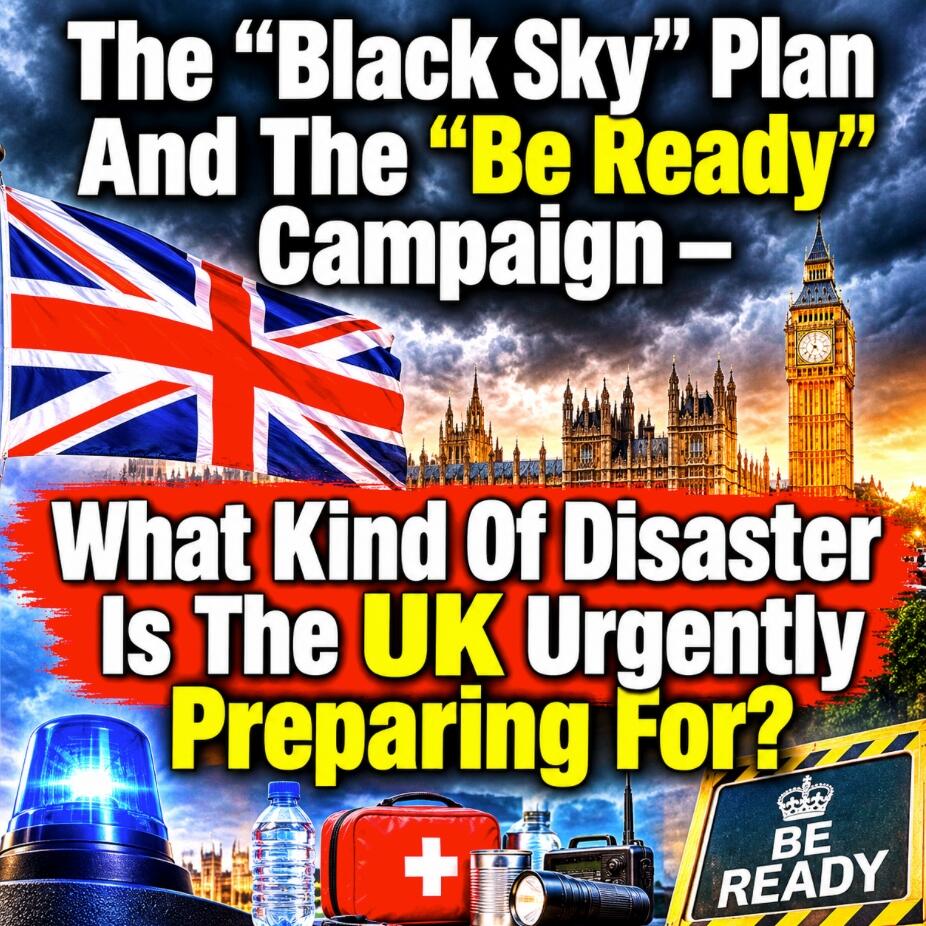
UK three-day stockpile advice tracks the risk register, not a disclosed single catastrophe
UK household stockpile advice and reported BBC emergency radio plans fit an existing multi-hazard resilience regime, not a disclosed single catastrophe. The alarmist reading stacks unrelated crises without a primary document linking them to the leaflet. The political trade is warning credibility and lower first-wave demand against accusations of alarmism and uneven ability to pre-buy.
Secondary reporting describes a Cabinet Office Be Ready leaflet, dated from 22 October, telling households to hold three days of water and non-perishable food, plus a torch, wind-up FM radio, first-aid kit and identity papers, bought gradually to limit panic buying. The same account says the BBC keeps a Black Sky studio plan: a small staff, FM feeds isolated from the internet, generator fuel for roughly three days, and satellite phones. Those details, if accurate, describe continuity of information. They do not, by themselves, establish a single imminent disaster.
The binding public instruments predate the leaflet. The Civil Contingencies Act 2004 already obliges Category 1 responders to assess and plan for emergencies. The Cabinet Office National Risk Register, 2023 edition, arrays concurrent hazards: flooding, storms, pandemic, malicious cyber activity, attacks on infrastructure, and loss of power or communications. Seventy-two-hour autonomy is a planning convention for critical sites across NATO Europe, not a fresh intelligence product. A reported surge in orders at one specialist retailer matches a demand response to official advice. It is not independent confirmation of a classified warning.
The secondary piece reads urgency as concealment, then stacks Ukraine, an asserted Iran escalation, weather disruption, and food and fertiliser stress as one cause. No treaty text, Security Council resolution, or the consumer leaflet is produced to tie Be Ready to any single item on that list. Peer practice cuts against novelty. Sweden's civil-contingencies agency has told households for years to manage a week of disruption; Germany's BBK publishes comparable stockpile advice. After the 2022 energy and cyber shocks, several European capitals shifted part of the resilience burden onto households while keeping the stated rationale multi-hazard.
Ledger, not motive-reading. Ministers gain a paper trail that the state warned the public, and they cut the first-wave load on responders so capacity can go to the vulnerable. They pay if opponents call the tone alarmist, and if pre-buying tightens supply for households that cannot front the cost. The BBC gains an FM path that still works if internet distribution fails; describing it advertises a known dependency. The next discriminating fact is a document: a Risk Register revision, a named exercise, or a statement that assigns a hazard class. Until then this is implementation, not a countdown.
Sources (3)
- [1]UK National Risk Register 2023(https://www.gov.uk/government/publications/national-risk-register-2023)
- [2]Civil Contingencies Act 2004(https://www.legislation.gov.uk/ukpga/2004/36/contents)
- [3]UK Government Resilience Framework(https://www.gov.uk/government/publications/the-uk-government-resilience-framework)