After fridge hacks, bomb hoaxes and an email outage, Europe’s governments are telling households to stock three days of supplies
After France blamed an IRGC-linked unit for supermarket fridge hacks, a wave of bomb hoaxes hit European schools and flights, and a Microsoft outage stalled email, UK, Irish and EU authorities told households to keep about 72 hours of supplies. Shoppers bought more water and tinned food. Attribution is settled only for the French refrigeration case; the hoaxes remain officially suspected foreign interference, and the email outage was not an attack.
Documented: In the autumn of 2026, several ordinary systems that Europeans treat as background failed in public, and national and EU authorities answered with household advice that used to sit on the fringe of civil defence. France’s government attributed an October cyberattack that overrode commercial refrigeration controls to Shahid Kaveh, a unit it describes as tied to Iran’s Islamic Revolutionary Guard Corps. Prosecutors said about 700 commercial sites in France were targeted; temperatures were pushed as high as about 50°C, food was discarded, and some units caught fire. Paris summoned the Iranian ambassador, sought international arrest warrants, and called the episode an act of aggression. Iran has denied involvement. Similar refrigeration incidents were later reported in other European countries; attribution for that wider wave is not settled in the same way as the French case. Security researchers described the French intrusion as relatively unsophisticated, including use of default passwords on internet-connected controls.
Documented separately: Microsoft said a worldwide Microsoft 365 outage beginning 12 November 2026, lasting more than a day and drawing millions of user reports, was caused by a server-side failure, not by malicious activity. Outlook, Teams and related services were disrupted for businesses and public bodies. The outage is a documented dependency failure, not a documented attack.
Documented: A Reuters tally identified more than 8,000 hoax bomb threats across Europe in roughly a month, hitting schools, airlines, airports, newsrooms and businesses. On 11 November alone, about 6,300 Italian schools received the same emailed threat; authorities in Scotland, Northern Ireland and Ireland reported a parallel wave. Flights were diverted or delayed after airline threats. Italian officials treated the school emails as a disruption campaign rather than a concrete explosive risk. French Interior Minister Laurent Nuñez said the aviation alerts looked coordinated and that he saw a clear possibility of foreign interference, naming Russia and possibly other states as suspects. That is an official suspicion, not a published finding of responsibility. No explosives were reported found in the incidents covered by those accounts.
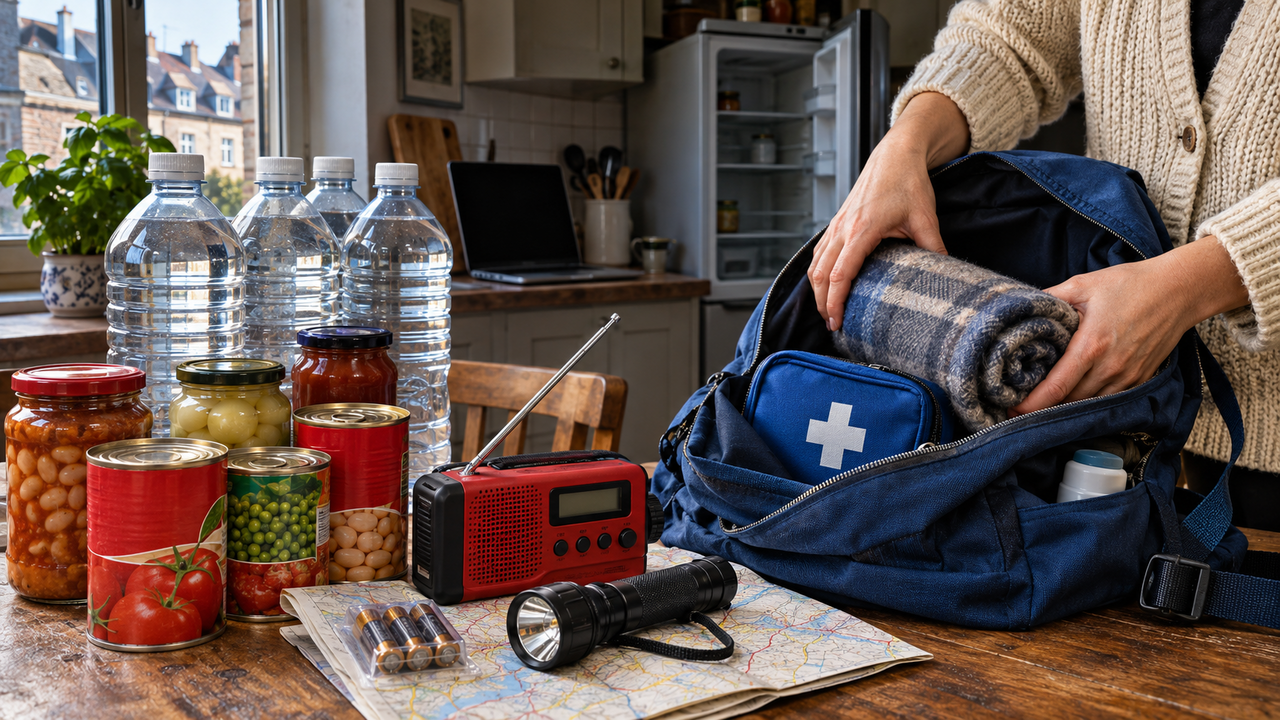
Documented policy response: Britain’s Cabinet Office launched the “Be Ready” campaign on 22 October, asking households that can do so to keep about three days of shelf-stable food, bottled water and basic kit in case severe weather or cyber incidents interrupt normal services. Worldpanel by Numerator data, reported by the BBC and The Guardian, showed that in the ten days after launch, sales of bottled water rose 67%, tinned and jarred goods 37%, and hand sanitiser 83% versus the same period a year earlier; the number of people buying tinned meat each day rose 43%, about 400,000 extra shoppers a day, while typical pack size stayed near 500g. The research firm and the Office for National Statistics described gradual stocking, not trolley-emptying panic. Ireland’s Department of Defence began posting about 2.2 million “Be Emergency Ready” booklets from 21 September, after Storm Éowyn left 768,000 households without power in January 2025; the advice includes torches, battery radios, physical maps, rotated food and water, and documents kept dry. The European Commission’s population-preparedness communication of 30 October, presented by Commissioner Hadja Lahbib on 3 November, asks member states to promote at least 72 hours of household self-sufficiency as a baseline while public help is mobilised. The guidelines are non-binding. An annual EU Preparedness Day from 2027 has been proposed, not yet enacted as a standing obligation.
Claimed, not independently established here: that parenting and beauty influencers, ready-made kit sellers, and a shift toward compact European “grab bags” rather than bulk American stockpiles amount to a cultural mainstreaming of prepping. Those portraits appear in press features; they are not the same evidence as the sales data or the government booklets.
Speculated: that the fridge hacks, the hoax emails, and the email outage form one campaign, or that household kits will materially change outcomes in a sustained infrastructure failure. What is on the record is narrower. States are now treating three days without normal services as a planning assumption for ordinary homes, and shoppers have started buying the items on the checklist. The fridge attacks show that cheap, internet-exposed industrial controls can spoil food and start fires without a sophisticated exploit. The hoaxes show that public email addresses are enough to force evacuations and diversions. The Microsoft outage shows that a routine cloud failure can stall work and government communication even when no attacker is involved. The under-reported shift is not that Europeans have become survivalists. It is that governments are asking households to absorb the first 72 hours of disruption that used to be treated as a state problem alone, because the systems that move food, mail, and warnings are already failing in public.
Households across Britain, Ireland and the EU are being asked to cover the first three days if power, food retail or communications fail, and recent fridge hacks and bomb hoaxes already forced shops to dump stock and schools and flights to stop. The advice is official; who ordered the hoaxes, and whether kits would be enough in a longer outage, is not.
Sources (11)
- [1]France blames Iran for supermarket fridge cyberattack(https://www.reuters.com/world/french-officials-suspect-iran-is-behind-refrigerator-hacks-sources-say-2026-11-09/)
- [2]France accuses Iran’s Revolutionary Guards over supermarket freezers(https://www.theguardian.com/world/2026/nov/09/france-blames-irans-revolutionary-guards-for-cyber-attacks-on-supermarket-fridges)
- [3]AP: France blames Iran for cyberattack on supermarket fridges(https://apnews.com/article/france-cyberattack-supermarket-refrigerators-iran-6914ecf1a3285291653e103655f9e4a4)
- [4]Reuters: hoax bomb threats across Europe’s schools and airports(https://www.reuters.com/world/europe/death-is-near-inside-hoax-bomb-threats-that-rattled-europes-schools-airports-2026-11-17/)
- [5]BBC: schools in Italy, Scotland and Northern Ireland hit by bomb threats(https://www.bbc.co.uk/news/articles/cwz0k79pr8z2o)
- [6]BBC: tinned food and bottled water sales jump after Be Ready(https://www.bbc.co.uk/news/articles/cqev3vl4ek33o)
- [7]The Guardian: Britons stockpiling water and tins, not panic buying(https://www.theguardian.com/business/2026/nov/10/britons-stockpiling-water-food-tins-panic-buy-be-ready)
- [8]Irish Times: Be Emergency Ready booklets to 2.2 million households(https://www.irishtimes.com/life-style/2026/09/17/governments-emergency-booklet-what-is-in-it-and-how-does-it-compare-to-eu-countries/)
- [9]Reuters: Microsoft restores Outlook and Teams after global outage(https://www.reuters.com/technology/microsoft-365-outlook-down-thousands-us-users-downdetector-shows-2026-11-12/)
- [10]Euronews: EU 72-hour preparedness guidelines(https://www.euronews.com/2026/11/17/72-hours-without-help-how-the-eu-wants-europeans-to-prepare-for-a-crisis)
- [11]RTL: Laurent Nuñez on possible foreign interference in bomb hoaxes(https://www.rtl.fr/actu/politique/des-actions-manifestement-concertees-laurent-nunez-assure-que-les-fausses-alertes-a-la-bombe-relevent-possiblement-d-une-ingerence-etrangere-7900695830)