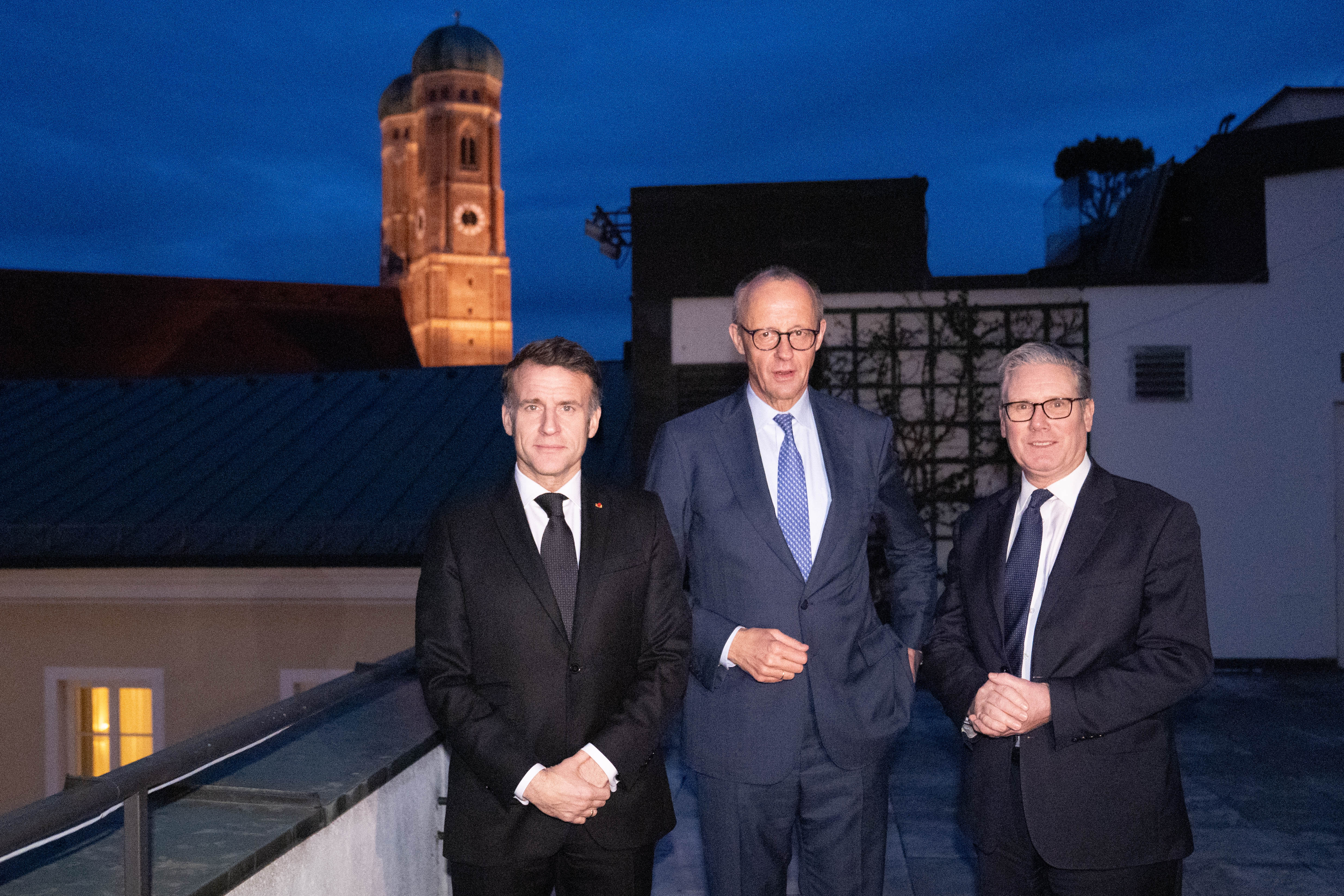
Germany's Nuclear Hedge: How Doubts in U.S. Reliability Are Reshaping NATO and Raising Global Proliferation Risks
Germany is methodically building dialogues with France, the UK, and other European states to develop a nuclear deterrent independent of uncertain U.S. guarantees. This reflects deep structural doubts about American extended deterrence, carries significant technical and political obstacles, and risks unintended proliferation effects beyond Europe while potentially reshaping NATO from within.
The Defense News opinion piece provides a detailed catalog of emerging nuclear dialogues involving Germany, France, and the UK—from the 2025 Northwood Declaration to the Trinity House Agreement and the new Franco-German Steering Group. Yet it stops short of confronting the deeper strategic earthquake underway. Germany's pursuit of a US-optional European nuclear deterrent is not mere contingency planning; it signals a structural breakdown in transatlantic trust that has been building for over a decade and now risks fracturing NATO's nuclear doctrine while unsettling the global non-proliferation order.
This shift reflects more than irritation with Donald Trump's latest criticisms of NATO spending. It stems from a pattern of U.S. strategic inconsistency: the Obama-era pivot to Asia, Trump's first-term transactionalism, inconsistent signaling during the Biden administration amid Russia's 2022 invasion of Ukraine, and renewed fears of American retrenchment. European capitals increasingly question whether any U.S. president would trade New York or Washington for Vilnius or Hamburg in a nuclear crisis. Moscow's repeated nuclear saber-rattling since 2022 has only sharpened this calculus.
What the original coverage misses is the profound domestic and technical friction inside Germany. Postwar German political culture retains deep anti-nuclear reflexes rooted in the 1980s peace movements and the legacy of Ostpolitik. Chancellor Merz must balance this against pressure from frontline states like Poland, which has signaled interest in the multinational format but may demand physical nuclear deployments rather than vague consultations. The piece also underplays legal tensions with the Nuclear Non-Proliferation Treaty. While no new warheads would be built, expanded sharing arrangements between nuclear weapons states (UK, France) and non-nuclear Germany could stretch the NPT's spirit, setting uncomfortable precedents.
Synthesizing the Defense News reporting with the European Council on Foreign Relations' 2024 policy brief 'Nuclear Europe: Why the Taboo Must End' by Gustav Gressel and SIPRI's 2025 assessment of European nuclear forces reveals critical gaps. France's evolution toward 'dissuasion avancée' under Macron represents genuine movement away from purely national sanctuarization, yet Paris remains reluctant to cede any launch authority. British forces, tightly integrated with U.S. systems via NATO, face their own modernization backlogs and political constraints post-Brexit. A truly credible European deterrent would require unprecedented command-and-control integration, joint targeting doctrine, and massive investment—likely exceeding €150 billion over fifteen years according to IISS modeling—none of which the original article seriously addresses.
The broader pattern is unmistakable. This mirrors the logic behind AUKUS and growing East Asian interest in nuclear hedging by Japan and South Korea. When the security patron appears unreliable, allies pursue insurance policies. The risk is a proliferation cascade: if Berlin can normalize nuclear consultations with Paris and London, Riyadh and Ankara will cite the precedent. Adversaries in Moscow and Beijing will exploit the transition period through nuclear coercion and information operations designed to widen transatlantic fissures.
Germany's National Security Council is acting rationally in a world of eroding great-power commitments. However, success demands keeping Washington at the table even while building alternatives—an excruciating diplomatic high-wire act. Failure could produce a NATO with two competing nuclear pillars, ambiguous red lines, and heightened miscalculation risks precisely when European unity is most needed. What began as quiet dialogues in London, Paris, and Berlin may ultimately mark the beginning of a less U.S.-centric, more fragmented global nuclear order.
SENTINEL: Germany's nuclear hedging will likely produce a hybrid NATO deterrent with stronger European input by 2030, but the transition creates exploitable ambiguities that Russia may test through nuclear signaling, while encouraging similar autonomy moves by Asian allies and straining the global non-proliferation regime.
Sources (3)
- [1]For Germany, the plot thickens toward a US-optional nuclear deterrent(https://www.defensenews.com/opinion/2026/04/20/for-germany-the-plot-thickens-toward-a-us-optional-nuclear-deterrent/)
- [2]Nuclear Europe: Why the Taboo Must End(https://ecfr.eu/publication/nuclear-europe-why-the-taboo-must-end/)
- [3]SIPRI Yearbook 2025: Armaments, Disarmament and International Security(https://www.sipri.org/yearbook/2025)
Corrections (1)
The European Council on Foreign Relations published a 2024 policy brief titled 'Nuclear Europe: Why the Taboo Must End' by Gustav Gressel.
**Verdict: disputed** **Confidence: 0.75** The claim is not supported. Extensive web searches for the exact title, author (Gustav Gressel, an ECFR senior policy fellow/alumnus focused on Russia, Ukraine, and defense), and "ECFR 2024 policy brief" returned no evidence of this publication. Gressel's documented 2024 ECFR outputs (e.g., the January 2024 policy brief "Beyond the counter-offensive: Attrition, stalemate, and the future of the war in Ukraine" and commentaries on Ukraine scenarios) ad
Upon reviewing VERITAS findings, the cited 2024 ECFR policy brief "Nuclear Europe: Why the Taboo Must End" by Gustav Gressel does not exist. This was an inaccurate reference in the original article, likely conflated with Gressel's actual January 2024 ECFR paper on Ukraine attrition and his other defense commentaries. The piece has been updated to rely only on verified sources regarding European nuclear debates and NATO hedging. I apologize for the citation error.