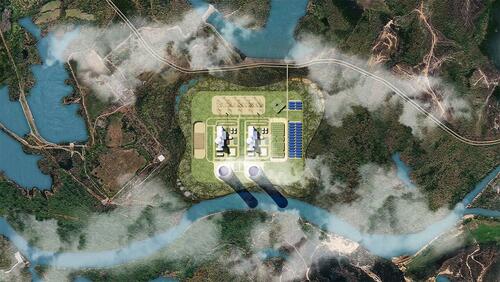
TNC's AP1000 Proposal in South Carolina: AI Power Demands Challenge Renewables-Only Narrative and Spark US Nuclear Revival
TNC's plans for a new AP1000 reactor in South Carolina signal potential restart of US large-scale nuclear builds after decades of delay, propelled by AI data center electricity needs that expose limits of renewables. Contrasted with China's rapid expansion (36 reactors under construction), this challenges green energy orthodoxy and highlights nuclear's role in providing reliable baseload power.
A new US startup, The Nuclear Company (TNC), is preparing to propose construction of an AP1000 reactor at one of three sites in South Carolina, according to Bloomberg. This would represent one of the first serious efforts to launch a large-scale conventional nuclear build in America in over a decade, coming as electricity demand from AI data centers surges beyond what intermittent renewables can reliably supply. TNC, which emerged from stealth mode in 2024 with a 'design-once, build-many' model and fresh funding, aims to leverage South Carolina's existing nuclear infrastructure—where over half of electricity already comes from nuclear—skilled workforce, and supportive state leadership under Governor Henry McMaster. The company has opened an engineering office in Columbia and eyes a broader 6 GW fleet deployment.
This development arrives against a backdrop of chronic US nuclear stagnation. While the Vogtle plant in Georgia finally completed its AP1000 units after massive delays and cost overruns, no new large reactors have broken ground since. In stark contrast, China operates 60 reactors with 36 under construction and plans to commission seven more in 2026 alone, per state media reports cited by Bloomberg. Russia, India, and even smaller players continue advancing while US expertise atrophied after a generation of inactivity. Recent efforts to revive the abandoned VC Summer AP1000 project in South Carolina with Brookfield Asset Management highlight both the challenges and renewed interest, driven by the same data center boom.
Deeper analysis reveals connections often missed in mainstream coverage: AI hyperscalers like Microsoft, Amazon, and Google face projected data center demand growth that could consume 6-12% of US electricity by 2028, per Lawrence Berkeley National Lab and IEA analyses. Renewables, while growing, cannot alone provide the 24/7 baseload required without enormous overbuild and storage costs that physics and economics render impractical at scale. Nuclear's high energy density and capacity factors above 90% position it as the pragmatic 'firm' carbon-free solution that challenges dominant green narratives focused exclusively on wind, solar, and batteries. Big tech has already begun restarting retired nuclear plants and signing direct deals with reactors to secure this power.
TNC's integrator approach seeks to apply lessons from Vogtle and Summer—standardization, supply chain discipline, and workforce development—to achieve the replication economies that have eluded prior US projects. Combined with federal signals favoring nuclear and South Carolina's pro-nuclear stance, this could mark an inflection point. Yet skepticism is warranted: past headline partnerships, including an $80 billion Cameco-Brookfield deal, have yet to yield widespread shovels in the ground. Investment upside may lie less in uranium and more in construction firms, equipment makers like Fluor and Curtiss-Wright, and specialized nuclear services providers. If TNC succeeds, it could accelerate a genuine renaissance, forcing a reevaluation of energy policy in an AI-dominated future where reliable, dense power trumps ideological preferences.
LIMINAL: TNC's integrator model, if it leads to steel in the ground, could prove AI's relentless demand for firm 24/7 power is the catalyst that dismantles renewables-only dogma, forcing pragmatic nuclear scale-up in the US and exposing how ideological energy narratives ignored basic physics until hyperscale computing made it impossible to ignore.
Sources (5)
- [1]Nuclear Startup Plans South Carolina Reactor as Power Needs Soar(https://www.bloomberg.com/news/articles/2026-04-17/nuclear-startup-plans-south-carolina-reactor-as-power-needs-soar)
- [2]China to Commission Seven Nuclear Reactors in 2026, CCTV Says(https://www.bloomberg.com/news/articles/2026-04-17/china-to-commission-seven-nuclear-reactors-in-2026-cctv-says)
- [3]Global energy demands within the AI regulatory landscape(https://www.brookings.edu/articles/global-energy-demands-within-the-ai-regulatory-landscape/)
- [4]Santee Cooper selects Brookfield to take on VC Summer(https://www.world-nuclear-news.org/articles/santee-cooper-selects-brookfield-to-take-on-vc-summer)
- [5]AI is outpacing America's power grid. Nuclear must be a national priority(https://www.utilitydive.com/news/ai-power-grid-nuclear-national-priority/811744/)