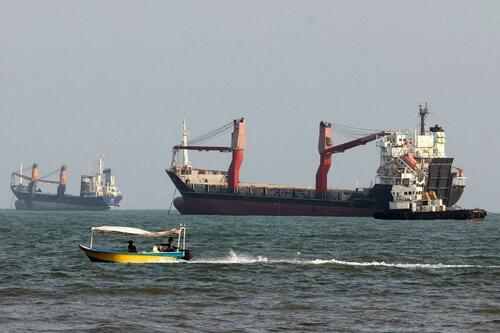
US Military Operations Degrade Iranian Threats to Strait of Hormuz, Enabling Sustained Commercial Transit
Credible sources confirm U.S. strikes and escorts have degraded Iran's Hormuz targeting capabilities, enabling over 1,000 safe transits amid ongoing tensions; DFC insurance supports commercial flows.
Recent reporting and official statements indicate that sustained U.S. Central Command (CENTCOM) operations have significantly eroded Iran's capacity to disrupt shipping through the Strait of Hormuz. The narrow waterway, historically carrying about one-fifth of global oil trade, has seen repeated Iranian threats and attacks amid broader regional tensions in 2026. However, a combination of precision strikes targeting Iranian radar, surveillance, missile, and drone assets—coupled with naval escorts and insurance mechanisms—has allowed commercial traffic to continue.
CENTCOM has publicly stated that U.S. forces have assisted more than 1,000 vessels transiting the strait since early May 2026, despite Iranian aggression, with the southern route remaining open for commercial use.[1][2] Strikes have focused on degrading mobile radars, coastal surveillance nodes, command centers, and launch sites on islands and mainland positions, reducing Iran's ability to detect and target ships effectively. This aligns with descriptions of systematic efforts to dismantle detection layers through anti-radiation responses and intelligence-driven targeting.
On the commercial side, the U.S. International Development Finance Corporation (DFC) established a maritime reinsurance facility—initially $20 billion and later expanded to $40 billion in partnership with insurers including Chubb—to provide war risk coverage for hull, machinery, and cargo, addressing insurance barriers that had spiked premiums.[3][4] While early uptake was limited and tied to escort requirements, transits have increased, with vessels often operating without AIS transponders under protection from Arleigh Burke-class destroyers, helicopters, and aircraft.
Independent analyses and reporting, including from The Virginian-Pilot (syndicated via The New York Times), confirm that CENTCOM operations have shepherded tankers through perilous routes, with oil exports rising from roughly 4 million barrels per day in June to 5 million in July.[2] Jerusalem Post reporting highlights ongoing strikes degrading Iran's threat to commercial shipping.[5] Iranian claims of control contrast with CENTCOM facts that the strait remains an international waterway open for transit.
These developments suggest a shift from theoretical chokepoint leverage to demonstrated operational constraints on Iranian forces, supported by layered U.S. air-maritime integration.
CENTCOM: Sustained degradation of Iranian sensors and strike assets, combined with escorts and reinsurance, will likely maintain Hormuz flows at elevated but stable levels, reducing global energy price volatility from this chokepoint in the near term.
Sources (5)
- [1]How the U.S. Navy is helping get oil through the Strait of Hormuz(https://www.pilotonline.com/2026/08/26/us-navy-oil-hormuz/)
- [2]U.S. Central Command X posts on Hormuz transits and strikes(https://x.com/CENTCOM)
- [3]US strikes degrading Iran’s threat to Hormuz shipping, CENTCOM tells 'Post'(https://www.jpost.com/israel-news/article-902640)
- [4]DFC Announces $20B Plan for Maritime Reinsurance in the Gulf(https://www.dfc.gov/media/press-releases/dfc-announces-20b-plan-maritime-reinsurance-gulf)
- [5]DFC and Chubb expand Hormuz maritime insurance facility to $40 bn(https://beinsure.com/news/dfc-chubb-expand-hormuz-maritime-insurance-facility-40bn/)