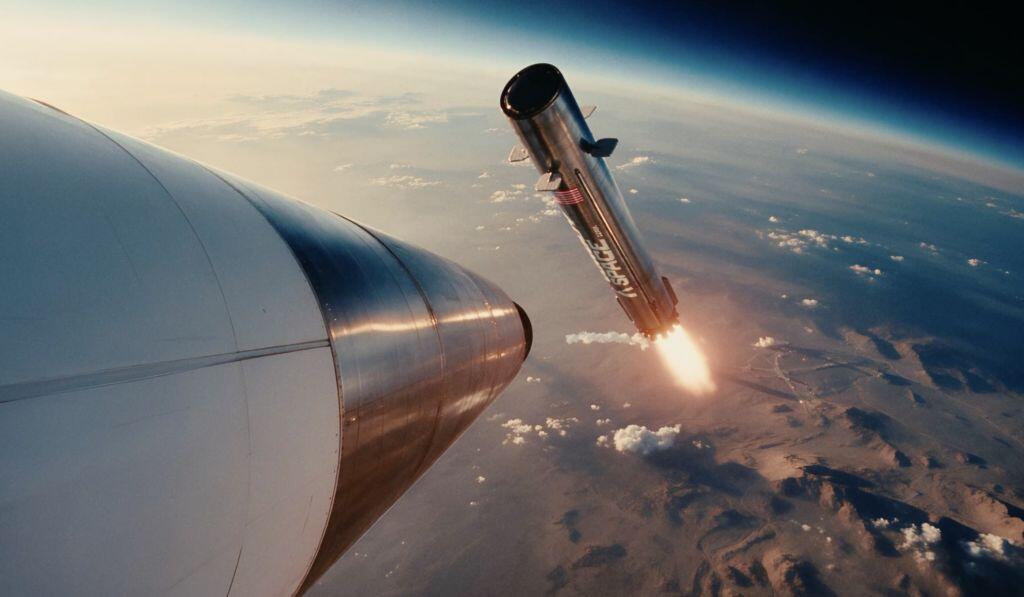
Cowboy Space's Big Iron: A Rocket That Becomes a Megawatt Orbital Data Center
Cowboy Space's Big Iron integrates rocket launch and orbital data center functions into a single system, backed by recent announcements, funding, and a successful demo satellite launch, aiming for 2028 first flight and cost-competitive space-based AI compute.
Cowboy Space Corporation, founded by Robinhood co-founder Baiju Bhatt and formerly known as Aetherflux, unveiled its 'Big Iron' rocket on October 26, 2026. The 86-meter stainless-steel vehicle features a reusable first stage powered by nine liquid oxygen-methane 'Clydesdale' engines, each delivering 300,000 pounds of thrust for a total of 2.7 million pounds. It is designed to lift over 15,000 kg to sun-synchronous orbit.[1][2]
What sets Big Iron apart is its upper stage, which remains in orbit as a megawatt-class data center rather than being discarded. Once deployed in a dawn-dusk orbit, the stage expands to 132 by 73 meters, using its stainless-steel skin as a radiator, ammonia propellant as coolant, and nitrogen for solar wing deployment. It will host five racks of NVIDIA Vera Rubin GPUs.[3][4]
The design aims for cost parity with terrestrial data centers by integrating launch and compute infrastructure. The company plans to build the first rocket by end of 2027 and fly it in 2028, while pursuing its Stampede constellation of up to 20,000 satellites. It has already launched Reason-1 on October 1, 2026, via SpaceX Transporter-18 to test laser power beaming, with Reason-2 (including GPU payloads and NOAA data processing) slated for 2027.[5][6]
Cowboy raised $275 million in Series B funding in May 2026 at a $2 billion valuation. It also offers 'Big Iron Express' commercial launches and targets National Security Space Launch contracts, positioning itself against SpaceX's own orbital data center ambitions.[7]
This vertically integrated approach—where the rocket's architecture directly enables orbital compute—offers a streamlined path for deploying AI infrastructure in space, with early hardware validation already underway.
Analyst: Big Iron's unified launch-compute design could accelerate orbital AI deployment if engine tests and FCC approvals succeed, potentially pressuring terrestrial data center economics within a decade.
Sources (7)
- [1]Cowboy Space debuts new 'Big Iron' rocket(https://www.axios.com/2026/10/27/big-iron-cowboy-space-rocket)
- [2]Cowboy Space unveils 'Big Iron' rocket to launch 20,000 AI data centers(https://www.space.com/space-exploration/launches-spacecraft/cowboy-space-unveils-big-iron-rocket-to-launch-20-000-ai-data-centers)
- [3]Cowboy Space Reveals Big Iron Data Center Rocket(https://payloadspace.com/cowboy-space-reveals-big-iron-data-center-rocket/)
- [4]Cowboy Space Details 'Big Iron' Launcher Plans(https://aviationweek.com/space/launch-vehicles-propulsion/cowboy-space-details-big-iron-launcher-plans)
- [5]Satellite firm Aetherflux rebrands to Cowboy Space Corporation, raises $275m Series B(https://www.datacenterdynamics.com/en/news/satellite-firm-aetherflux-rebrands-to-cowboy-space-corporation-raises-275m-series-b/)
- [6]Our First Mission Takes Flight | Cowboy Space(https://www.cowboyspace.com/news/reason-1-takes-flight)
- [7]NOAA and Cowboy Space Corporation to Test Faster Satellite Data Processing(https://www.nesdis.noaa.gov/news/noaa-and-cowboy-space-corporation-test-faster-satellite-data-processing)