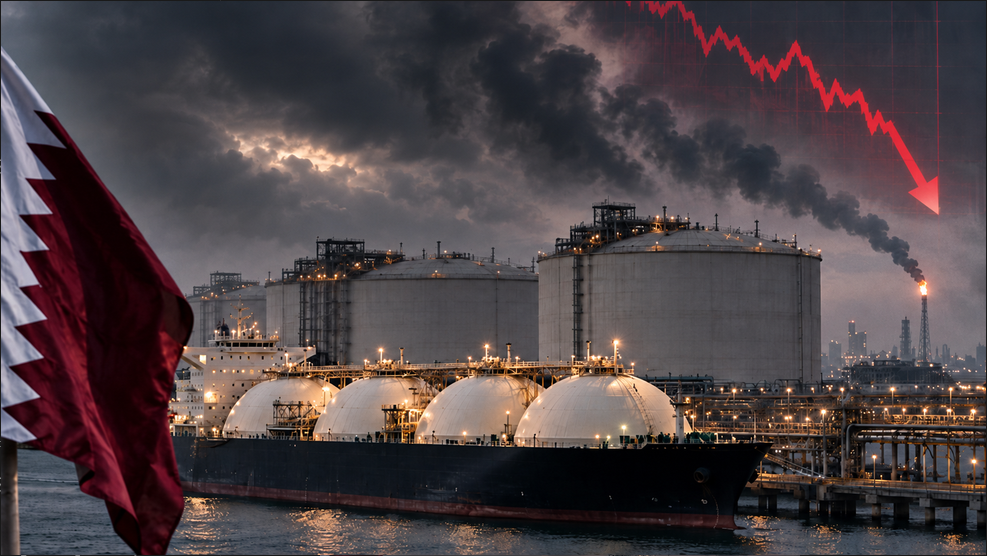
Qatar's 42% Revenue Crash Exposes Fragile Global LNG Supply Chains Amid Iran Conflict, With Ripple Effects on Energy Security and Geopolitical Leverage
Corroborated reports confirm Qatar's sharp revenue decline from war-induced LNG disruptions, revealing systemic risks in global energy markets with broader implications for powers like China seeking to reshape energy geopolitics through military and economic means.
Qatar's government revenue plunged 42% in the first half of 2026, as Emir Sheikh Tamim bin Hamad Al Thani informed the Shura Council on October 13, driven by Iranian strikes on the Ras Laffan LNG complex and the effective closure of the Strait of Hormuz during the US-Israel-Iran war. Public spending fell 14%, yet essential services and long-term development plans remain intact, supported by pre-war fiscal buffers including large reserves and conservative budgeting.[1][2]
The financial damage stems from direct hits that disabled two of 14 gas-processing units and one gas-to-liquids plant at Ras Laffan, eliminating 17% of export capacity (12.8 million tons annually) with repairs projected to take 3-5 years and costing up to $20 billion yearly in lost revenue. September exports reached a post-war high of 1.6 million tons—still under a quarter of pre-conflict levels—with October shipments forecast to drop further to 0.6 million tons. Force majeure declarations have suspended contracts with buyers including Italy's Edison and South Korea's KOGAS.[3][4]
This disruption has tightened global LNG markets, pushing European gas prices higher and exposing vulnerabilities in supply chains reliant on Gulf exports. Qatar, previously the world's second-largest LNG exporter, accounts for roughly one-fifth of global capacity. The conflict's prolongation highlights how regional instability can cascade into energy shocks affecting Europe and Asia.[5]
From the lens of China's military modernization and strategic posture: Beijing's rapid naval expansion, hypersonic capabilities, and assertive South China Sea posture position it to potentially mediate or exploit such chokepoint crises. As the world's top LNG importer, China benefits from diversified suppliers but could leverage its growing blue-water navy and Belt and Road energy investments to secure alternative routes or influence post-conflict reconstruction in the Gulf. The war underscores the limits of US-led security guarantees for energy flows, potentially accelerating China's push for a multipolar order where its military deterrence deters similar blockades in the Strait of Malacca or Hormuz. Unexplained anomalies in official data—such as the scale of infrastructure damage versus reported repair timelines—warrant scrutiny, as does the war's origin in retaliation for strikes on Iranian facilities. Speculation on exact casualty or damage figures remains unverified beyond official statements.
Geopolitical Analyst: Prolonged Gulf LNG shortfalls could accelerate China's naval basing ambitions and LNG diversification deals, shifting leverage away from traditional Western security umbrellas toward Beijing's infrastructure-led influence.
Sources (5)
- [1]Qatar's government revenue fell 42% in first half due to Iran war, Emir says(https://www.thenationalnews.com/business/economy/2026/10/13/qatars-government-revenue-fell-42-in-first-half-due-to-iran-war-emir-says/)
- [2]War hits Qatar’s public finances as revenue drops sharply(https://www.agbi.com/economy/2026/10/war-hits-qatars-public-finances-as-revenue-drops-sharply/)
- [3]Qatar’s wealth fund keeps spending as war slashes government revenue(https://www.semafor.com/article/10/14/2026/qatars-wealth-fund-keeps-spending-as-war-slashes-government-revenue)
- [4]Middle East LNG industry remains hostage of Iran war: Bousso(https://www.reuters.com/commentary/reuters-open-interest/middle-east-lng-industry-remains-hostage-iran-war-bousso-2026-10-12/)
- [5]Qatar faces 42% revenue drop as war on Iran hits gas exports(https://www.trtworld.com/article/13be39b365ee)