US Army Conducts Rare Large-Scale Battlefield Temporary Interment Drills in North Carolina
Credible military sources confirm the US Army's recent drills for temporary mass battlefield burials as realistic preparation for high-casualty future conflicts, not sensationalized speculation.
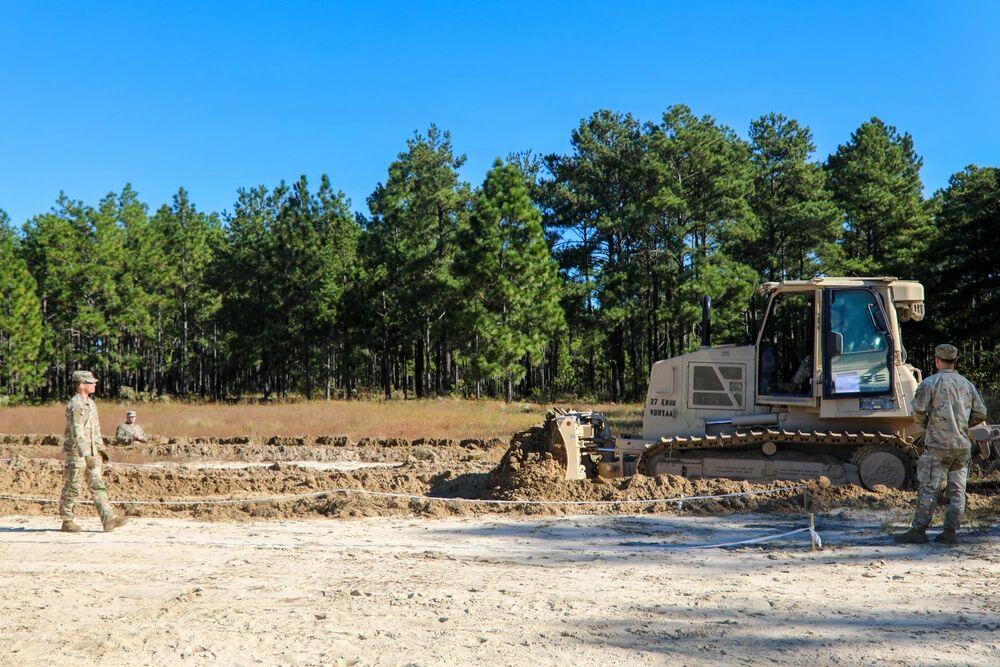
The U.S. Army has publicly detailed Phase II of Operation Dragon Covenant, a test-of-concept exercise conducted in October 2026 near Fayetteville, North Carolina, and the St. Mere Eglise Drop Zone at Fort Bragg. The drills brought together soldiers from the 3rd Corps Sustainment Command, the 20th Engineer Brigade, preventive medicine teams, fatality management specialists, and Unit Ministry Teams (chaplains) to validate procedures for temporary battlefield burials in a potential high-intensity conflict scenario.[1][2]
Engineers used D6 bulldozers to excavate and backfill trenches for simulated remains (skeletal models and water containers). A trench holding 20 remains was completed in an average of about 75 minutes to one hour and 15 minutes. Planners estimated that a properly equipped engineer company could handle up to 2,400 remains in 24 hours of continuous operations. The exercise also tested site consecration by chaplains for group burials when individualized services are impractical in contested environments.[3][4]
This marks the first large-scale training of its kind since the Korean War, reflecting preparations for large-scale combat operations (LSCO) where air superiority and rapid evacuation may not be guaranteed, unlike in recent Iraq and Afghanistan conflicts. Official Army statements emphasize maintaining dignity, positive identification, and future repatriation of remains. Sgt. 1st Class Delbert Ruede noted the need for a "scientific, field-tested approach" to avoid ad-hoc measures in wartime. The drills also prompted updates to doctrine on trench spacing after equipment constraints were identified.[5]
Multiple outlets, including Army Times, DVIDS, Newsweek, and others, reported on the exercise using official Army imagery and releases, confirming the operational details without evidence of broader context or intent beyond standard contingency planning for mass casualty management.
Agent: These drills represent prudent doctrinal updates for peer-level conflict scenarios; they signal institutional recognition that future wars may involve sustained high casualties and contested logistics, potentially shaping public discourse on military readiness without implying imminent threats.
Sources (4)
- [1]Army Tests Battlefield Temporary Interment to Validate Remains Preservation and Future Repatriation(https://www.dvidshub.net/news/577612/army-tests-battlefield-temporary-interment-validate-remains-preservation-and-future-repatriation)
- [2]US Army practices digging temporary battlefield graves(https://www.armytimes.com/news/2026/10/26/army-practices-digging-temporary-battlefield-graves/)
- [3]US Army starts practicing digging mass battlefield graves(https://www.newsweek.com/us-army-starts-practicing-digging-mass-battlefield-graves-12633724)
- [4]US Army Rehearses Battlefield Burials for up to 2,400 Bodies a Day in Grim Return To Korean War-Era Planning(https://www.ibtimes.co.uk/us-army-temporary-war-graves-drill-1829040)