China's Blocking of US Sanctions on 'Teapot' Refineries Exposes Limits of American Economic Coercion Ahead of Trump-Xi Summit
Beijing's invocation of blocking rules against U.S. sanctions on Chinese teapot refineries importing Iranian oil reveals a direct challenge to American secondary sanctions, occurring days before a pivotal Trump-Xi summit and highlighting the weaponization of energy trade amid broader geopolitical and economic decoupling.
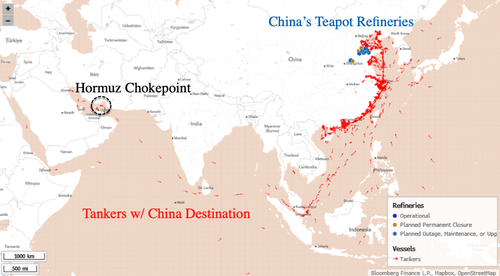
In a direct challenge to Washington’s sanctions regime, China’s Ministry of Commerce has issued an injunction prohibiting any recognition, implementation, or compliance with U.S. penalties imposed on five Chinese refineries accused of purchasing Iranian crude. The affected entities include Hengli Petrochemical (Dalian) Refinery and several independent “teapot” processors in Shandong province such as Shandong Jincheng Petrochemical, Shouguang Luqing Petrochemical, and Shandong Shengxing Chemical. Beijing described the U.S. measures as unlawful unilateral sanctions lacking United Nations authorization and a basis in international law.
This development, reported just days before a high-stakes summit between President Donald Trump and President Xi Jinping scheduled for mid-May 2026, underscores a deepening rift in U.S.-China relations. The Trump administration’s renewed “maximum pressure” campaign on Iranian oil exports has targeted not only Tehran’s shadow fleet but also its primary customer: Chinese independent refiners that process roughly 90% of Iran’s exported crude. Recent U.S. Treasury actions against Hengli and associated shippers aimed to disrupt these flows amid ongoing energy market turbulence linked to Middle East conflicts.
Yet China’s response goes beyond rhetoric. By activating its anti-foreign sanctions blocking rules—reportedly for the first time in such a direct manner against U.S. secondary sanctions—Beijing is shielding its domestic firms and signaling that it will not allow extraterritorial U.S. law to dictate its energy security needs. This move enables affected Chinese companies to potentially sue for damages in Chinese courts if they suffer losses from complying with U.S. demands, creating a legal counter-weapon in the escalating economic contest.
The timing is strategic. With global oil markets still absorbing shocks from disruptions in the Strait of Hormuz and broader Iran-related instability, China’s decision to reopen fuel exports to neighboring countries reflects stabilized domestic inventories but also highlights Asia’s acute vulnerability to energy price spikes. Analysts see this defiance as part of a broader pattern: Beijing’s willingness to absorb short-term friction to preserve long-term leverage over Iranian supplies, which offer discounted crude that supports China’s refining margins and strategic stockpiles.
Deeper connections emerge when viewed against the full spectrum of U.S.-China friction. The same toolkit of financial sanctions and export controls deployed against Chinese firms over Iran oil is mirrored in restrictions on AI chips, rare earth minerals, and technology transfers. This summit— the first U.S. presidential visit to China in eight years—will likely bundle discussions of Iranian crude purchases with Taiwan tensions, trade imbalances, and supply chain decoupling. By rejecting the legitimacy of U.S. sanctions outright, China is contesting the foundational premise of dollar-based financial dominance and secondary sanctions as tools of foreign policy.
Corporate media often frames these episodes as discrete enforcement actions, yet the pattern reveals trade itself being systematically weaponized. China’s growing embrace of de-dollarized settlement mechanisms with partners like Iran, Russia, and BRICS nations suggests a slow erosion of the unilateral power once enjoyed by the U.S. Treasury’s Office of Foreign Assets Control. Should this precedent hold, other nations may increasingly view U.S. sanctions as negotiable rather than absolute, accelerating fragmentation of the global financial architecture.
While short-term market reactions have been measured, the long-term risk is heightened economic warfare: tit-for-tat asset freezes, countersanctions on American firms, and parallel trading networks that bypass Western oversight. The Trump-Xi meeting now carries added weight—not merely as diplomacy, but as a potential off-ramp or escalation point in the contest over who writes the rules of 21st-century global commerce.
Liminal Analyst: China's open defiance accelerates the shift toward parallel economic architectures, weakening the effectiveness of U.S. secondary sanctions and increasing the likelihood of sustained fragmented global oil and financial markets regardless of summit outcomes.
Sources (5)
- [1]China rejects US sanctions on refineries over Iran oil links(https://www.firstpost.com/world/china-rejects-us-sanctions-on-refineries-over-iran-oil-links-calls-measures-illegal-14006841.html)
- [2]U.S. warns banks of sanctions risk over China 'teapot' refineries(https://www.cnbc.com/2026/04/29/us-treasury-warns-sanctions-china-refineries-iran-oil-malaysian-blend.html)
- [3]China blocks US sanctions on five Chinese firms over alleged Iran oil ties(https://www.chinadaily.com.cn/a/202605/02/WS69f5ecd6a310d6866eb46b9e.html)
- [4]China rejects U.S. sanctions on refineries over Iran oil links(https://www.thehindu.com/news/international/china-rejects-us-sanctions-on-refineris-over-iran-oil-links/article70932170.ece)
- [5]China Uses Blocking Law for First Time to Counter U.S. Sanctions on Chinese Teapot Refineries(https://www.geopolitechs.org/p/china-uses-blocking-law-for-first)