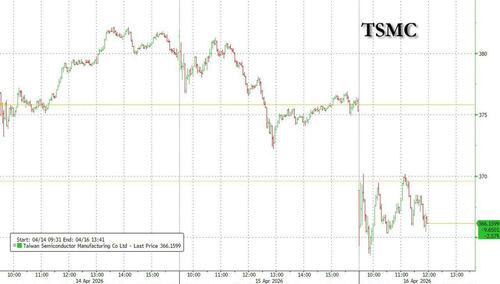
TSMC Record Profits Mask AI Boom Vulnerabilities as Geopolitical Risks Mount
Despite TSMC beating Q1 records on AI demand, its post-earnings slide, consumer weakness, and macro cautions from Middle East tensions signal potential limits to the semiconductor supercycle, with UBS and Samsung data highlighting bifurcated impacts that primary coverage underplayed.
TSMC reported record Q1 net profit of NT$572.5 billion, up 58.3% year-over-year, with revenue climbing 35.1% to NT$1.13 trillion, primarily attributed to surging demand for AI accelerators as detailed in the company's official earnings release and transcript from April 2025. Gross margin expanded to 66.2%, exceeding estimates. However, shares declined post-earnings, a divergence the original ZeroHedge coverage framed as a 'warning sign for chip companies' but did not fully connect to longer-term sectoral patterns or geopolitical fault lines. What the source understated was the extent of bifurcation: while AI-related revenue (high-performance computing) grew sharply, smartphone segment revenue fell 11% quarter-over-quarter amid memory shortages and elevated component costs, a dynamic also evident in downstream PC manufacturer pressures omitted from much initial reporting.
Synthesizing TSMC's primary earnings call transcript, the UBS analyst note from April 2025 warning that 'supply constraints will limit meaningful upside for TSMC this year,' and Samsung Electronics' preliminary Q1 results showing 755% operating profit growth driven by the same AI-induced memory shortage, reveals a consistent pattern. Memory producers like Samsung, SK Hynix, and Micron (with gross margins projected near 81%) benefit in the near term, yet this squeezes price-sensitive consumer markets. Historical parallels include the 2017-2018 crypto mining ASIC boom followed by overcapacity, and the 2021-2022 automotive chip shortage that later contributed to inventory corrections; both illustrate how concentrated demand surges can precede sector-wide volatility.
Geopolitical dimensions receive limited treatment in the original piece beyond TSMC CFO Wendell Huang's reassurance on diversified helium and hydrogen sourcing with safety stocks. Primary documents from the U.S. Department of Commerce on CHIPS Act implementation and Taiwan's Ministry of Economic Affairs supply-chain resilience reports highlight TSMC's critical role (over 60% of advanced-node production). Perspectives differ: semiconductor industry associations emphasize AI infrastructure spend remaining 'insulated' from Middle East disruptions per UBS, while risk analysts at firms tracking Strait tensions cite potential escalation scenarios that could cascade through global foundry capacity. Consumer electronics representatives, by contrast, flag rising input costs as dampening demand recovery. TSMC Chairman CC Wei's call for prudence amid 'macroeconomic uncertainties' from the Middle East aligns with broader patterns where energy and specialty gas price spikes have previously altered fab economics, as seen in 2022. This earnings cycle may thus function as a leading indicator, suggesting the AI-chip expansion faces simultaneous constraints from concentrated supply, softening non-AI end markets, and layered geopolitical exposures across the Taiwan Strait and Persian Gulf, even as official forecasts project 32% revenue growth for Q2.
MERIDIAN: TSMC's stock reaction despite record AI-fueled results points to market pricing in supply limits and consumer softening; this divergence, viewed alongside Taiwan Strait policy documents and Middle East energy reports, may foreshadow broader semiconductor caution without implying an immediate downturn.
Sources (3)
- [1]TSMC Q1 2025 Earnings Release and Transcript(https://investor.tsmc.com/english/quarterly-results/2025/q1)
- [2]UBS Research Note on TSMC - April 2025(https://www.ubs.com/global/en/investment-bank/research.html)
- [3]Samsung Electronics Q1 2025 Preliminary Results(https://news.samsung.com/global/samsung-electronics-announces-first-quarter-2025-results)