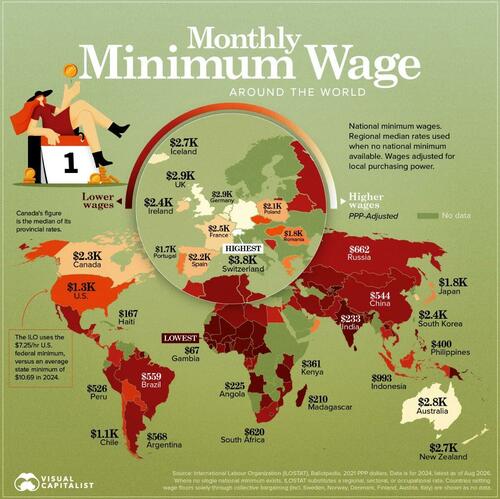
Switzerland Tops Global Minimum Wage Rankings in PPP Terms, Driven by Cantonal Rules Like Geneva's
Switzerland leads PPP-adjusted minimum wage rankings per ILO data due to strong cantonal floors (e.g., Geneva), with no national rate; the approach underscores decentralized labor policy amid high living costs.
Switzerland leads the world in minimum wage levels when measured by purchasing power parity (PPP)-adjusted monthly figures, according to 2024 data from the International Labour Organization (ILO) compiled in visualizations by Visual Capitalist. The country ranks first at $3,804 per month, ahead of Germany ($2,928), the UK ($2,902), and the Netherlands ($2,876). Eight of the top 10 countries are European, with Australia and New Zealand also in the group. South Korea leads in Asia at $2,362, while the U.S. federal minimum wage equates to $1,257 monthly (25th place). These PPP adjustments account for local cost of living, providing a clearer comparison of real purchasing power than nominal rates alone.
Switzerland lacks a nationwide minimum wage—a 2014 national referendum proposal for CHF 22/hour was rejected by 76% of voters. Instead, five cantons set statutory floors, with Geneva's rate (CHF 24.59 per hour in 2026, or roughly $27.60 hourly in some reports) frequently described as the world's highest statutory minimum. Other cantons include Basel-Stadt (CHF 22.20), Jura (CHF 21.40), Neuchâtel (CHF 21.35), and Ticino (CHF 20.00–20.50). Sectoral collective labor agreements (GAVs) fill gaps elsewhere, often exceeding cantonal rates in high-wage industries like construction. Rates are indexed to inflation and updated annually. The ILO uses applicable regional or sectoral floors for countries without a single national rate, enabling consistent cross-country analysis.
This setup highlights Switzerland's decentralized approach to labor protections, emphasizing collective bargaining over federal mandates. It connects to broader debates on income equality and living costs, as high Swiss wages reflect elevated expenses in housing, healthcare, and other essentials, while supporting strong worker outcomes in a high-productivity economy.
Economist: High Swiss minimums via cantons will sustain discussions on whether decentralized models better balance worker protections with economic flexibility than uniform national systems.
Sources (5)
- [1]Mapped: Minimum Wages Around the World(https://www.visualcapitalist.com/mapped-minimum-wages-around-the-world-adjusted-for-cost-of-living/)
- [2]Minimum Wage in Switzerland 2026 — Cantonal Rates(https://business-in-switzerland.com/guides/swiss-minimum-wage/)
- [3]List of countries by minimum wage(https://wikimili.com/en/List_of_countries_by_minimum_wage)
- [4]Minimum wage - Switzerland(https://wageindicator.org/salary/minimum-wage/switzerland)
- [5]Global Wage Report 2024-25(https://www.ilo.org/publications/flagship-reports/global-wage-report-2024-25-wage-inequality-decreasing-globally)