New York State Common Retirement Fund Weighs $4 Billion CFO Backed by Private Credit Stakes
New York's Common Retirement Fund is considering a $4 billion collateralized fund obligation to monetize private credit stakes while keeping the first-loss equity. The structure would provide liquidity without a secondary-market discount, but it concentrates valuation and distribution risk in a public pension.
The New York State Common Retirement Fund, which manages about $310 billion, is weighing a roughly $4 billion collateralized fund obligation, or CFO, backed by stakes in around 20 private credit funds run by Blackstone, Blue Owl, Sixth Street, Pimco and Ares. The pension has reportedly told some managers and sought access to fund information for potential buyers. The transaction could still change or fall apart, and everyone involved declined comment.
The structure would place the pension's fund stakes into a vehicle that issues rated debt against expected distributions, with senior paper sold mainly to fixed-income buyers such as insurers. Insurers often face limits on owning private fund stakes directly but can buy rated paper backed by them. The pension would retain the equity tranche, the first-loss slice. Bloomberg says the deal would be one of the largest of its kind and unusual because CFOs have mostly been issued by alternative asset managers, not by limited partners.
For the pension, the trade is liquidity without an immediate secondary-market sale, which can force a discount and a mark. The usual alternatives are secondary sales or NAV loans, both of which add pressure on illiquid assets. The retained equity means future cash flows pay debt first, and the pension absorbs losses if distributions slow, values fall, or stakes are sold at discounts. The underlying funds may already use subscription lines and NAV facilities, adding leverage on top of leverage.
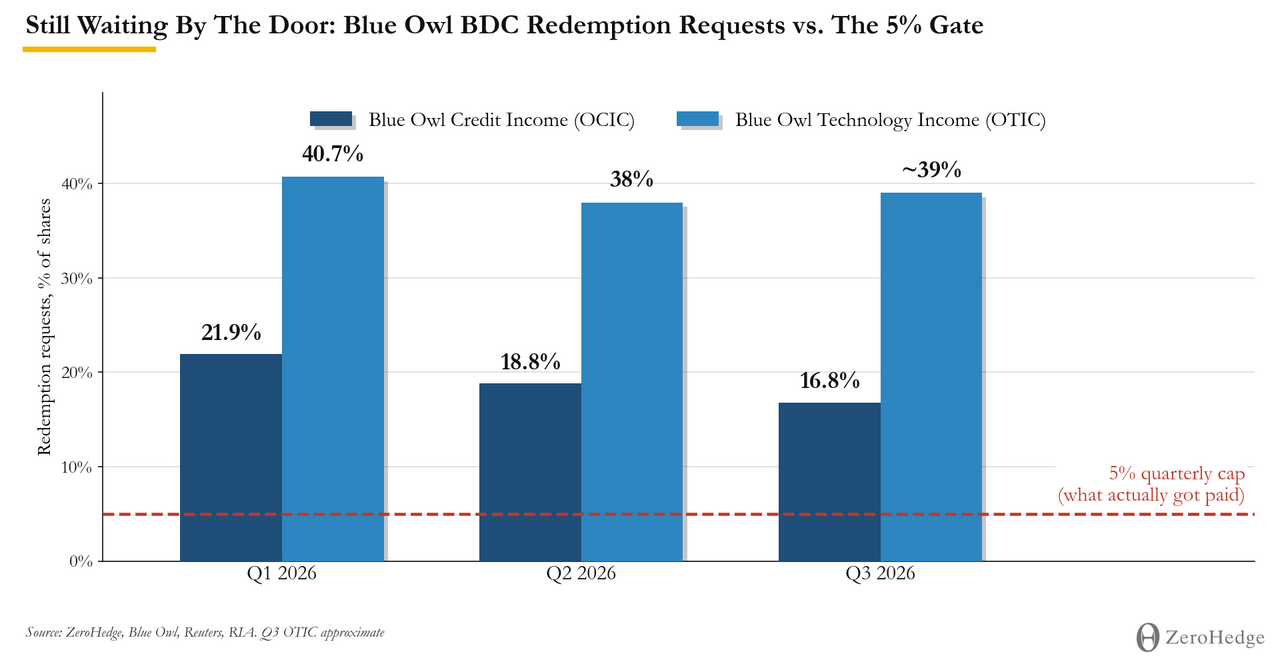
New York Common committed another $550 million to credit strategies in January 2026, with its credit book near 9 percent of assets, while Blue Owl gated its OBDC II fund in February and later restricted redemptions. A completed CFO would shift private credit exposure into rated debt markets and place the first-loss residual with a public pension, affecting state employees and retirees who rely on the fund.
State employees and retirees depend on the pension's returns, while insurers and other fixed-income buyers would take senior exposure to private credit cash flows whose value is not continuously marked.
Sources (1)
- [1]Original source(https://www.zerohedge.com/markets/pension-goes-full-cdo-new-yorks-giant-reitrement-fund-bundles-blue-owl-blackstone-fund)