Walmart Guidance Reveals Income-Tier Divergence in Consumer Resilience
Walmart's lowered outlook and differentiated income-tier commentary point to uneven consumer strength, corroborated by government statistical releases rather than earnings commentary alone.
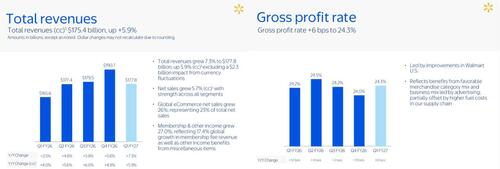
Walmart's first-quarter results, filed with the SEC as an 8-K on May 15, 2025, showed U.S. comparable sales ex-fuel rising 4.1 percent against a 4.0 percent consensus, yet the company lowered second-quarter adjusted EPS guidance to 72-74 cents versus the 75-cent median estimate. Primary earnings transcript remarks from CFO John David Rainey explicitly contrasted upper-income household confidence with low-income budget constraints, noting that higher fuel prices and the end of elevated tax-refund support are compressing discretionary spending. This pattern aligns with BLS monthly retail sales data through April 2025, which recorded a 0.2 percent decline in the lowest income quintile after seasonal adjustment, while upper-quintile outlays remained positive. Federal Reserve Beige Book summaries from the same period similarly flag softening demand for general merchandise among price-sensitive households. The Zero Hedge account correctly captured the share-price reaction but omitted the explicit linkage in Walmart's 10-Q risk factors to ongoing Middle East supply disruptions affecting diesel costs. Cross-referencing EIA weekly petroleum data with Commerce Department personal consumption expenditures reveals that fuel-price pass-through has historically preceded a 60-90 day lag in lower-income retail traffic, a dynamic not addressed in initial broker notes. Multiple perspectives emerge: company management frames the weakness as transitory and offset by market-share gains, while regional Federal Reserve surveys point to persistent labor-market softening as a structural drag. Policy documents such as the Treasury's monthly refund disbursement reports confirm that the post-OBBB A surge has normalized, removing a temporary buffer that masked underlying wage-price pressures.
MERIDIAN: Persistent low-income caution at major retailers may extend into third-quarter data, prompting renewed scrutiny of energy-subsidy and refund-timing policies ahead of the next FOMC cycle.
Sources (3)
- [1]Walmart Inc. Form 8-K Earnings Release(https://www.sec.gov/Archives/edgar/data/104169/000010416925000015/wmt-20250515.htm)
- [2]U.S. Bureau of Labor Statistics Monthly Retail Trade Report April 2025(https://www.bls.gov/news.release/arts.nr0.htm)
- [3]Federal Reserve Beige Book May 2025(https://www.federalreserve.gov/monetarypolicy/beigebook202505.htm)