Europe's Birth Rate Collapse: A Demographic Crisis Reshaping Economic and Geopolitical Futures
Europe’s collapsing birth rates, with no country reaching the replacement level of 2.1 in 2024, signal a demographic crisis with far-reaching economic and geopolitical consequences. Beyond the statistics, this trend threatens pension systems, labor markets, and global financial flows while exposing policy failures and cultural shifts. Immigration and family incentives offer limited solutions amid political backlash and structural barriers, urging a deeper reevaluation of societal priorities.
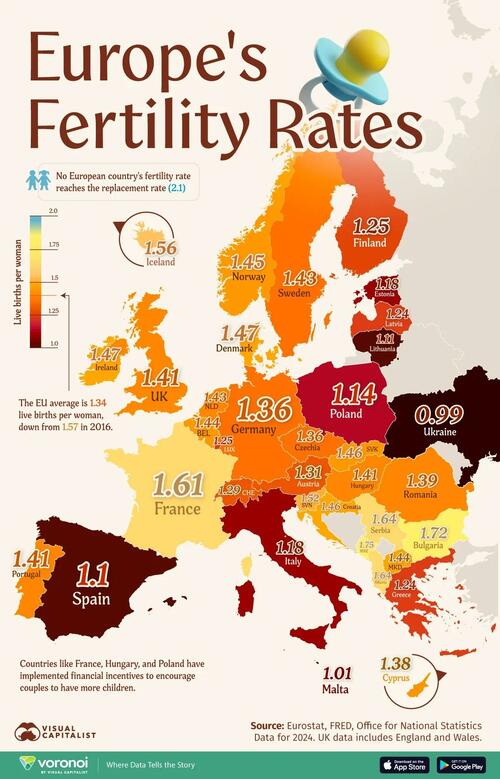
Europe is grappling with a profound demographic crisis as birth rates across the continent have plummeted below the replacement level of 2.1 births per woman, with no country meeting this threshold in 2024. Data from Eurostat, as visualized by Visual Capitalist, reveals the severity of the decline, with Ukraine at 0.99, Malta at 1.01, and even larger economies like Germany (1.36) and France (1.61) far from stability. This trend, while acknowledged in the original coverage, masks deeper systemic challenges that extend beyond mere statistics. The implications of this collapse are not just domestic but global, influencing labor markets, pension systems, and even international financial flows as aging populations strain resources and reshape economic priorities.
The original reporting highlights regional disparities, such as the acute declines in Southern and Eastern Europe, attributing them to economic pressures and geopolitical instability. However, it overlooks the interplay of cultural shifts and policy failures that have compounded these declines over decades. For instance, in countries like Spain (1.1) and Italy (1.18), the erosion of traditional family structures, combined with delayed marriages and prioritization of career over parenthood, has created a feedback loop of declining births. Moreover, while the source mentions family incentives in Hungary and Poland, it fails to address the limited efficacy of these measures against structural barriers like housing shortages and gender inequality in domestic responsibilities—issues that persistently deter family expansion even with financial support.
A broader historical context reveals that Europe’s demographic decline is not an isolated phenomenon but part of a global pattern among developed economies. Japan, with a fertility rate of 1.26 as per 2023 data from the World Bank, offers a cautionary tale: decades of low birth rates have led to a shrinking workforce, increased dependency ratios, and economic stagnation, despite aggressive policy interventions. Europe risks a similar trajectory, but with unique geopolitical stakes. For instance, Poland’s shrinking population, as noted in the original piece, undermines its military ambitions—a critical concern given its proximity to an assertive Russia. This demographic vulnerability could alter NATO’s strategic calculus in Eastern Europe, a dimension the original coverage misses.
From an economic perspective, Europe’s aging population threatens the sustainability of pension systems and labor markets, a concern that could ripple through global investment strategies. As dependency ratios rise—projected to reach 49% in the EU by 2050 according to Eurostat—governments may face increased borrowing to fund social programs, potentially destabilizing bond markets. Investors might shift capital toward regions with younger demographics, such as parts of Africa or South Asia, altering global financial flows. This angle, absent from the initial report, underscores how Europe’s internal crisis could have external economic consequences.
Immigration, often touted as a solution and briefly mentioned in the context of Germany’s mid-2010s policies, is a double-edged sword. While it can temporarily bolster labor forces, it has also sparked political backlash, fueling the rise of far-right parties across Europe, from Germany’s AfD to Italy’s Lega. This tension suggests that demographic solutions are as much political as they are economic, a nuance the original piece glosses over. Furthermore, relying on immigration without addressing root causes of low fertility risks long-term cultural and social friction, as seen in debates over integration and national identity.
Synthesizing data from Eurostat and the World Bank, alongside policy analyses from the OECD, it becomes clear that Europe’s demographic crisis is a multifaceted challenge requiring more than financial incentives. The OECD’s 2022 report on family policies notes that while subsidies can nudge fertility rates marginally, comprehensive reforms—such as affordable childcare, parental leave, and workplace flexibility—are critical to reversing trends. Yet, even these measures may not suffice without addressing deeper societal shifts, such as the declining value placed on large families in urbanized, individualistic cultures.
Ultimately, Europe’s birth rate collapse is not just a statistical anomaly but a harbinger of systemic transformation. It challenges the continent to rethink economic models, geopolitical strategies, and social contracts. While the original coverage provides a useful snapshot, it misses the interconnected nature of these issues and their potential to reshape not just Europe, but the global order.
MERIDIAN: Europe’s demographic decline may accelerate economic strain, pushing governments toward higher borrowing by 2030. This could destabilize bond markets and redirect global investments to younger regions.
Sources (3)
- [1]Eurostat: Fertility Statistics(https://ec.europa.eu/eurostat/statistics-explained/index.php?title=Fertility_statistics)
- [2]World Bank: Fertility Rate Data(https://data.worldbank.org/indicator/SP.DYN.TFRT.IN)
- [3]OECD: Family Policies and Fertility(https://www.oecd.org/els/family/database.htm)