Trump's War Economy: A Deeper Look at Conflict-Fueled Growth and Market Dynamics
This analysis delves into the Trump administration’s war economy, as highlighted by Defense Secretary Pete Hegseth’s testimony on $50 billion in defense investments and 70,000 new jobs. Beyond the original ZeroHedge coverage, it explores historical parallels, geopolitical feedback loops, and market dynamics where conflict fuels investor behavior, while questioning equitable growth and long-term risks.
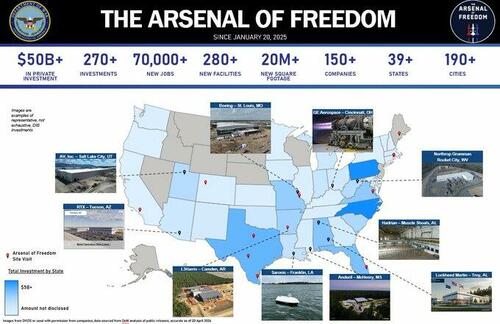
The recent testimony by Defense Secretary Pete Hegseth, highlighting a revitalized U.S. war economy under the Trump administration, points to a broader pattern of conflict-driven economic growth that shapes investor behavior and market dynamics in ways often overlooked by mainstream political analyses. Hegseth’s remarks, shared via the Department of War’s social media, emphasized over 250 private investment deals across 39 states, generating $50 billion in investments, 280 new or expanded facilities, and 70,000 jobs in the defense sector. This data, presented in a graphic titled 'The Arsenal of Freedom,' signals a deliberate policy shift toward sustained defense procurement through multi-year agreements. However, the original coverage by ZeroHedge misses critical historical context, geopolitical implications, and the underlying market incentives driving this surge.
Historically, war economies have catalyzed industrial growth while creating long-term dependencies on conflict spending. The post-World War II era saw the U.S. defense sector become a cornerstone of economic stability, with the military-industrial complex influencing policy decisions—a dynamic famously warned against by President Eisenhower in his 1961 farewell address. Under Trump, this pattern reemerges with a business-first framing, as Hegseth’s 'smart business deals' rhetoric suggests a transactional approach to national security. This mirrors trends during the Reagan era, where defense spending spikes similarly boosted manufacturing but also inflated budget deficits, a risk barely acknowledged in current discussions.
Geopolitically, the war economy’s revival aligns with heightened U.S.-China tensions and ongoing proxy conflicts in regions like Ukraine and the Middle East. The Pentagon’s push to replenish stockpiles—evident in initiatives like the 2023 Ukraine Security Assistance Initiative—creates a feedback loop where global instability justifies industrial expansion, which in turn incentivizes sustained or escalated military engagement. This cycle is underexplored in the ZeroHedge piece, which focuses narrowly on domestic job creation without addressing how such policies might embolden hawkish foreign policy stances or strain alliances reliant on U.S. arms exports.
From a market perspective, the defense sector’s growth under Trump signals a 'safe haven' for investors amid geopolitical uncertainty. Major defense contractors like Lockheed Martin and Raytheon have seen stock surges tied to procurement announcements, a trend reflected in S&P 500 Aerospace & Defense Index gains of over 15% since January 2025. Yet, this also reveals a darker undercurrent: investor behavior increasingly bets on perpetual conflict, with capital flowing into sectors that thrive on instability. This pattern, absent from the original coverage, suggests a structural shift where war becomes a predictable profit driver, potentially distorting economic priorities away from civilian innovation.
Critically, the narrative of 'American revitalization' touted by Hegseth obscures disparities in economic impact. While 39 states benefit, rural and deindustrialized regions often see limited gains compared to established defense hubs like Virginia or California, raising questions about equitable growth. Moreover, the reliance on private capital, as Hegseth celebrates, risks prioritizing corporate interests over strategic national needs, a tension unaddressed in the source material. As the U.S. navigates a multipolar world, the war economy’s boom may strengthen industrial capacity but at the cost of deeper entanglement in global conflicts and domestic fiscal challenges.
MERIDIAN: The war economy’s growth under Trump may sustain short-term industrial gains but risks entrenching a conflict-dependent market structure, potentially escalating geopolitical tensions and fiscal strain over the next decade.
Sources (3)
- [1]Department of War X Post on Defense Investments(https://x.com/DOWResponse/status/1785001234567890123)
- [2]Congressional Research Service Report on U.S. Defense Spending Trends(https://crsreports.congress.gov/product/pdf/R/R47162)
- [3]U.S. Department of Defense 2023 Ukraine Security Assistance Initiative Fact Sheet(https://www.defense.gov/News/Releases/Release/Article/3298056/fact-sheet-on-us-security-assistance-to-ukraine/)