Record Transport Cost Surge From Hormuz Disruptions Signals Hard-to-Tame Supply-Driven Inflation
Mid-2026 data shows transportation prices at record levels and logistics costs matching 2022 peaks, driven by Strait of Hormuz closure and energy shocks. This points to persistent supply-side inflation transmitting directly into consumer prices for fuel, goods, and food—pressures monetary policy struggles to resolve.
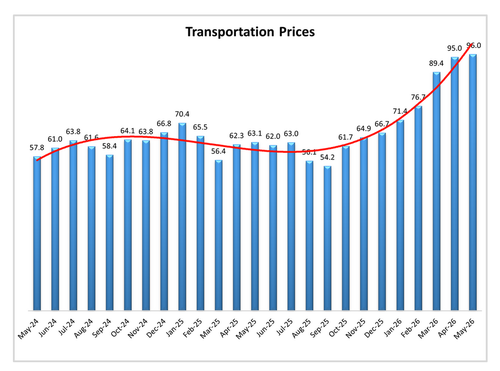
The May 2026 Logistics Managers' Index (LMI) reports transportation prices hitting an all-time high of 96.0, the strongest expansion for any metric in the index's nearly 10-year history, while aggregate logistics costs reached 250.9—the highest since the 2022 inflation peak. Transportation capacity contracted sharply to 31.7 even as utilization remained elevated at 69.5. These figures come amid the closure of the Strait of Hormuz, which has disrupted roughly 20% of global oil exports, sent diesel prices surging over 40% in many U.S. markets (reaching $5.40 per gallon or higher in California), and triggered emergency freight surcharges of $3,000 per FEU or more from major carriers.
This data paints a clearer picture than the vague 'supply chain issues' often cited in mainstream coverage: concrete cost spikes in fuel, shipping, and trucking are transmitting directly into higher prices for goods. The LMI explicitly notes that prior episodes of elevated logistics costs above 240 have reliably preceded supply-driven inflation. Smaller firms are absorbing the worst of it, with some sub-indices nearing the maximum reading of 100. Upstream companies pulling inventory forward while downstream players stay lean adds further volatility.
UBS analyst Pierre Lafourcade's mid-May warning of the Global Supply Chain Stress Index rising at the fastest pace since the early pandemic aligns with the LMI trends. The Federal Reserve's June 2026 Beige Book reinforces the alarm, documenting rapid increases in nonlabor input costs, freight rates, and energy prices tied to Middle East conflict. Businesses reported successfully passing higher shipping and material costs to customers, with consumer prices rising notably on gasoline and related items. Districts highlighted spillovers into packaging, fertilizers, steel, chemicals, and groceries—impacts felt daily at the pump, supermarket, and in retail shelves.
UNCTAD and other analyses link the chokepoint failure to broader effects: higher energy and transport costs elevating food prices, insurance premiums, and cost-of-living pressures worldwide, with developing economies particularly exposed. This mirrors 2021-2022 dynamics but originates in geopolitics rather than pandemic snarls. Monetary policy has limited tools here; higher interest rates cannot create trucking capacity, reroute oil tankers, or lower diesel prices and may even constrain supply by raising borrowing costs for logistics operators. The Trump administration's focus on resolving Hormuz underscores the recognized risk of sticky inflation amid slowing growth. Bloomberg's coverage of the LMI has similarly flagged these tightening metrics as a potential headache for policymakers.
Deeper connections reveal how abstract 'supply stress' becomes tangible: fuel accounts for 20-25% of over-the-road trucking costs, which moves the majority of U.S. freight. Surcharges and delays compound into higher per-unit costs passed to retailers and consumers, hitting lower-income households hardest through elevated gas and grocery bills. If sustained, this risks repeating the 40-year inflation highs of recent years, but with fewer easy fixes.
LIMINAL: These concrete freight and diesel spikes are flowing straight into higher prices at the gas pump, grocery store, and retail shelf, creating sticky inflation that rate hikes can't easily fix and hitting daily household budgets hardest.
Sources (4)
- [1]May 2026 Logistics Managers' Index Report(https://www.the-lmi.com/may-2026-logistics-managers-index.html)
- [2]Federal Reserve Beige Book June 2026(https://www.federalreserve.gov/monetarypolicy/files/BeigeBook_20260603.pdf)
- [3]US Supply Chains Are Straining Like It's 2022 Again(https://www.bloomberg.com/news/newsletters/2026-04-07/us-supply-chains-and-diesel-prices)
- [4]Strait of Hormuz disruptions: Implications for global trade and development(https://unctad.org/publication/strait-hormuz-disruptions-implications-global-trade-and-development)