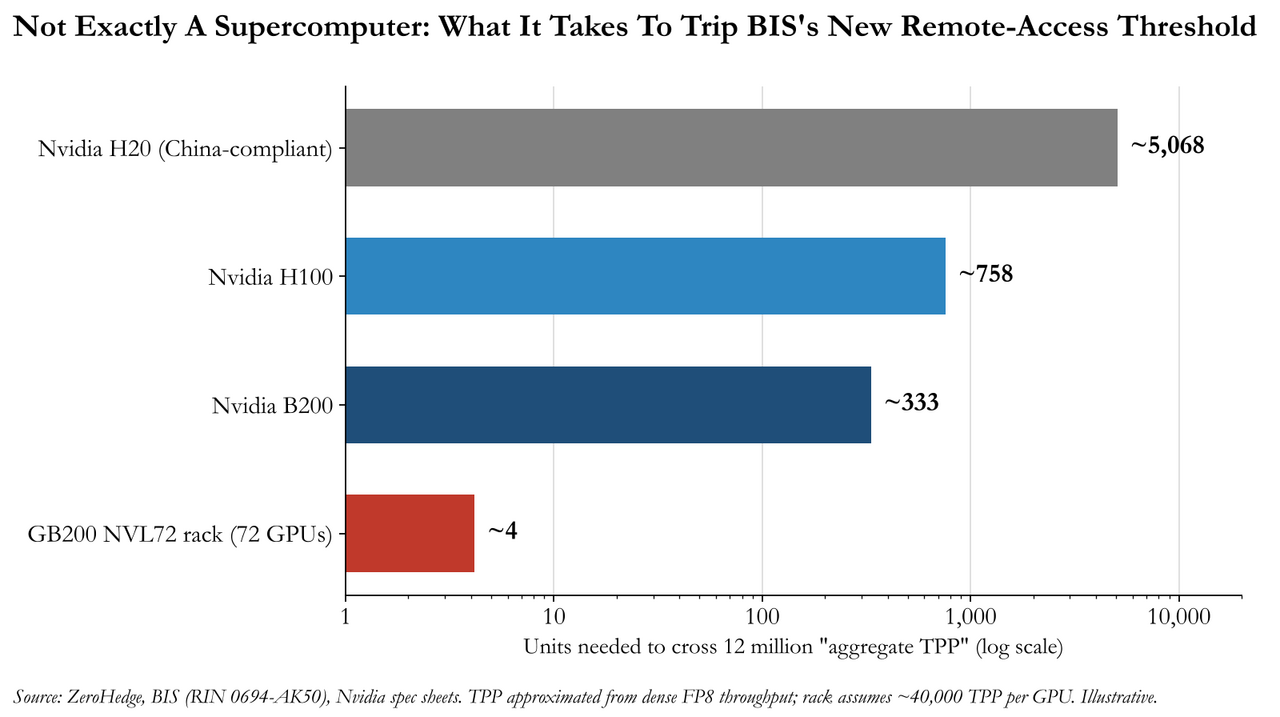
Commerce Department requires licenses for remote AI chip access above 12 million TPP
Washington moved to close a cloud-compute loophole by requiring licenses for remote access to advanced AI chips and for shipments to five diversion-risk countries. The rule extends controls to linked data centers, intermediary model training and advanced-node manufacturing, with a 90-day license window for existing providers. It matters because rented compute, not just physical chip exports, now falls under U.S. export-control law.
The Commerce Department issued an interim final rule on Monday restricting remote access to advanced artificial-intelligence chips and servers, according to a report citing the rule. The rule, RIN 0694-AK50, requires an export license when a provider knows that data centers will supply more than 12 million aggregate trillion operations per second, or TPP, to companies headquartered in China, Macau or other Country Group D:5 destinations. It also places advanced AI chip shipments to Singapore, Malaysia, Indonesia, Thailand and Brazil under a destination license requirement.
The 132-page text counts compute across linked data centers, including digitally connected infrastructure, to prevent operators from splitting clusters across facilities. It extends controls to fabs and packaging firms making advanced-node logic chips for designers in D:1, D:4 or D:5 countries, or in the five named hubs. The rule also rescinds the Biden-era AI Diffusion Rule, which the Bureau of Industry and Security, the Commerce export-control agency, says was never enforced, removing country tiers, model-weight controls and a data-center verified end-user program. Existing providers have 90 days from the effective date to seek licenses.
The measure converts a physical export ban into a control on rented compute, reflecting how Chinese labs and intermediaries have used cloud access and third-country data centers to obtain advanced chips. The named hubs have been cited in earlier reporting on suspected diversion routes, including scrutiny of Singapore-based middlemen and Malaysian transshipment. The rule also reaches non-Chinese cloud customers that train or provide models for D:5 firms, a broader end-use test than simple shipment checks. The report links the timing to scrutiny after alleged espionage concerns involving Nvidia and the reported departure of Jensen Huang from a key advisory role.
The rule affects cloud providers, chip designers, data-center operators and buyers in the five named countries, because ordinary rental agreements may now require U.S. licenses. It raises compliance costs for hyperscale AI workloads and creates new legal exposure for intermediaries that route compute or models to Chinese-headquartered entities. For Washington, the rule closes a gap between chip export controls and remote service delivery. For Beijing, it constrains access to advanced training capacity through foreign cloud and data-center networks. The 90-day window gives existing operators a defined period to seek licenses.
It affects cloud providers, data centers and AI buyers in Singapore, Malaysia, Indonesia, Thailand and Brazil by making rented advanced-chip access and some chip shipments subject to U.S. licensing. It also raises compliance costs and legal risk for intermediaries that route compute or models to Chinese-headquartered firms.
Sources (1)
- [1]Zero Hedge: US Closes The Cloud Loophole(https://www.zerohedge.com/markets/us-closes-cloud-loophole-days-after-jensens-exit-new-rule-puts-ai-chip-rentals-china-and)