Beijing's Sanctions Flip-Flop Exposes Fragility of Chinese Economic Defiance Under US Pressure
China's swift reversal from ordering non-compliance with US sanctions on Iranian oil-linked refiners to instructing banks to pause new loans highlights the practical limits of its economic sovereignty, amid rising US-China tensions before a key summit and revealing selective enforcement patterns in global sanctions regimes.
In a striking policy reversal reported by Bloomberg, China's National Financial Regulatory Administration directed the nation's largest banks to temporarily halt new yuan-denominated loans to five privately owned refiners recently sanctioned by the US for their alleged ties to Iranian oil imports. This directive, issued just days after the Ministry of Commerce activated its 2021 blocking statute ordering firms to ignore the US measures, underscores the tightrope Beijing is walking. The sanctioned entities include Hengli Petrochemical (Dalian) Refinery—one of China's most advanced private processors—and several so-called 'teapot' refiners in Shandong and Hebei provinces. While the initial blocking order was hailed as a 'watershed' in resisting extraterritorial US laws, the subsequent pause on lending reveals deep vulnerabilities in China's economic architecture when confronted with secondary sanctions threats that could cut off access to dollar clearing systems.[1][2]
Reuters and Al Jazeera confirmed the sequence: On May 2, 2026, China's Commerce Ministry invoked the anti-foreign sanctions rules for the first time since their 2021 introduction, declaring US asset freezes and transaction bans 'shall not be recognized, enforced or complied with' domestically. Yet by May 7, financial regulators were quietly instructing banks to review exposures and freeze new credit lines—without calling existing loans—to shield systemically important lenders from potential US retaliation. This mirrors historical patterns where Beijing has publicly railed against unilateral sanctions while allowing major state banks to comply quietly, often routing sensitive Iran-related deals through already-sanctioned entities like Bank of Kunlun.[3][4]
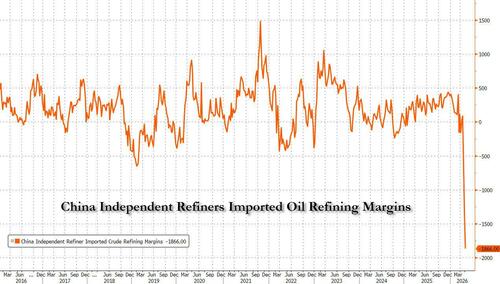
The episode connects to escalating superpower tensions ahead of the anticipated May 14-15 Trump-Xi summit in Beijing. The US Treasury's actions, including warnings to Chinese banks about secondary sanctions, are part of a broader campaign to starve Iran's regime of oil revenue—the country's primary financial lifeline. Independent Chinese refiners have reportedly slowed Iranian crude purchases amid collapsing margins and policy uncertainty, with millions of barrels idling off the coast. Global Times framed the blocking statute as a defense of international law, yet the rapid walk-back highlights what heterodox analysts describe as the inherent fragility of China's position: rhetorical sovereignty meets the reality of dollar dominance and integrated global finance.[5]
This dynamic reveals underreported patterns in sanction enforcement. Both Washington and Beijing selectively apply economic weapons—America through financial extraterritoriality, China through selective non-compliance and state channeling—exposing hypocrisy amid claims of principled stands. The flip-flop suggests that while China seeks to project strength and support discounted Iranian oil flows for energy security, systemic risks to its largest banks force pragmatic retreats. Such policy inconsistency may erode confidence in Beijing's de-risking narrative, potentially foreshadowing concessions in high-level talks and illustrating how intertwined trade tensions constrain even great powers. As Asia Times noted, invoking the five-year-old blocking rules against 'teapot' refiners marked a bold escalation that was almost immediately tempered by financial caution.[6]
Liminal Analyst: This reversal will likely force Chinese refiners to further reduce Iranian crude imports, easing US leverage on Tehran while exposing the hollowness of Beijing's anti-sanctions bravado and accelerating quiet de-risking compromises before the Trump-Xi summit.
Sources (6)
- [1]China Asks Banks to Pause New Loans to US-Sanctioned Refiners(https://www.bloomberg.com/news/articles/2026-05-07/china-asks-banks-to-pause-new-loans-to-us-sanctioned-refiners)
- [2]Beijing Tells China Firms to Ignore US Sanctions on Refiners(https://www.bloomberg.com/news/articles/2026-05-02/beijing-tells-chinese-firms-to-ignore-us-sanctions-on-refiners)
- [3]China asks banks to pause new loans to US-sanctioned refiners, Bloomberg News reports(https://www.reuters.com/world/asia-pacific/china-asks-banks-pause-new-loans-us-sanctioned-refiners-bloomberg-news-reports-2026-05-07/)
- [4]China blocks US sanctions against five 'teapot' refineries(https://www.aljazeera.com/economy/2026/5/3/china-blocks-us-sanctions-against-five-teapot-refineries)
- [5]'Unprecedented': China's blocking ban on US sanctions(https://www.globaltimes.cn/page/202605/1360330.shtml)
- [6]China invokes rules to blunt US sanctions on 'teapot' refiners(https://asiatimes.com/2026/05/china-invokes-rules-to-blunt-us-sanctions-on-teapot-refiners/)