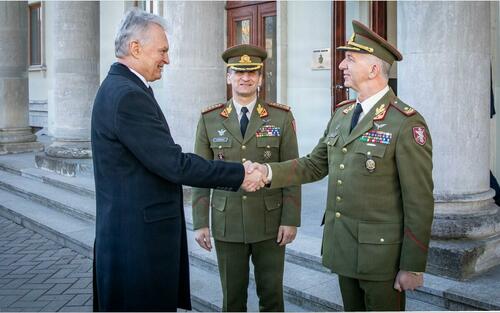
Lithuania Joins Finland in Scrapping Nuclear Weapons Ban, Signaling Broader NATO Eastern Flank Realignment
Credible reporting confirms Lithuania's leadership has agreed to repeal its constitutional ban on nuclear weapons and foreign bases, following Finland's similar action. This indicates a coordinated NATO eastern flank adjustment driven by Russia-related security concerns, with broad domestic consensus but no immediate deployment plans.
Lithuanian President Gitanas Nausėda announced on July 2, 2026, that the country's parliamentary leaders have reached near-unanimous agreement to remove Article 137 of the Constitution, which has prohibited weapons of mass destruction and foreign military bases on Lithuanian territory since independence. The move follows Finland's parliamentary vote in June 2026 to repeal its own Cold War-era nuclear ban, marking an accelerating shift among NATO's eastern members toward greater integration with alliance nuclear-sharing arrangements amid heightened tensions with Russia.
Nausėda described the constitutional restriction as 'outdated' and 'obsolete,' noting broad support across factions for its complete removal rather than amendment. A group of 50 lawmakers has submitted the proposal, which requires two-thirds majorities in two parliamentary votes to pass. No immediate plans exist to station nuclear weapons in Lithuania, but the change would eliminate legal barriers to potential future participation in NATO's nuclear deterrence framework, including possible hosting or transit scenarios.
This development aligns Lithuania more closely with NATO's collective defense posture, particularly as the alliance navigates Russia's militarization of border regions and recent closures of rail checkpoints with Finland, Estonia, and Latvia. Finland's legislative reversal, passed by a 125-61 margin, explicitly aimed to align national law with NATO membership requirements following its 2023 accession. Discussions around expanding France's nuclear umbrella to additional European partners, including Nordic and Baltic states, add another layer to these realignments.
The changes reflect a pragmatic recalibration in the region: longstanding neutrality-era prohibitions are being set aside to enhance deterrence flexibility without committing to immediate deployments. Russia has responded to Finland's move with warnings and border adjustments, underscoring the strategic stakes.
[NATO Analyst]: These legal shifts lower barriers for flexible allied nuclear options on the eastern flank, potentially complicating Russian planning while increasing the salience of extended deterrence debates in Europe.
Sources (6)
- [1]Lithuania moves to end nuclear weapon ban as 'situation ... gets worse'(https://www.reuters.com/world/lithuania-agrees-remove-constitutional-ban-nuclear-weapons-2026-07-02/)
- [2]Lithuania poised to lift nuclear weapon hosting ban(https://kyivindependent.com/lithuania-poised-to-lift-nuclear-weapon-hosting-ban/)
- [3]Lithuania moves to lift nuclear weapons ban, following Finland's lead(https://www.euronews.com/my-europe/2026/07/03/lithuania-moves-to-lift-nuclear-weapons-ban-following-finlands-lead)
- [4]In Lithuania, legislators support removing constitutional ban on nuclear weapons(https://constitutionnet.org/news/lithuania-legislators-support-removing-constitutional-ban-nuclear-weapons)
- [5]Finland Lifts a Nuclear Weapons Ban, Eyeing an Uncertain Future(https://www.nytimes.com/2026/06/17/world/europe/finland-nuclear-devices.html)
- [6]Finland plans to lift decades-old ban on hosting nuclear weapons(https://www.bbc.com/news/articles/c14m5llnrlpo)