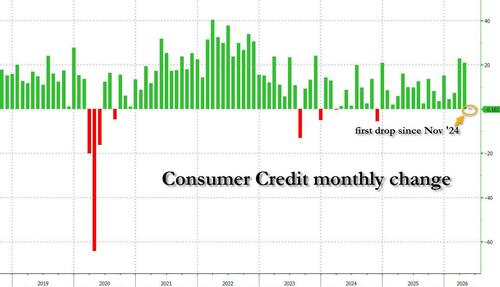
U.S. Consumer Credit Contracts $0.2 Billion in May as Revolving Debt Drops $5.3 Billion
May's unexpected consumer credit contraction, led by revolving debt, signals rising household stress at credit card rates of 22.15 percent. Cross-checks with Fed and BEA series link the move to broader weakening in consumption capacity. Retail sales and Q2 loan updates will confirm whether the trend continues.
Federal Reserve G.19 data show nonrevolving credit rose only $5.1 billion in May while revolving balances posted their largest decline since late 2024. Student loans continued their climb toward $1.9 trillion and auto loan balances remained near $1.55 trillion. Average auto loan size hit a record $42,500 in Q1 2026, indicating price-driven rather than volume-driven growth.
The contraction coincides with sustained high credit-card rates that have not eased despite earlier policy adjustments. This pattern matches earlier episodes in which households reduced revolving balances ahead of weaker retail spending. Paydowns in May are therefore likely to appear in June retail sales data due next week.
Cross-referenced with New York Fed Quarterly Report on Household Debt and Credit and BEA personal consumption expenditures, the May figures mark an early divergence from the post-2024 recovery trajectory. Elevated rates on revolving debt combined with flat auto-loan volumes point to constrained household cash flow rather than deliberate deleveraging.
Next data releases will test whether the May decline persists or reverses. Persistent contraction would confirm the signal of eroding consumer resilience already visible in credit utilization metrics.
BEA: June retail sales will fall at least 0.4 percent month-over-month when reported next week.
Sources (3)
- [1]Federal Reserve G.19 Consumer Credit(https://www.federalreserve.gov/releases/g19/)
- [2]New York Fed Quarterly Report on Household Debt and Credit(https://www.newyorkfed.org/microeconomics/hhdc.html)
- [3]Bureau of Economic Analysis Personal Consumption Expenditures(https://www.bea.gov/data/consumer-spending)