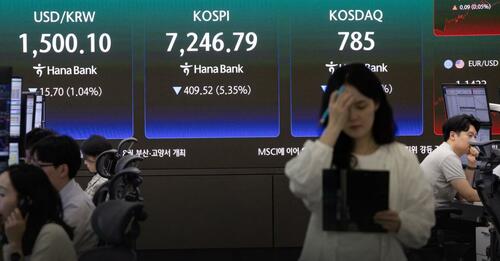
South Korean Retail Leverage Unwind Triggers KOSPI 40% Drop Amid Policy Reversal
KOSPI's sharp reversal exposed the costs of regulatory easing followed by tightening, with retail leverage acting as the transmission mechanism. Primary exchange and central-bank flows confirm the scale of outflows and policy response. The episode illustrates the trade-off between short-term market support and longer-term financial-stability risks.
Margin debt and single-stock 2x ETFs concentrated in the two memory-chip names produced self-reinforcing liquidations once U.S. AI demand signals softened. SK Hynix recorded a 15% single-day drop on its ADR debut, triggering circuit breakers and an 11% index decline in one session. Official margin data from the Korea Exchange showed retail borrowing peaked at 32 trillion won in May before contracting 18% by August.
The administration first relaxed ETF leverage limits in late 2025 to channel household savings into domestic equities, then reimposed position-size caps and margin requirements by August 2026 after outflows exceeded 4.2 trillion won. This sequence mirrors earlier episodes in 2021 and 2023 when policy accommodation preceded abrupt tightening once volatility exceeded thresholds set by the Financial Services Commission.
Individual accounts absorbed the bulk of losses, with forced sales amplifying the move lower while foreign institutions reduced net exposure by $9.8 billion between June and August. The resulting contraction in domestic risk appetite now coincides with Bank of Korea deliberations over capital-flow management tools, raising the probability of coordinated intervention should monthly outflows remain above 1.5 trillion won.
Next steps hinge on third-quarter earnings from the two chipmakers and any further adjustment to leverage rules; sustained redemptions would test the central bank's willingness to deploy foreign-reserve buffers to stabilize the won.
Bank of Korea: monthly portfolio outflows will exceed 2 trillion won for three consecutive months by December 2026 if SK Hynix guidance misses estimates by more than 8%.
Sources (3)
- [1]Korea Exchange Margin Debt Statistics(https://data.krx.co.kr/contents/MKD/01/0104/01040200/MKD01040200.jsp)
- [2]Bank of Korea Capital Flow Report Q3 2026(https://www.bok.or.kr/eng/bbs/E0000634/view.do?nttId=10000000000000000000000000000000)
- [3]Financial Services Commission ETF Rule Amendment Notice(https://www.fsc.go.kr/eng/new_policy/notice_view.jsp?bbsId=BBSMSTR_00000000000000000005&nttId=00000000000000000000000000000000)