Federal Probe into California's Vote Delays Reveals Deeper Systemic Risks in Mail-In Election Infrastructure
Mainstream sources confirm a federal probe into California primaries amid record vote-counting delays under universal mail-in rules. Beyond partisan framing, the case highlights structural election integrity risks, federal overreach into state systems, and eroding trust in democratic processes that demand urgent reform.
The announcement by First Assistant U.S. Attorney Bill Essayli that his office has opened multiple election fraud investigations in California, coordinating with the FBI, has thrust the state's election administration into national scrutiny. Days after the June 2026 primary, with key races for governor and Los Angeles mayor still unresolved due to ongoing ballot processing, President Trump publicly alleged deliberate delays aimed at manipulating outcomes favoring Republican candidates. Essayli's statement went further, highlighting "serious structural vulnerabilities" in California's universal vote-by-mail system, which lacks voter ID requirements and accepts ballots postmarked by Election Day if received up to a week later.[1][2]
This is not merely partisan theater. Data analyst Nate Silver documented California's outlier status: it consistently lags the nation and most developed democracies in tabulating votes, with nearly 40% of ballots counted post-Election Day on average and even slower performance in recent cycles. Comparisons are stark—Colombia reported near-complete presidential results overnight, while the UK resolves parliamentary races by the next morning. California's model, expanded from pilot programs in 2016 to permanent universal mail-in by 2022, prioritizes access and accuracy over speed, yet critics argue this creates opportunities for undetected irregularities while eroding public confidence.[3]
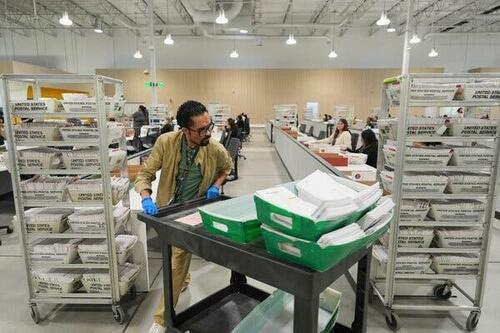
Mainstream coverage has often reduced the story to Trump's unsubstantiated claims versus Democratic defenses emphasizing accuracy over haste. A deeper examination reveals core tensions over federal-state power. The DOJ's parallel efforts to audit California's voter rolls—coordinated with Assistant Attorney General Harmeet Dhillon—echo long-standing disputes about state resistance to federal verification standards. Essayli's office has dispatched prosecutors to observe Los Angeles County's ballot processing center, signaling active oversight that tests boundaries of federal intervention in state-run elections.[4][5]
California's system, while expanding participation, introduces logistical complexity: every ballot requires signature verification, envelope opening, and individual processing, inherently delaying results and inviting skepticism. This isn't isolated. It connects to broader heterodox concerns about how expanded mail-in frameworks, accelerated during the pandemic and made permanent in several states, test the resilience of election infrastructure against both error and exploitation. When half the votes in a major state's midterm were counted after Election Day, as Silver noted, it fosters "learned helplessness"—tolerating practices that would be unacceptable in peer nations. Democratic officials like Secretary of State Shirley Weber defend the process by prioritizing accuracy, but persistent delays without demonstrably superior fraud safeguards fuel narratives of systemic risk.[6]
The investigation touches philosophical questions of sovereignty: how much federal authority should police state election mechanics when public trust collapses? Rather than framing solely as Trump vs. California, this moment exposes how administrative choices in high-volume mail voting can amplify perceptions of fragility, potentially inviting more centralized federal standards. Without concrete evidence of widespread fraud released yet, the probe itself underscores a feedback loop where slow, opaque processes breed doubt, which in turn justifies greater scrutiny—potentially reshaping the balance of power in American elections for years ahead.
Liminal Analyst: This federal intervention risks escalating state-federal conflicts over election control while spotlighting universal mail-in vulnerabilities, likely accelerating national debates on standardized ID/verification rules that could restore trust or deepen polarization depending on findings.
Sources (5)
- [1]US attorney opens investigations into California's elections(https://apnews.com/article/california-primary-ballot-counting-trump-investigation-22b06b32abdca1eb638b1603fcac27fc)
- [2]U.S. attorney's office in California announces probe into elections(https://www.washingtonpost.com/politics/2026/06/06/us-attorneys-office-california-announces-probe-into-elections/)
- [3]Feds pursuing 'multiple' election fraud investigations, top prosecutor says(https://www.latimes.com/california/story/2026-06-05/u-s-attorney-says-fbi-federal-prosecutors-are-investigating-alleged-election-fraud-in-california)
- [4]Why can't California count?(https://www.natesilver.net/p/why-cant-california-count)
- [5]DOJ office says 'multiple' probes of California elections(https://www.nbcnews.com/politics/elections/doj-office-investigations-california-elections-trump-claims-cheating-rcna348746)