Critical Metals' 92.5% Stake in Greenland's Tanbreez Project Accelerates Western Challenge to China's Rare Earth Monopoly
Critical Metals' acquisition of majority control over Greenland's massive Tanbreez rare earth deposit, backed by government approval, advances Western efforts to reduce dependence on China's near-monopoly of materials vital for defense, EVs, renewables, and high-tech applications, amid intensifying Arctic geopolitical competition.
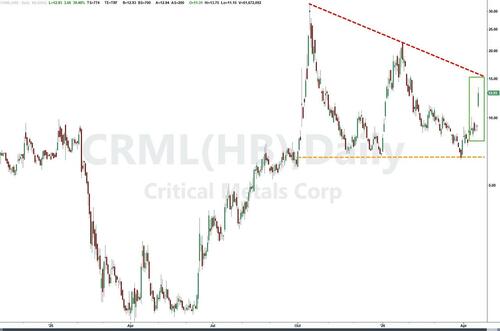
Critical Metals Corp. has secured 92.5% ownership of the Tanbreez rare earth project in Greenland after acquiring the remaining 50.5% stake from Rimbal Pty Ltd., with the Greenland government approving the transfer. This move triggered a sharp surge in the company's shares, reflecting investor optimism about advancing one of the world's largest undeveloped rare earth deposits toward production. According to Bloomberg, the deal consolidates control of a site particularly rich in heavy rare earth elements (HREEs) like dysprosium and terbium, which are critical for high-performance magnets used in defense systems, electric vehicle motors, wind turbines, and advanced electronics.[1][2]
The transaction builds on earlier stages of the acquisition and aligns with a $30 million acceleration program approved in March 2026 for drilling, infrastructure, metallurgy, and resource expansion at Tanbreez. The company targets initial ore production in late 2028 or early 2029. CEO Tony Sage has stated that full production could position the project to control a significant share of non-Chinese heavy rare earth supply, potentially up to 50% of certain market segments currently dominated by China.[3][4]
This development occurs against a backdrop of escalating global competition for critical minerals. China maintains overwhelming dominance, controlling around 90% of rare earth processing capacity and significant reserves, enabling it to influence supply chains for defense technologies (such as F-35 fighter jet components) and the green energy transition. U.S. officials previously lobbied to prevent Chinese acquisition of Tanbreez, highlighting its strategic value for building resilient, US-aligned supply chains. Analyses from think tanks underscore Greenland's growing importance: its untapped deposits position it as a key alternative source, amid renewed U.S. interest in the Arctic that includes national security concerns, potential infrastructure deals, and efforts to counter Chinese influence via the Polar Silk Road.[5][6]
Beyond the immediate corporate milestone, the Tanbreez expansion reveals deeper geopolitical dynamics. It forms part of a broader scramble for Arctic resources driven by climate-driven accessibility, technological demand from EVs and AI hardware, and great-power rivalry. While promising for supply diversification, challenges remain—including regulatory approvals, high development costs in remote Arctic terrain, environmental and indigenous community concerns, and the need for Western processing facilities to fully bypass Chinese refining dominance. If successful, Tanbreez could meaningfully erode China's leverage over materials essential to modern economies and militaries, accelerating a multipolar realignment in strategic resource control.
LIMINAL Analyst: This consolidation of Tanbreez could deliver meaningful non-Chinese heavy rare earth supply by 2029, weakening Beijing's leverage over defense and EV technologies while turning Greenland into a focal point for resource-driven great power competition in the Arctic.
Sources (4)
- [1]Critical Metals Boosts Stake in Greenland Rare Earths Asset(https://www.bloomberg.com/news/articles/2026-04-17/critical-metals-boosts-stake-in-greenland-rare-earths-asset)
- [2]Critical Metals approves $30 million for Greenland rare earth project development(https://www.reuters.com/business/energy/critical-metals-approves-30-million-greenland-rare-earth-project-development-2026-03-10/)
- [3]Greenland, Rare Earths, and Arctic Security(https://www.csis.org/analysis/greenland-rare-earths-and-arctic-security)
- [4]Dig, Baby, Dig? China's Mineral Dominance and Ripple Effects in the Arctic(https://www.thearcticinstitute.org/dig-baby-dig-chinas-mineral-dominance-ripple-effects-arctic/)